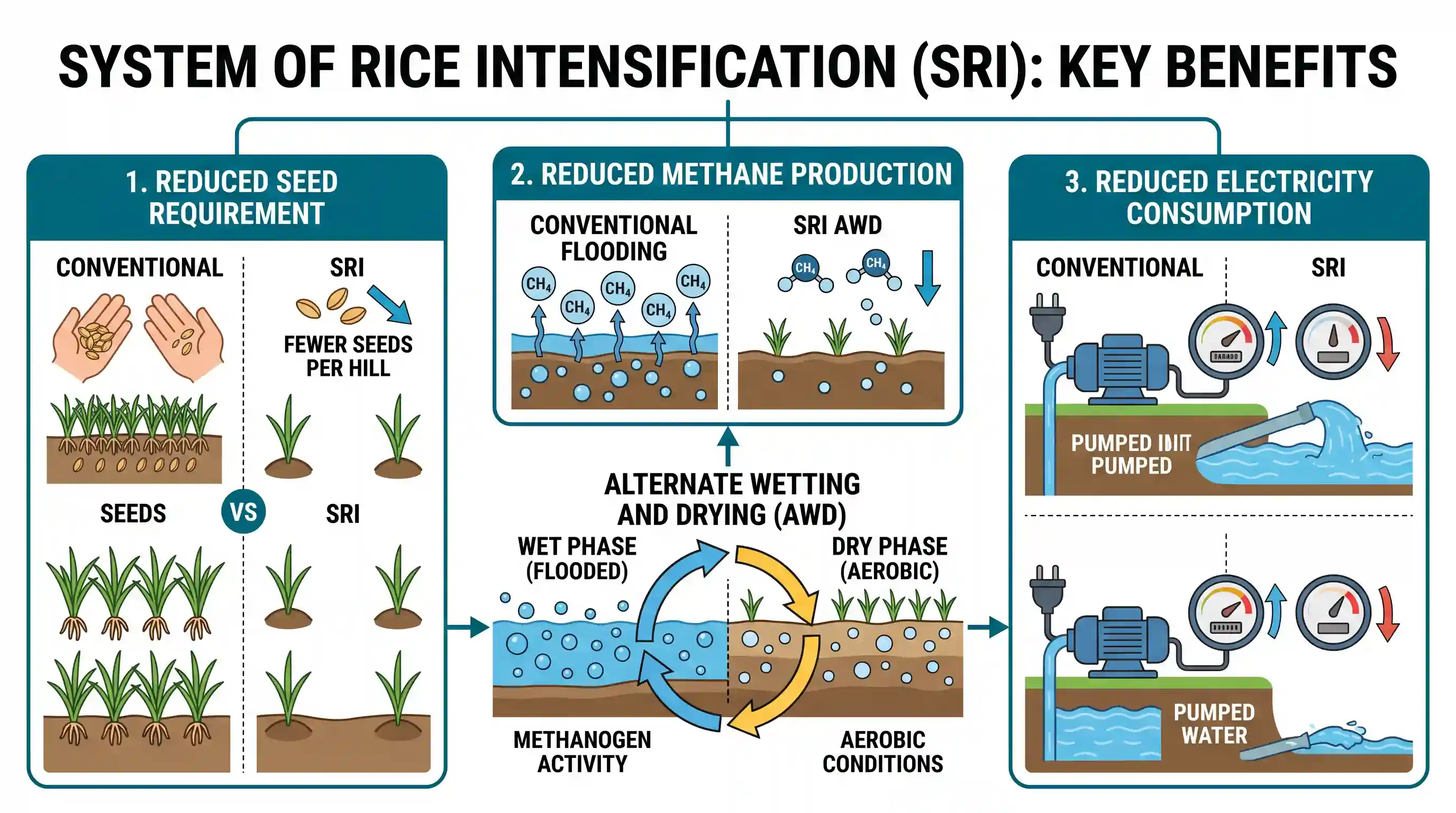
"System of Rice Intensification" of cultivation, in which alternate wetting and drying of rice fields is practised, results in : 1. Reduced seed requirement 2. Reduced methane production 3. Reduced electricity consumption Select the correct answer using the code given below:

- A1 and 2 only
- B2 and 3 only
- C1 and 3 only
- D1, 2 and 3Correct
Explanation
All three statements about the System of Rice Intensification (SRI) are correct:
-
SRI uses significantly fewer seeds compared to conventional rice cultivation — typically 2 kg per acre versus 30-40 kg, as seedlings are transplanted individually at wider spacing.
-
SRI's practice of alternate wetting and drying reduces the duration of anaerobic conditions in paddy fields, which reduces methane production.
-
SRI requires less water due to alternate wetting and drying, which reduces the need for pumping water and consequently reduces electricity consumption.
Therefore, all three statements (1, 2 and 3) are correct.
Related questions
More UPSC Prelims practice from the same subject and topic.
- Prelims 2022GS1geography
Among the following crops, which one is the most important anthropogenic source of both methane and nitrous oxide?
- Prelims 2022GS1geography
"Climate Action Tracker" which monitors the emission reduction pledges of different countries is a :
- Prelims 2022GS1geography
Consider the following statements : 1. "The Climate Group" is an international non-profit organization that drives climate action by building large networks and runs them. 2. The International Energy …
- Prelims 2022GS1geography
"If rainforests and tropical forests are the lungs of the Earth, then surely wetlands function as its kidneys." Which one of the following functions of wetlands best reflects the above statement?
- Prelims 2022GS1geography
In the context of WHO Air Quality Guidelines, consider the following statements: 1. The 24-hour mean of PM2.5 should not exceed 15 µg/m³ and annual mean of PM2.5 should not exceed 5 µg/m³. 2. In a yea…
- Prelims 2022GS1geography
With reference to "Gucchi" sometimes mentioned in the news, consider the following statements: 1. It is a fungus. 2. It grows in some Himalayan forest areas. 3. It is commercially cultivated in the Hi…