In the context of WHO Air Quality Guidelines, consider the following statements: 1. The 24-hour mean of PM2.5 should not exceed 15 µg/m³ and annual mean of PM2.5 should not exceed 5 µg/m³. 2. In a year, the highest levels of ozone pollution occur during the periods of inclement weather. 3. PM10 can penetrate the lung barrier and enter the bloodstream. 4. Excessive ozone in the air can trigger asthma. Which of the statements given above are correct?

- A1, 3 and 4
- B1 and 4 onlyCorrect
- C2, 3 and 4
- D1 and 2 only
Explanation
Let's analyze the statements regarding WHO Air Quality Guidelines:
-
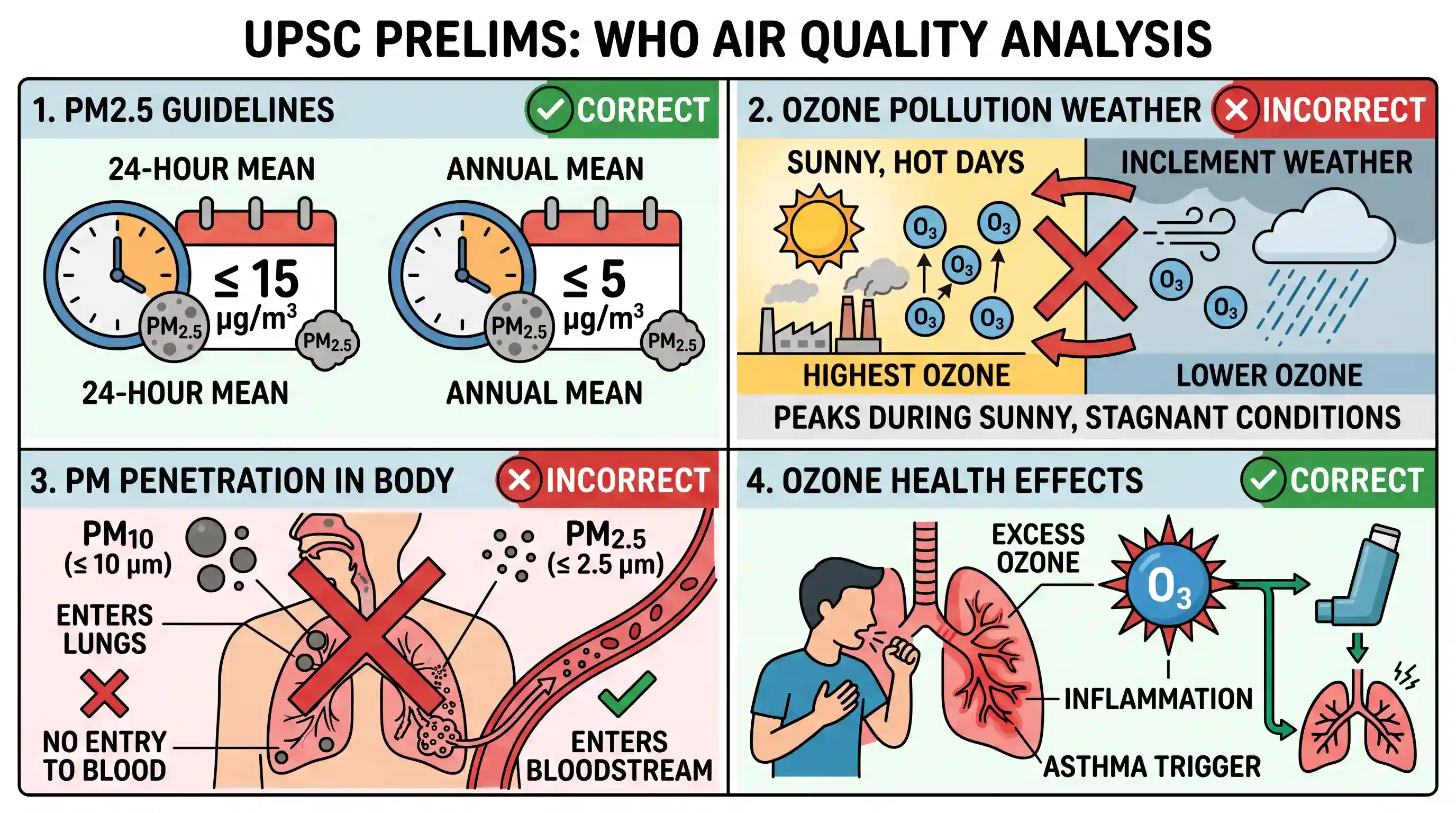
The 24-hour mean of PM2.5 should not exceed 15 µg/m³ and annual mean of PM2.5 should not exceed 5 µg/m³. Correct. These are the guideline values set by the WHO in its 2021 Global Air Quality Guidelines. These are significantly stricter than previous guidelines, emphasizing the health risks of even low levels of PM2.5.
-
In a year, the highest levels of ozone pollution occur during the periods of inclement weather. Incorrect. Ozone (ground-level ozone) is a secondary pollutant formed when pollutants from vehicles and industries react with sunlight. Therefore, ozone pollution typically peaks during warm, sunny, and stagnant weather conditions, not inclement (stormy or bad) weather.
-
PM10 can penetrate the lung barrier and enter the bloodstream. Incorrect. PM10 (particulate matter with a diameter of 10 micrometers or less) can penetrate deep into the lungs. However, it is primarily PM2.5 (particulate matter with a diameter of 2.5 micrometers or less) and even finer ultrafine particles that are small enough to pass through the lung barrier and enter the bloodstream, causing systemic health effects.
-
Excessive ozone in the air can trigger asthma. Correct. Ground-level ozone is a powerful respiratory irritant. Exposure to high levels of ozone can inflame and damage the airways, trigger asthma attacks, worsen other respiratory conditions like bronchitis and emphysema, and increase susceptibility to respiratory infections.
Therefore, statements 1 and 4 are correct.
Related questions
More UPSC Prelims practice from the same subject and topic.
- Prelims 2022GS1geography
Among the following crops, which one is the most important anthropogenic source of both methane and nitrous oxide?
- Prelims 2022GS1geography
"System of Rice Intensification" of cultivation, in which alternate wetting and drying of rice fields is practised, results in : 1. Reduced seed requirement 2. Reduced methane production 3. Reduced el…
- Prelims 2022GS1geography
"Climate Action Tracker" which monitors the emission reduction pledges of different countries is a :
- Prelims 2022GS1geography
Consider the following statements : 1. "The Climate Group" is an international non-profit organization that drives climate action by building large networks and runs them. 2. The International Energy …
- Prelims 2022GS1geography
"If rainforests and tropical forests are the lungs of the Earth, then surely wetlands function as its kidneys." Which one of the following functions of wetlands best reflects the above statement?
- Prelims 2022GS1geography
With reference to "Gucchi" sometimes mentioned in the news, consider the following statements: 1. It is a fungus. 2. It grows in some Himalayan forest areas. 3. It is commercially cultivated in the Hi…