In the northern hemisphere, the longest day of the year normally occurs in the :

- AFirst half of the month of June
- BSecond half of the month of JuneCorrect
- CFirst half of the month of July
- DSecond half of the month of July
Explanation
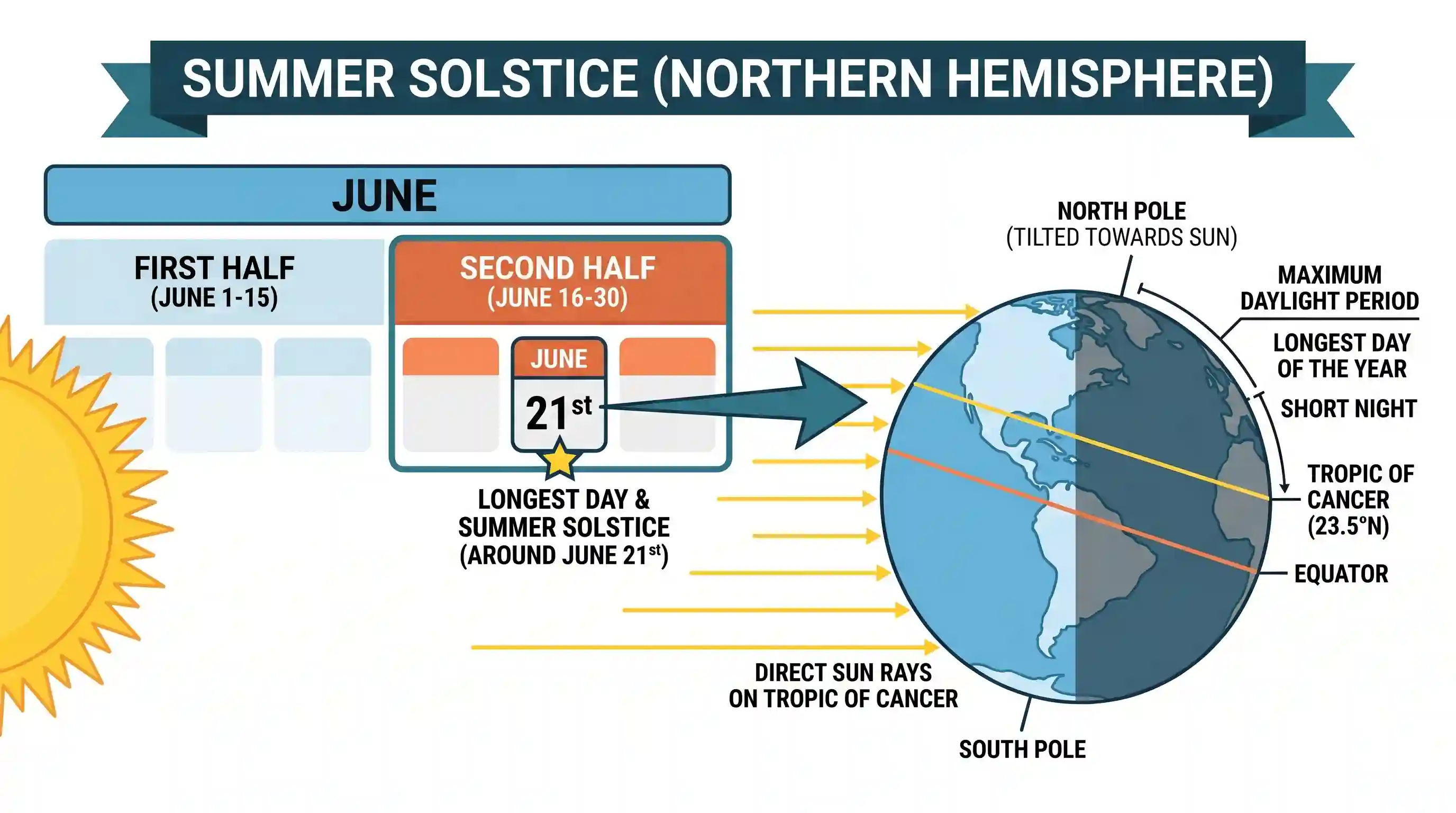
In the northern hemisphere, the longest day of the year occurs around June 21st, which is known as the Summer Solstice. On this day, the Earth's Northern Hemisphere is tilted most directly towards the Sun, resulting in the longest period of daylight and the shortest night of the year. June 21st falls in the second half of the month of June.
Related questions
More UPSC Prelims practice from the same subject and topic.
- Prelims 2022GS1geography
Consider the following statements: 1. High clouds primarily reflect solar radiation and cool the surface of the Earth. 2. Low clouds have a high absorption of infrared radiation emanating from the Ear…
- Prelims 2022GS1geography
Among the following crops, which one is the most important anthropogenic source of both methane and nitrous oxide?
- Prelims 2022GS1geography
"System of Rice Intensification" of cultivation, in which alternate wetting and drying of rice fields is practised, results in : 1. Reduced seed requirement 2. Reduced methane production 3. Reduced el…
- Prelims 2022GS1geography
Which one of the following lakes of West Africa has become dry and turned into a desert?
- Prelims 2022GS1geography
Gandikota canyon of South India was created by which one of the following rivers ?
- Prelims 2022GS1geography
Consider the following pairs: Peak Mountains 1. Namcha Barwa: Garhwal Himalaya 2. Nanda Devi: Kumaon Himalaya 3. Nokrek: Sikkim Himalaya Which of the pairs given above is/are correctly matched?