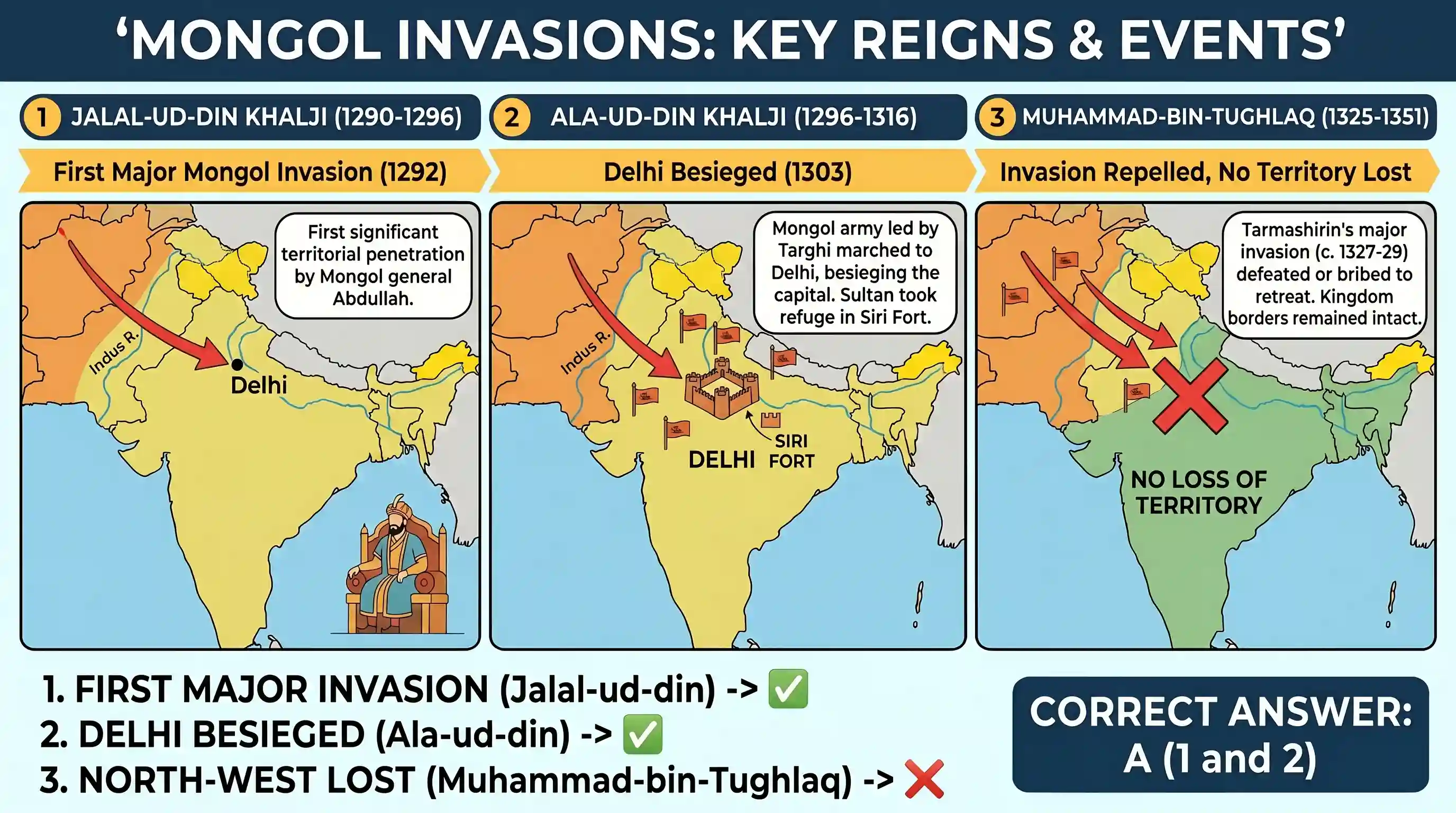
With reference to Indian history, consider the following statements: 1. The first Mongol invasion of India happened during the reign of Jalal-ud-din Khalji. 2. During the reign of Ala-ud-din Khalji, one Mongol assault marched up to Delhi and besieged the city. 3. Muhammad-bin-Tughlaq temporarily lost portions of north-west of his kingdom to Mongols. Which of the statements given above is/are correct?

- A1 and 2Correct
- B2 only
- C1 and 3
- D3 only
Explanation
Let's analyze the statements regarding Mongol invasions in Indian history:
- The first Mongol invasion of India happened during the reign of Jalal-ud-din Khalji: While the Mongols, under Genghis Khan, first reached the Indus frontier in 1221 during Iltutmish's reign, the first significant incursions into the Delhi Sultanate's core territory and concerted attempts at conquest began later. The first major and sustained Mongol invasion that reached the vicinity of Delhi occurred in 1292 under Abdullah, a grandson of Hulegu, during the reign of Jalal-ud-din Khalji. Thus, in the context of direct invasions threatening the Sultanate, this statement is considered correct.
- During the reign of Ala-ud-din Khalji, one Mongol assault marched up to Delhi and besieged the city: This statement is correct. Ala-ud-din Khalji faced numerous severe Mongol invasions. The most famous was in 1303, when Targhi's Mongol army marched up to Delhi and besieged the city, forcing Ala-ud-din to take refuge in the Siri fort and reorganize his defenses.
- Muhammad-bin-Tughlaq temporarily lost portions of north-west of his kingdom to Mongols: This statement is incorrect. Muhammad-bin-Tughlaq did face a major Mongol invasion led by Tarmashirin around 1327-29. However, he managed to repel the invasion, either through force or by bribing the Mongols, and did not lose permanent or even temporary portions of his kingdom to them. His policies, like shifting the capital, were partly influenced by the Mongol threat, but he did not lose territory. Therefore, statements 1 and 2 are correct.
Related questions
More UPSC Prelims practice from the same subject and topic.
- Prelims 2022GS1history
In medieval India, the term "Fanam" referred to:
- Prelims 2022GS1history
With reference to Indian history, who of the following were known as "Kulah-Daran"?
- Prelims 2022GS1history
"Yogavāsistha" was translated into Persian by Nizamuddin Panipati during the reign of:
- Prelims 2022GS1history
In the Government of India Act 1919, the functions of Provincial Government were divided into "Reserved" and "Transferred" subjects. Which of the following were treated as "Reserved" subjects? 1. Admi…
- Prelims 2022GS1history
Consider the following freedom fighters : 1. Barindra Kumar Ghosh 2. Jogesh Chandra Chatterjee 3. Rash Behari Bose Who of the above was/were actively associated with the Ghadar Party?
- Prelims 2022GS1history
With reference to the proposals of Cripps Mission, consider the following statements: 1. The Constituent Assembly would have members nominated by the Provincial Assemblies as well as the Princely Stat…