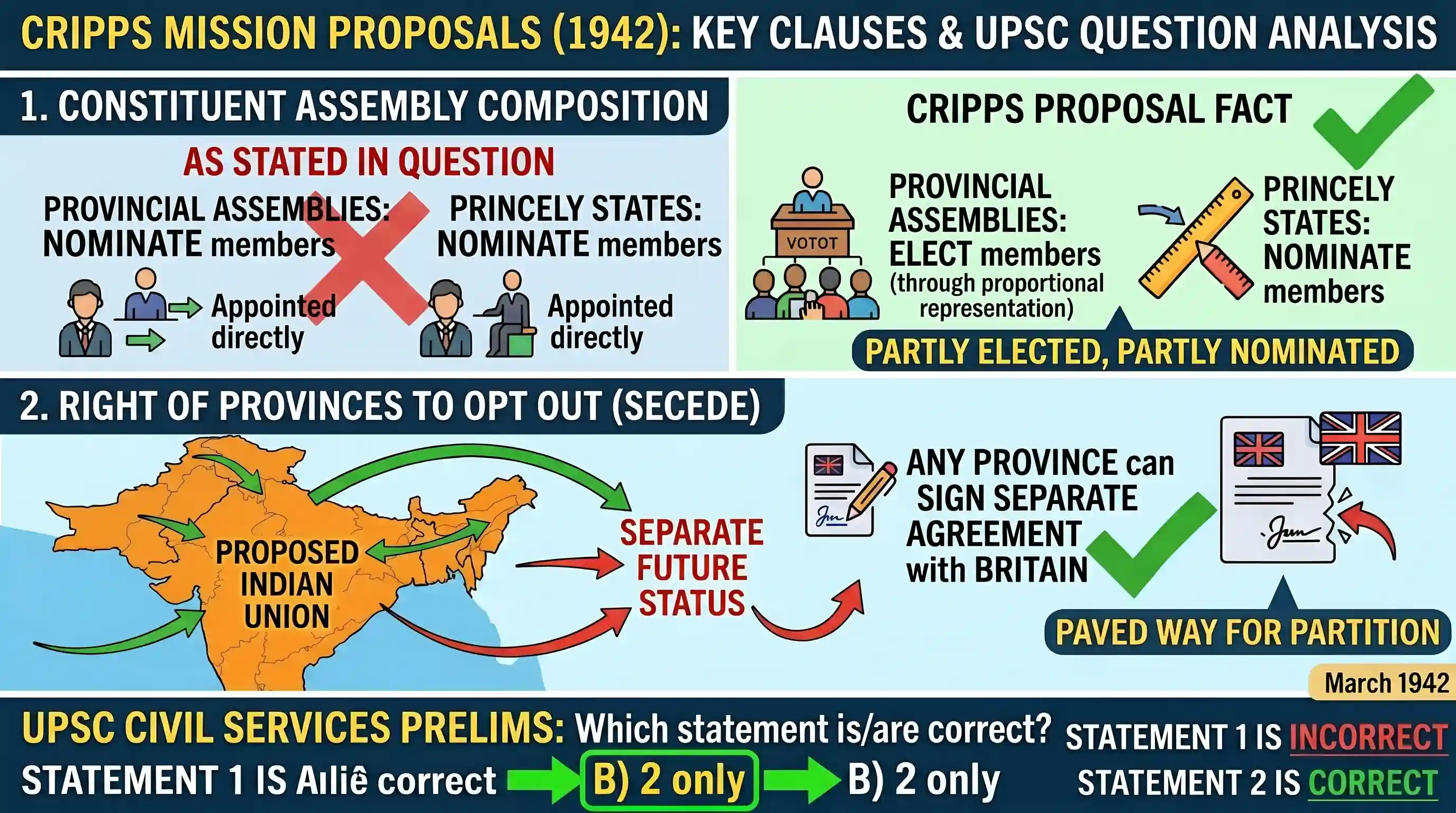
With reference to the proposals of Cripps Mission, consider the following statements: 1. The Constituent Assembly would have members nominated by the Provincial Assemblies as well as the Princely States. 2. Any Province, which is not prepared to accept the new Constitution would have the right to sign a separate agreement with Britain regarding its future status. Which of the statements given above is/are correct?

- A1 only
- B2 onlyCorrect
- CBoth 1 and 2
- DNeither 1 nor 2
Explanation
The Cripps Mission, led by Sir Stafford Cripps, came to India in March 1942 with proposals for constitutional reform. Its main proposals were aimed at securing India's support in World War II. Let's analyze the statements:
- The Constituent Assembly would have members nominated by the Provincial Assemblies as well as the Princely States: This statement is incorrect. The Cripps proposals stipulated that members of the Constituent Assembly would be partly elected by the provincial assemblies (through proportional representation) and partly nominated by the Princely States. It was not 'nominated by the Provincial Assemblies'.
- Any Province, which is not prepared to accept the new Constitution would have the right to sign a separate agreement with Britain regarding its future status: This statement is correct. The Cripps Mission's proposal included a clause that allowed any province or princely state to opt out of the proposed Indian Union and form a separate agreement with the British government, essentially granting the right to secede. This provision was a major point of contention and was seen as paving the way for the partition of India. Therefore, only statement 2 is correct.
Related questions
More UPSC Prelims practice from the same subject and topic.
- Prelims 2022GS1history
In the Government of India Act 1919, the functions of Provincial Government were divided into "Reserved" and "Transferred" subjects. Which of the following were treated as "Reserved" subjects? 1. Admi…
- Prelims 2022GS1history
Consider the following freedom fighters : 1. Barindra Kumar Ghosh 2. Jogesh Chandra Chatterjee 3. Rash Behari Bose Who of the above was/were actively associated with the Ghadar Party?
- Prelims 2022GS1history
In medieval India, the term "Fanam" referred to:
- Prelims 2022GS1history
With reference to Indian history, consider the following texts : 1. Nettipakarana 2. Parishishtaparvan 3. Avadanashataka 4. Trishashtilakshana Mahapurana Which of the above are Jaina texts?
- Prelims 2022GS1history
With reference to Indian history, consider the following pairs: Historical person Known as 1. Aryadeva - Jaina scholar 2. Dignaga - Buddhist scholar 3. Nathamuni - Vaishnava scholar How many pairs giv…
- Prelims 2022GS1history
With reference to Indian history, consider the following statements: 1. The first Mongol invasion of India happened during the reign of Jalal-ud-din Khalji. 2. During the reign of Ala-ud-din Khalji, o…