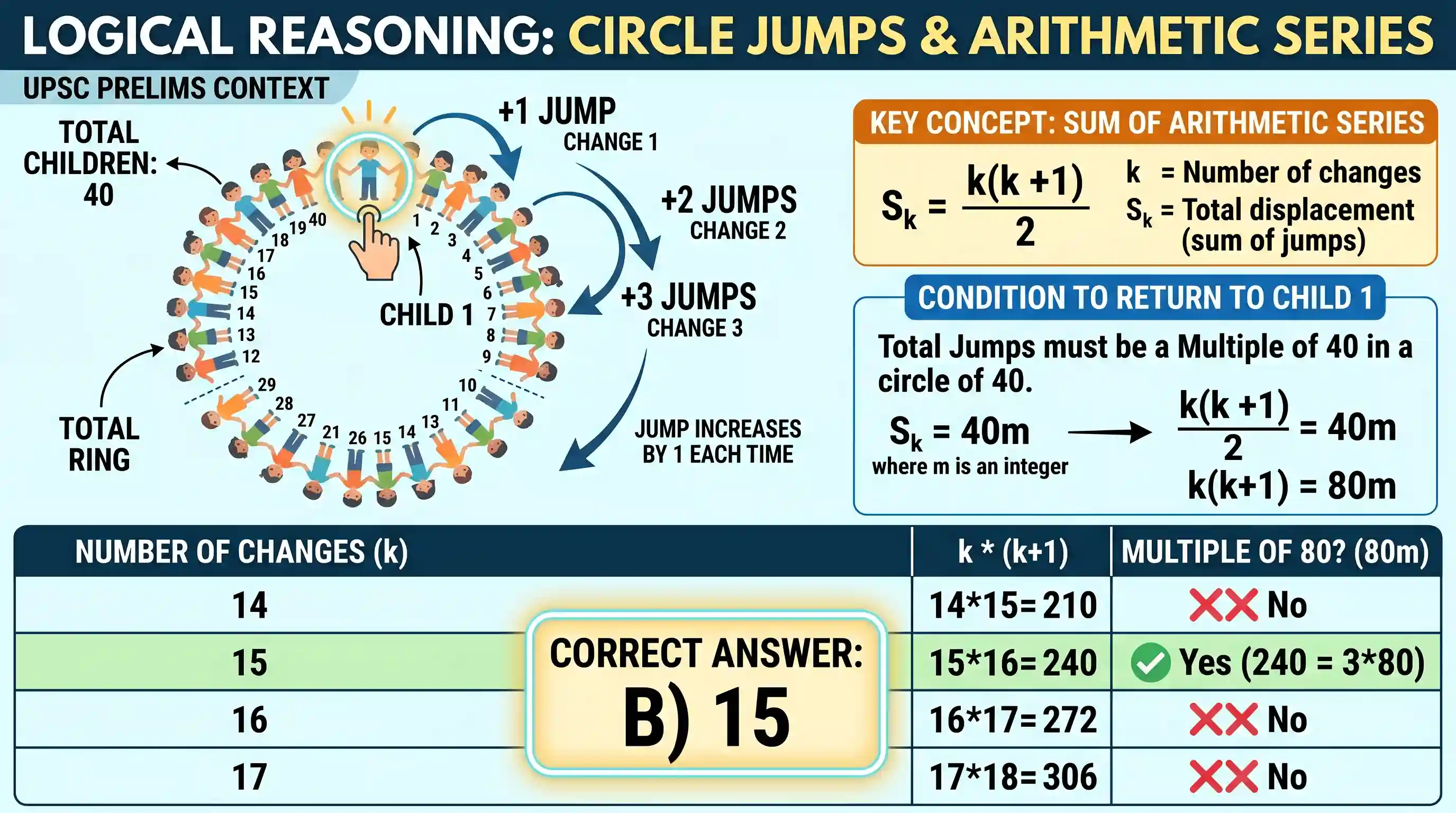
40 children are standing in a circle and one of them (say child-1) has a ring. The ring is passed clockwise. Child-1 passes on to child-2, child-2 passes on to child-4, child-4 passes on to child-7 and so on. After how many such changes (including child-1) will the ring be in the hands of child-1 again?

- A14
- B15Correct
- C16
- D17
Explanation
The ring starts with Child-1. The passing pattern is: Child-1 passes to Child-2 (jump of 1) Child-2 passes to Child-4 (jump of 2) Child-4 passes to Child-7 (jump of 3) And so on. The jump increases by 1 each time.
Let 'k' be the number of changes (passes). The total displacement (sum of jumps) after 'k' changes is S_k = 1 + 2 + 3 + ... + k. Using the formula for the sum of the first 'k' natural numbers, S_k = k * (k + 1) / 2.
For the ring to be back in the hands of Child-1, the total displacement must be a multiple of the total number of children (40). So, S_k must be a multiple of 40. k * (k + 1) / 2 = 40 * m (where 'm' is an integer) k * (k + 1) = 80 * m
We need to find the smallest positive integer 'k' such that k * (k + 1) is a multiple of 80. Let's test the values: If k = 14: k * (k + 1) = 14 * 15 = 210. 210 is not a multiple of 80. If k = 15: k * (k + 1) = 15 * 16 = 240. 240 is a multiple of 80 (240 = 3 * 80).
Thus, after 15 changes, the ring will be back in the hands of Child-1.
The final answer is B) 15.
Related questions
More UPSC Prelims practice from the same subject and topic.
- Prelims 2023CSATLogical Reasoning
What is the middle term of the sequence Z, Z, Y, Y, Y, X, X, X, X, W, W, W, W, W,..., A?
- Prelims 2023CSATLogical Reasoning
Consider the sequence ABC_ _ABC_DABBCD_ABCD that follows a certain pattern. Which one of the following completes the sequence?
- Prelims 2023CSATLogical Reasoning
If 7 ⊕ 9 ⊕ 10 = 8 , 9 ⊕ 11 ⊕ 30 = 5 , 11 ⊕ 17 ⊕ 21 = 13 , what is the value of 23 ⊕ 4 ⊕ 15 ?
- Prelims 2023CSATLogical Reasoning
If 'ZERO' is written as 'CHUR', then how is 'PLAYER' written?
- Prelims 2023CSATLogical Reasoning
Consider the following statements: 1. A is older than B. 2. C and D are of the same age. 3. E is the youngest. 4. F is younger than D. 5. F is older than A. How many statements given above are require…
- Prelims 2023CSATLogical Reasoning
Consider the following including the Question and the Statements: There are 5 members A, B, C, D, E in a family. Question: What is the relation of E to B? Statement- 1: A and B are a married couple. S…