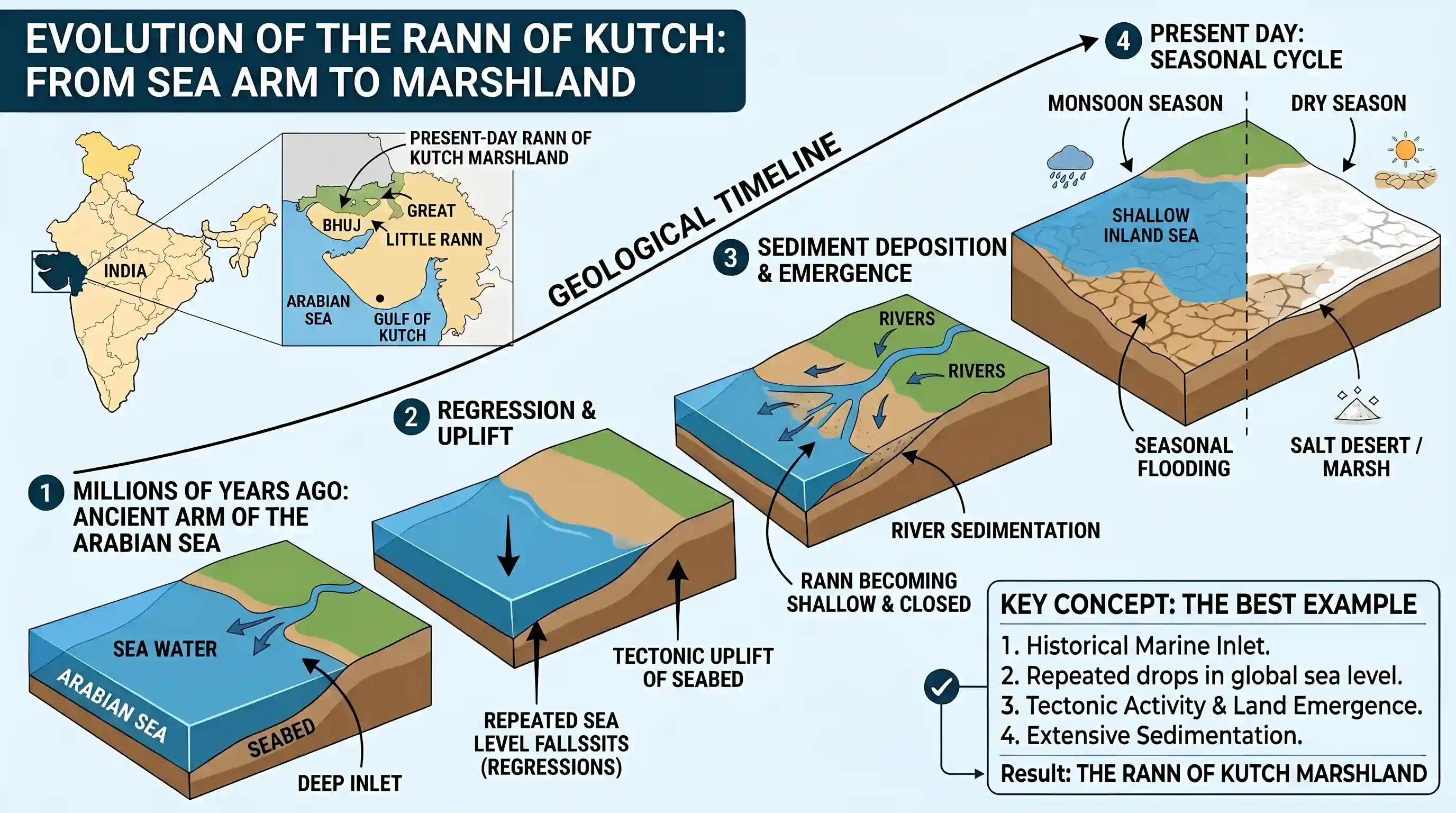
Which one of the following is the best example of repeated falls in sea level, giving rise to present-day extensive marshland?

- ABhitarkanika Mangroves
- BMarakkanam Salt Pans
- CNaupada Swamp
- DRann of KutchCorrect
Explanation
The Rann of Kutch, located in Gujarat, is widely recognized as the best example of an extensive marshland formed by repeated falls in sea level and tectonic activity. Historically, the Rann was an arm of the Arabian Sea. Geological evidence suggests that due to uplifting of the seabed and repeated regressions (falls) of sea level over geological time, combined with sediment deposition by rivers, it transformed into the vast salt marsh it is today. During monsoons, it gets inundated, appearing like a shallow sea, and dries up in other seasons, forming a salt desert. This dynamic process of sea-level fluctuations and land emergence best fits the description.
Other options: Bhitarkanika Mangroves are known for their dense mangrove forests. Marakkanam Salt Pans are primarily human-made salt production facilities. Naupada Swamp is a coastal wetland, but not as extensively or historically linked to repeated sea-level falls on the scale of the Rann of Kutch.
Related questions
More UPSC Prelims practice from the same subject and topic.
- Prelims 2023GS1geography
Consider the following statements: 1. In a seismograph, P waves are recorded earlier than S waves. 2. In P waves, the individual particles vibrate to and fro in the direction of wave propagation where…
- Prelims 2023GS1geography
Consider the following statements: 1. Jhelum River passes through Wular Lake. 2. Krishna River directly feeds Kolleru Lake. 3. Meandering of Gandak River formed Kanwar Lake. How many of the statements…
- Prelims 2023GS1geography
Consider the following pairs: Port Well known as 1. Kamarajar Port: First major port in India registered as a company 2. Mundra Port: Largest privately owned port in India 3. Visakhapatnam Port: Large…
- Prelims 2023GS1geography
Consider the following trees: 1. Jackfruit (Artocarpus heterophyllus) 2. Mahua (Madhuca indica) 3. Teak (Tectona grandis) How many of the above are deciduous trees?
- Prelims 2023GS1geography
Consider the following statements: 1. India has more arable area than China. 2. The proportion of irrigated area is more in India as compared to China. 3. The average productivity per hectare in India…
- Prelims 2023GS1geography
Ilmenite and rutile, abundantly available in certain coastal tracts of India, are rich sources of which one of the following?