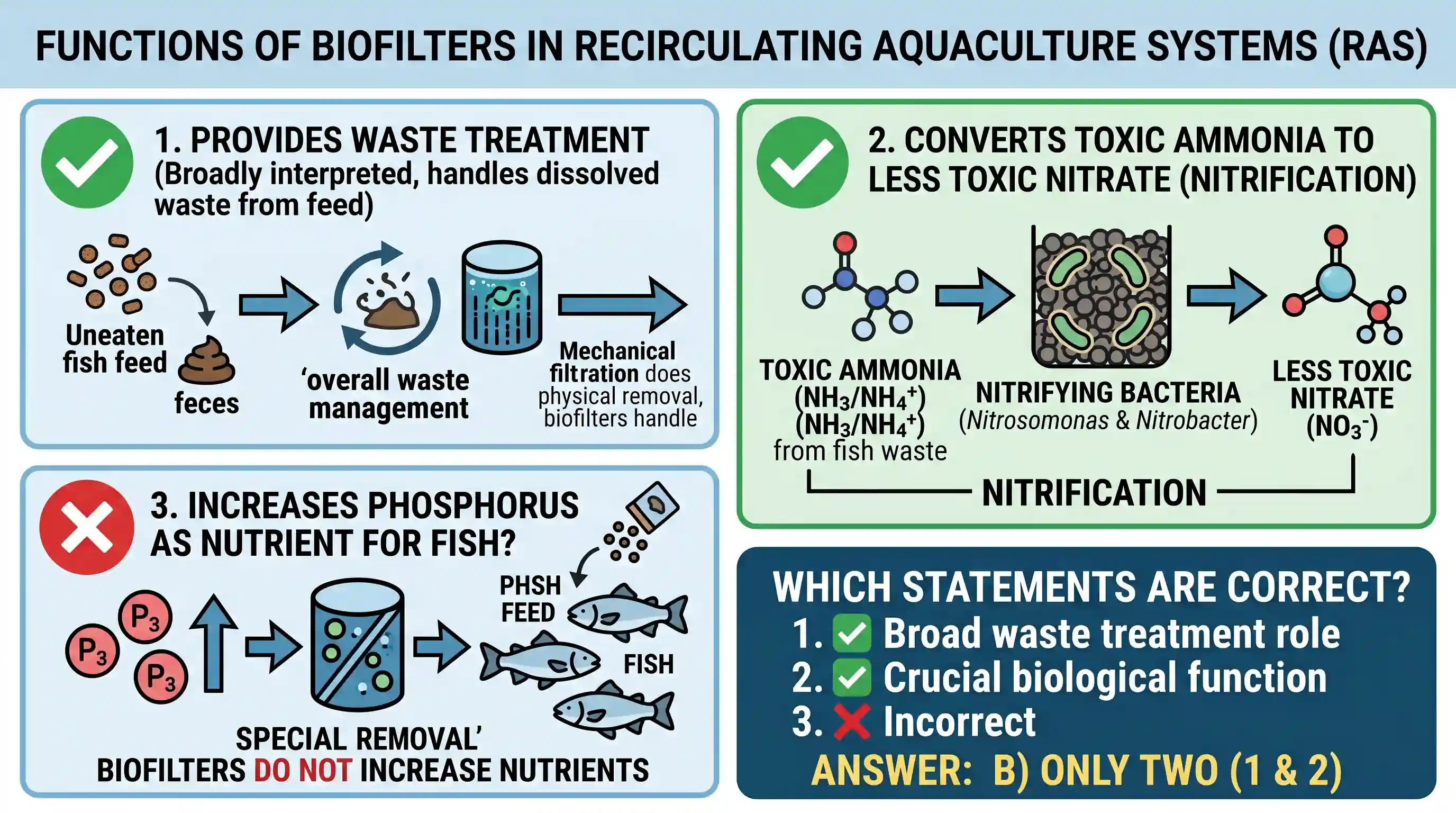
With reference to the role of biofilters in Recirculating Aquaculture System, consider the following statements: 1. Biofilters provide waste treatment by removing uneaten fish feed. 2. Biofilters convert ammonia present in fish waste to nitrate. 3. Biofilters increase phosphorus as nutrient for fish in water. How many of the statements given above are correct?

- AOnly one
- BOnly twoCorrect
- CAll three
- DNone
Explanation
Let's analyze the statements regarding the role of biofilters in Recirculating Aquaculture Systems (RAS):
-
Biofilters provide waste treatment by removing uneaten fish feed. This statement is largely incorrect in its direct sense. Biofilters are primarily responsible for biological filtration, meaning they convert dissolved nitrogenous wastes (like ammonia) into less toxic forms. The physical removal of solid wastes, such as uneaten fish feed and faeces, is typically handled by mechanical filters (e.g., drum filters, settlement tanks, protein skimmers) which operate before the water enters the biofilter. However, in a broad interpretation of 'waste treatment' within the entire RAS, the biofilter plays a crucial role in processing the dissolved organic load that originates from feed breakdown. Given the correct answer, this implies a broader interpretation might be intended where biofilters are a critical component of the overall waste treatment process that handles by-products originating from uneaten feed.
-
Biofilters convert ammonia present in fish waste to nitrate. This statement is correct. This is the primary and most vital function of biofilters in RAS. Beneficial bacteria (nitrifying bacteria) colonize the biofilter media and carry out nitrification, a two-step process: converting toxic ammonia (NH3/NH4+) to nitrite (NO2-), and then nitrite to less toxic nitrate (NO3-).
-
Biofilters increase phosphorus as nutrient for fish in water. This statement is incorrect. Biofilters are designed to remove waste products and maintain water quality. They do not increase phosphorus levels; rather, phosphorus, if present as a waste product, would ideally be removed from the system through water changes or other filtration methods. Fish primarily obtain phosphorus from their feed.
Based on the provided answer being 'Only two', and statement 2 being definitively correct, statement 1 is considered correct under a broad interpretation of 'waste treatment' in RAS.
Related questions
More UPSC Prelims practice from the same subject and topic.
- Prelims 2023GS1geography
Consider the following trees: 1. Jackfruit (Artocarpus heterophyllus) 2. Mahua (Madhuca indica) 3. Teak (Tectona grandis) How many of the above are deciduous trees?
- Prelims 2023GS1geography
Consider the following statements: Statement-I: Marsupials are not naturally found in India. Statement-II: Marsupials can thrive only in montane grasslands with no predators. Which one of the followin…
- Prelims 2023GS1geography
'Invasive Species Specialist Group' (that develops Global Invasive Species Database) belongs to which one of the following organizations?
- Prelims 2023GS1geography
Consider the following fauna: 1. Lion-tailed Macaque 2. Malabar Civet 3. Sambar Deer How many of the above are generally nocturnal or most active after sunset?
- Prelims 2023GS1geography
Which of the following organisms perform waggle dance for others of their kin to indicate the direction and the distance to a source of their food?
- Prelims 2023GS1geography
Consider the following statements regarding the Indian squirrels: 1. They build nests by making burrows in the ground. 2. They store their food materials like nuts and seeds in the ground. 3. They are…