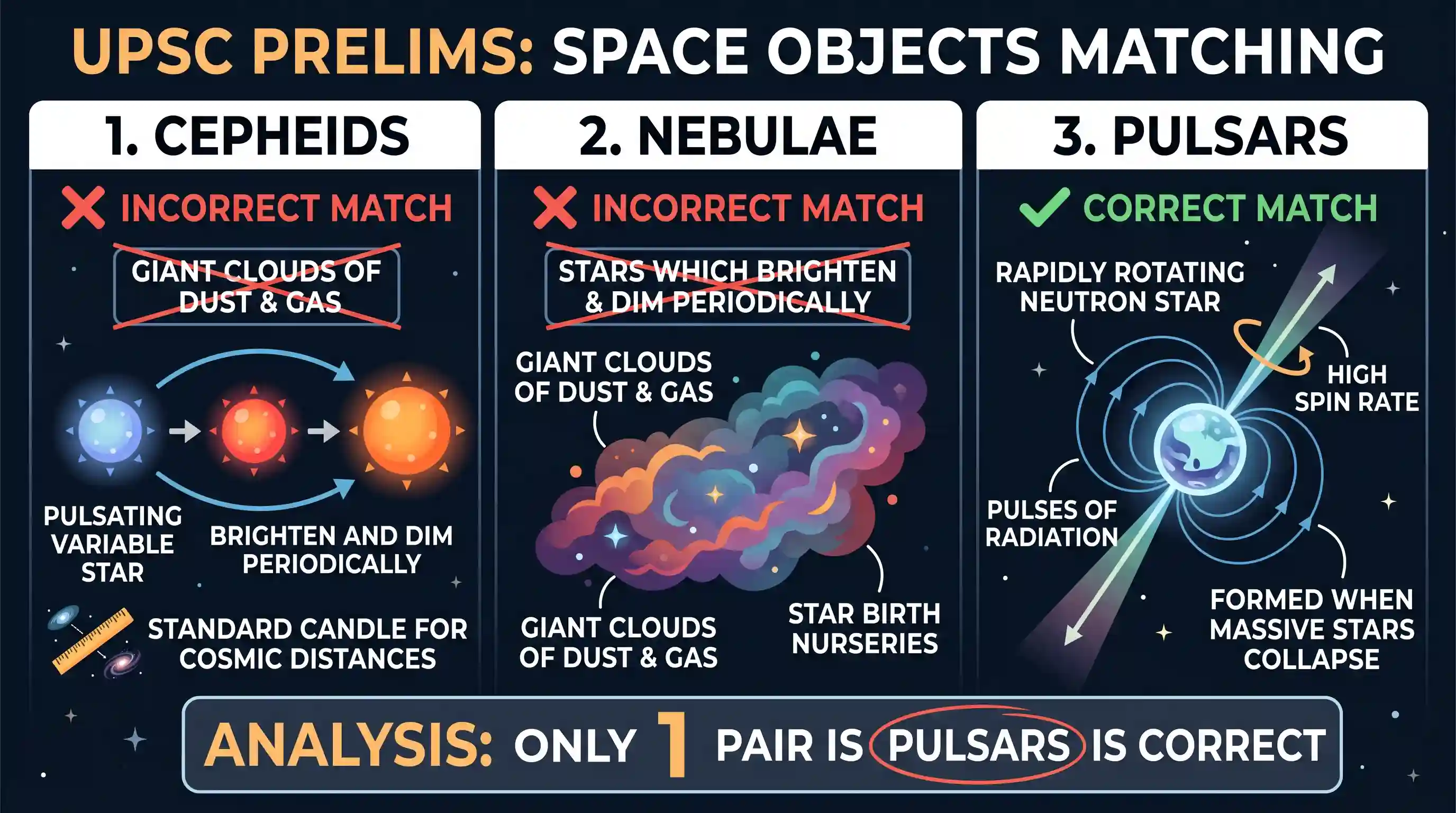
Consider the following pairs: Objects in space Description 1. Cepheids: Giant clouds of dust and gas in space 2. Nebulae: Stars which brighten and dim periodically 3. Pulsars: Neutron stars that are formed when massive stars run out of fuel and collapse How many of the above pairs are correctly matched?

- AOnly oneCorrect
- BOnly two
- CAll three
- DNone
Explanation
-
Cepheids — Giant clouds of dust and gas in space: Incorrectly matched. Cepheids are pulsating variable stars that periodically brighten and dim. Their luminosity period is directly related to their absolute brightness, making them important "standard candles" for measuring cosmic distances. Giant clouds of dust and gas are actually nebulae.
-
Nebulae — Stars which brighten and dim periodically: Incorrectly matched. Nebulae are giant clouds of dust and gas in space where new stars are born. The description given here (brighten and dim periodically) actually describes Cepheids.
-
Pulsars — Rapidly spinning neutron stars that emit regular pulses of radio waves and other radiation: Correctly matched. Pulsars are indeed rapidly rotating neutron stars that emit beams of electromagnetic radiation.
Only one pair (Pulsars) is correctly matched.
Related questions
More UPSC Prelims practice from the same subject and topic.
- Prelims 2023GS1science-and-technology
Which one of the following countries has its own Satellite Navigation System?
- Prelims 2023GS1science-and-technology
Consider the following statements: Statement-I: India, despite having uranium deposits, depends on coal for most of its electricity production. Statement-II: Uranium, enriched to the extent of at leas…
- Prelims 2023GS1science-and-technology
Consider the following statements: 1. Some mushrooms have medicinal properties. 2. Some mushrooms have psycho-active properties. 3. Some mushrooms have insecticidal properties. 4. Some mushrooms have …
- Prelims 2023GS1science-and-technology
Consider the following statements: 1. Some microorganisms can grow in environments with temperature above the boiling point of water. 2. Some microorganisms can grow in environments with temperature b…
- Prelims 2023GS1science-and-technology
Consider the following: 1. Aerosols 2. Foam agents 3. Fire retardants 4. Lubricants In the making of how many of the above are hydrofluorocarbons used?
- Prelims 2023GS1science-and-technology
Consider the following statements: 1. Carbon fibres are used in the manufacture of components used in automobiles and aircrafts. 2. Carbon fibres once used cannot be recycled. Which of the statements …