Consider the following statements in respect of a rectangular sheet of length 20 cm and breadth 8 cm: 1. It is possible to cut the sheet exactly into 4 square sheets. 2. It is possible to cut the sheet into 10 triangular sheets of equal area. Which of the above statements is are correct?

- A1 only
- B2 only
- CBoth 1 and 2Correct
- DNeither 1 nor 2
Explanation
Here's a brief explanation for each statement:
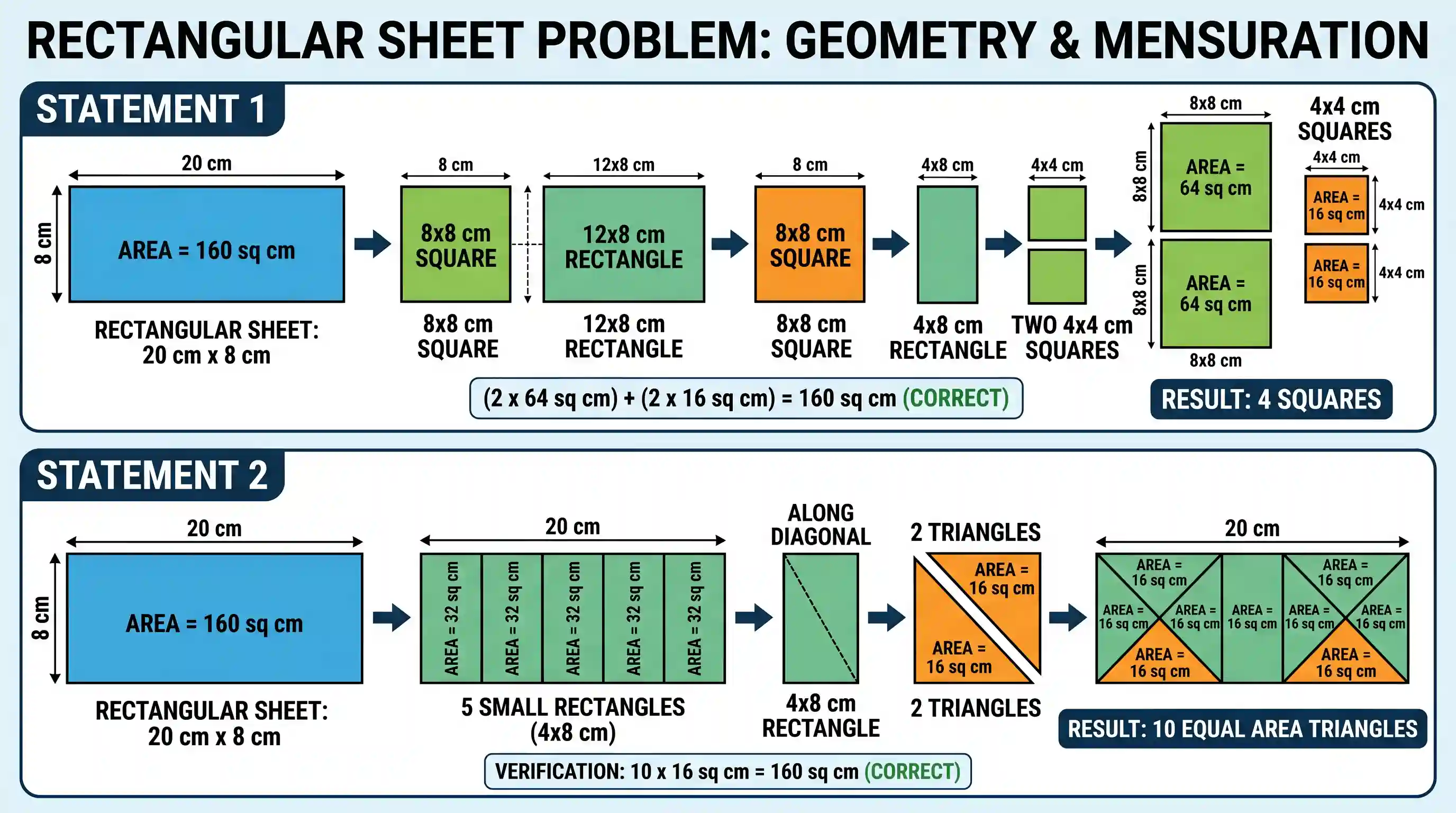
Statement 1: It is possible to cut the sheet exactly into 4 square sheets. The rectangular sheet has dimensions 20 cm x 8 cm, so its area is 20 * 8 = 160 sq cm. It is possible to cut the sheet into four square sheets of different sizes:
- Two squares of 8 cm x 8 cm. Each has an area of 64 sq cm. Total area = 2 * 64 = 128 sq cm.
- Two squares of 4 cm x 4 cm. Each has an area of 16 sq cm. Total area = 2 * 16 = 32 sq cm. The total area of these four squares is 128 + 32 = 160 sq cm, which matches the area of the original sheet. To cut them: From the 20x8 sheet, cut an 8x8 square from one end. This leaves a 12x8 rectangle. Cut another 8x8 square from the other end of the original sheet (or the remaining 12x8 part). This leaves a 4x8 rectangle in the middle. The 4x8 rectangle can then be cut into two 4x4 squares. Thus, statement 1 is correct.
Statement 2: It is possible to cut the sheet into 10 triangular sheets of equal area. The area of the rectangular sheet is 160 sq cm. If it is cut into 10 triangular sheets of equal area, each triangle must have an area of 160 / 10 = 16 sq cm. This is possible: Divide the 20 cm length of the rectangle into 5 equal segments of 4 cm each. This creates five smaller rectangles, each measuring 4 cm x 8 cm. Each of these 4x8 cm rectangles has an area of 32 sq cm. Each 4x8 cm rectangle can be cut along its diagonal into two triangles. Each of these triangles will have an area of 32 / 2 = 16 sq cm. Since there are 5 such 4x8 cm rectangles, and each yields 2 triangles of 16 sq cm, we get a total of 5 * 2 = 10 triangular sheets, each with an area of 16 sq cm. Thus, statement 2 is correct.
Since both statements 1 and 2 are correct, the answer is C.
Related questions
More UPSC Prelims practice from the same subject and topic.
- Prelims 2024CSATQuantitative Aptitude
Which is the least possible number of cuts required to cut a cube into 64 identical pieces?
- Prelims 2024CSATQuantitative Aptitude
There are eight equidistant points on a circle. How many right-angled triangles can be drawn using these points as vertices and taking the diameter as one side of the triangle?
- Prelims 2024CSATQuantitative Aptitude
125 identical cubes are arranged in the form of cubical block. How many cubes are surrounded by other cubes from each side?
- Prelims 2024CSATQuantitative Aptitude
The average weight of A, B, C is 40 kg, the average weight of B, D, E is 42 kg and the weight of F is equal to that of B. What is the average weight of A, B, C, D, E and F?
- Prelims 2024CSATQuantitative Aptitude
What is the number of numbers of the form 0.xy, where x and y are distinct non-zero digits?
- Prelims 2024CSATQuantitative Aptitude
The sum of three consecutive integers is equal to their product. How many such possibilities are there?