24 men and 12 women can do a piece of work in 30 days. In how many days can 12 men and 24 women do the same piece of work?

- A30 days
- Bmore than 30 days
- CLess than 30 days or more than 30 days
- DData is inadequate to draw any conclusionCorrect
Explanation
Explanation:
Let 'M' be the work rate of one man per day and 'W' be the work rate of one woman per day.
From the first statement: 24 men and 12 women can do a piece of work in 30 days. Total work = (24M + 12W) * 30
We need to find the number of days (let's call it 'D') for 12 men and 24 women to do the same work. Total work = (12M + 24W) * D
Equating the total work: (24M + 12W) * 30 = (12M + 24W) * D
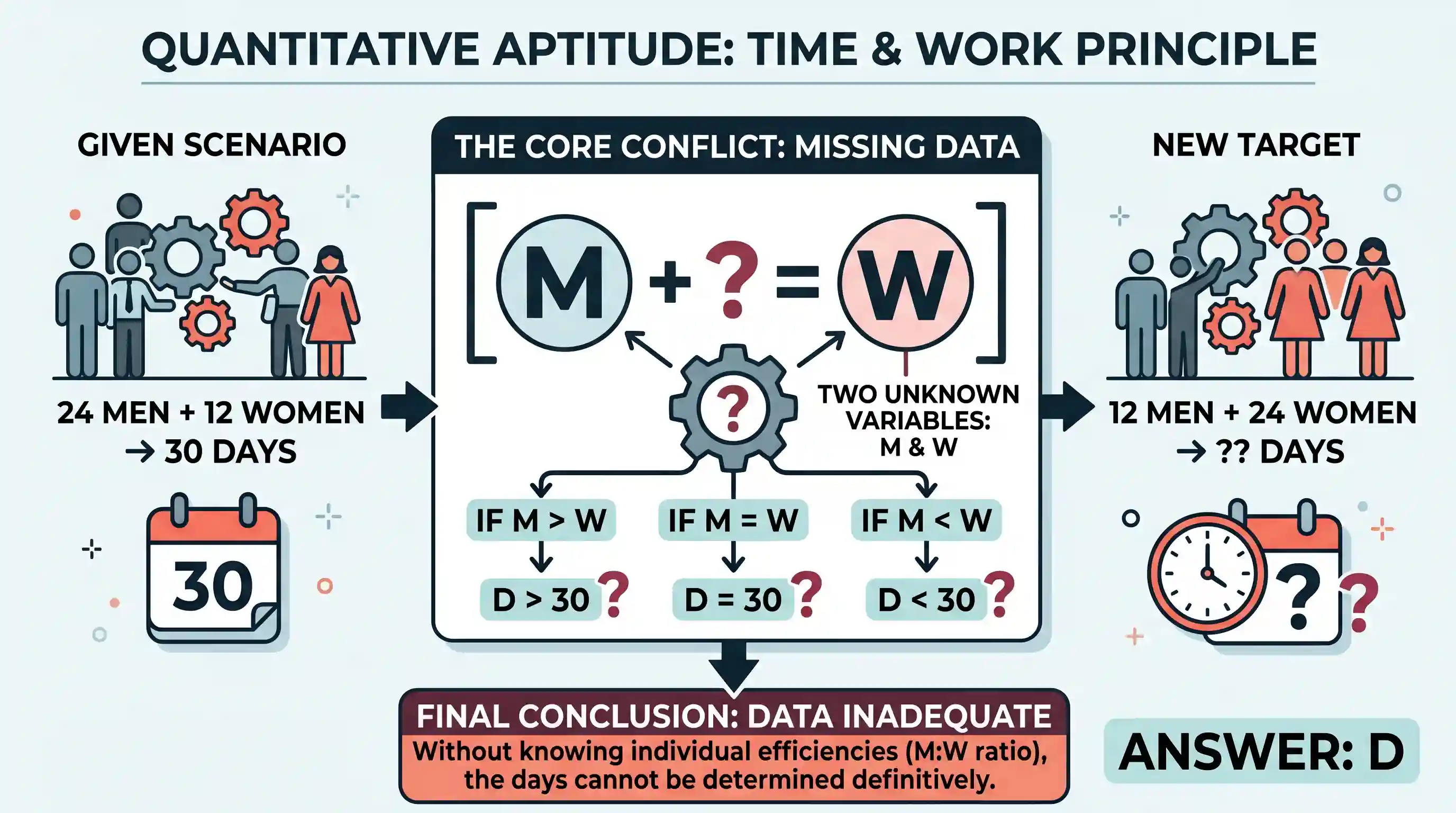
To solve for D, we would need to know the relationship between M and W (i.e., how much work a man does compared to a woman). Since this information is not provided, we have one equation with two unknown variables (M and W) in the context of their ratio.
Let's analyze the options:
A) 30 days: This would only be true if (24M + 12W) = (12M + 24W), which simplifies to 12M = 12W, or M = W. We cannot assume men and women have equal work rates.
B) More than 30 days: This would be true if the combined work rate of (12M + 24W) is less than (24M + 12W), which means 12W < 12M, or W < M (women work slower than men). We cannot assume this relationship.
C) Less than 30 days or more than 30 days: This option suggests that an answer can be determined, just not a specific number like 30. However, without the M:W ratio, we cannot even definitively say if it's less than or more than 30 days, as shown in the analysis for A and B. The answer could be 30, less than 30, or more than 30, depending on the unknown ratio.
D) Data is inadequate to draw any conclusion: Since the individual work rates of men and women (or their ratio) are unknown, we cannot determine the exact number of days. The number of days could be 30, more than 30, or less than 30, depending on the relative efficiency of men and women. Therefore, the given data is insufficient.
The final answer is D
Related questions
More UPSC Prelims practice from the same subject and topic.
- Prelims 2024CSATQuantitative Aptitude
A, B, C working independently can do a piece of work in 8, 16 and 12 days respectively. A alone works on Monday, B alone works on Tuesday, C alone works on Wednesday; A alone, again works on Thursday …
- Prelims 2024CSATQuantitative Aptitude
Which is the least possible number of cuts required to cut a cube into 64 identical pieces?
- Prelims 2024CSATQuantitative Aptitude
The average weight of A, B, C is 40 kg, the average weight of B, D, E is 42 kg and the weight of F is equal to that of B. What is the average weight of A, B, C, D, E and F?
- Prelims 2024CSATQuantitative Aptitude
What is the number of numbers of the form 0.xy, where x and y are distinct non-zero digits?
- Prelims 2024CSATQuantitative Aptitude
The sum of three consecutive integers is equal to their product. How many such possibilities are there?
- Prelims 2024CSATQuantitative Aptitude
There are 9 cups placed on a table arranged in equal number of rows and columns out of which 6 cups contain coffee and 3 cups contain tea. In how many ways can they be arranged so that each row should…