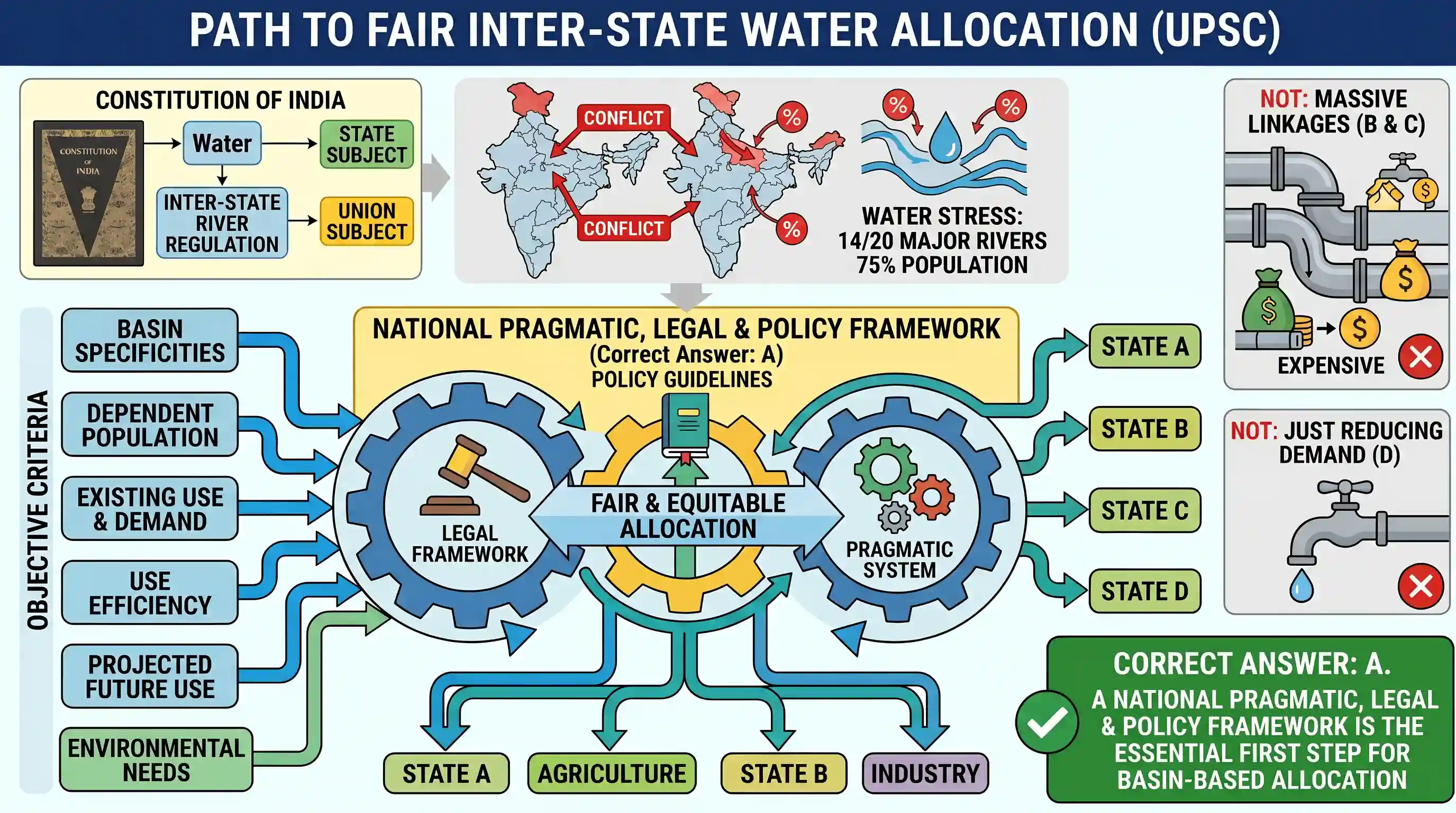
We often hear about conflicts among different States in India over river waters. Of the 20 major river system, 14 are already water-stressed; 75% of the population lives in water-stressed regions, a third of whom live in water-scarce areas. Climate change, the demands of rising population and the need for agriculture to keep pace, and increased rate of urbanization and industrialization will exacerbate water stress. According to the Constitution of India, water is a State subject and not that of the Union, except for regulation of inter-State rivers. Key to ensuring balance between competing demands of various stakeholders is a basin-based approach to allocate water amongst constituent regions and States. Allocating fair share of water to them requires assessments based on objective criteria, such as specificities of the river basin, size of dependent population, existing water use and demand, efficiency of use, projected future use, etc. while ensuring the environmental needs of the river and aquifers. Which one of the following statements best reflects the most rational, practical and immediate action required to ensure fair and equitable allocation of water to different stakeholders?

- AA national, pragmatic, legal and policy framework for water allocation should be madeCorrect
- BAll river systems of the country should be linked and huge aquifers created
- CWater channels between regions of water surplus and regions of water deficit should be created
- DTo mitigate water crisis, water demand of sectors such as agriculture and industry should be reduced.
Explanation
The passage highlights the complexity of water allocation due to inter-state conflicts, water being a State subject, and the need for a basin-based approach with objective criteria for fair and equitable distribution.
A) A national, pragmatic, legal and policy framework for water allocation should be made. This option directly addresses the core problem identified in the passage: the need for a structured approach to allocate water fairly among competing stakeholders and States. A "national, pragmatic, legal and policy framework" would provide the necessary rules, guidelines, and mechanisms (including objective criteria and a basin-based approach) to ensure equitable allocation, making it the most rational, practical, and immediate foundational action.
B) All river systems of the country should be linked and huge aquifers created. This is a massive, long-term, extremely expensive, and environmentally contentious infrastructure project. It focuses on augmenting supply and distribution rather than establishing a framework for fair allocation of existing resources, and is far from an "immediate" or easily "practical" solution.
C) Water channels between regions of water surplus and regions of water deficit should be created. Similar to option B, this describes a large-scale infrastructure project (like river linking or canals) for physical transfer of water. While it addresses distribution, it doesn't provide the legal or policy framework for how that water should be allocated fairly and equitably among different stakeholders once transferred, nor is it an immediate solution.
D) To mitigate water crisis, water demand of sectors such as agriculture and industry should be reduced. While reducing demand is a crucial part of water management and conservation, it is a measure to conserve water, not a framework for allocating it fairly among competing users and States. The passage emphasizes balancing "competing demands" through a structured allocation approach, not just blanket reduction.
Therefore, option A is the best choice as it proposes the foundational policy and legal structure required for fair and equitable water allocation, which is the immediate and practical step to address the conflicts and stress mentioned.
Related questions
More UPSC Prelims practice from the same subject and topic.
- Prelims 2024CSATReading Comprehension
According to the Food and Agriculture Organization, one-third of food produced for human consumption is lost or wasted globally. Food is lost or wasted throughout the supply chain, from initial agricu…
- Prelims 2024CSATReading Comprehension
As inflation rises, even governments previously committed to budget discipline are spending freely to help households. Higher interest rates announced by central banks are supposed to help produce mod…
- Prelims 2024CSATReading Comprehension
As inflation rises, even governments previously committed to budget discipline are spending freely to help households. Higher interest rates announced by central banks are supposed to help produce mod…
- Prelims 2024CSATReading Comprehension
How best can the problems of floods and droughts be addressed so that the losses are minimal and the system becomes resilient? In this context, one important point that needs to be noted is that India…
- Prelims 2024CSATReading Comprehension
"The social order is a sacred right which is the basis of all other rights. Nevertheless, this right does not come from nature, and must therefore be founded on conventions." With reference to the abo…
- Prelims 2024CSATReading Comprehension
In an economic organization, allowing mankind to benefit by the productivity of machines should lead to a very good life of leisure, and much leisure is apt to be tedious except to those who have inte…