What is the sum of all digits which appear in all the integers from 10 to 100?

- A855
- B856Correct
- C910
- D911
Explanation
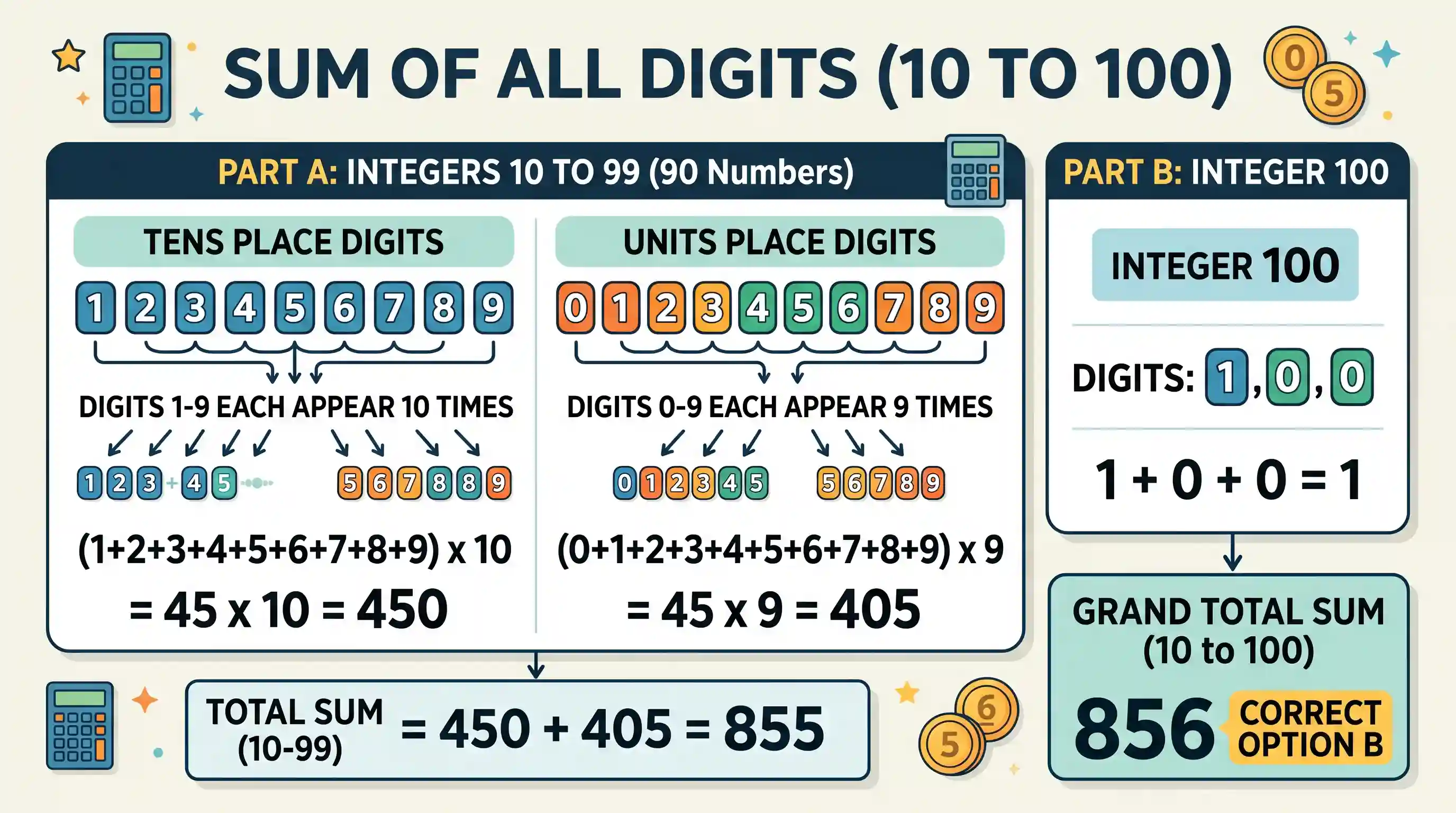
To find the sum of all digits from 10 to 100, we break the range into two parts: 10 to 99 and the number 100.
First, consider numbers from 10 to 99. These are 90 two-digit numbers. The tens place contains the digits 1 through 9, each appearing 10 times. Sum of tens digits = 1+2+3+4+5+6+7+8+9 multiplied by 10 = 45 multiplied by 10 = 450.
The units place contains the digits 0 through 9, each appearing 9 times. Sum of units digits = 0+1+2+3+4+5+6+7+8+9 multiplied by 9 = 45 multiplied by 9 = 405.
Total sum for 10 to 99 = 450 + 405 = 855.
Finally, add the digits of the number 100. The digits are 1, 0, and 0. Their sum is 1.
Grand total = 855 + 1 = 856.
Therefore, the correct option is B.
Related questions
More UPSC Prelims practice from the same subject and topic.
- Prelims 2024CSATQuantitative Aptitude
What is the number of numbers of the form 0.xy, where x and y are distinct non-zero digits?
- Prelims 2024CSATQuantitative Aptitude
The sum of three consecutive integers is equal to their product. How many such possibilities are there?
- Prelims 2024CSATQuantitative Aptitude
15 × 14 × 13 × … × 3 × 2 × 1 = 3 m × n 12. 15 × 14 × 13 × … × 3 × 2 × 1 = 3 m × n Where m and n are positive integers, then what is the maximum value of m?
- Prelims 2024CSATQuantitative Aptitude
Consider the following statements in respect of two natural numbers p and q such that p is a prime number and q is a composite number: 1. p x q can be an odd number. 2. q / p can be a prime number. 3.…
- Prelims 2024CSATQuantitative Aptitude
Let p be a two-digit number and q be the number consisting of same digits written in reverse order. If p x q = 2430, then what is the difference between p and q?
- Prelims 2024CSATQuantitative Aptitude
What is the smallest number greater than 1000 that when divided by any one of the numbers 6, 9, 12, 15, 18 leaves a remainder of 3?