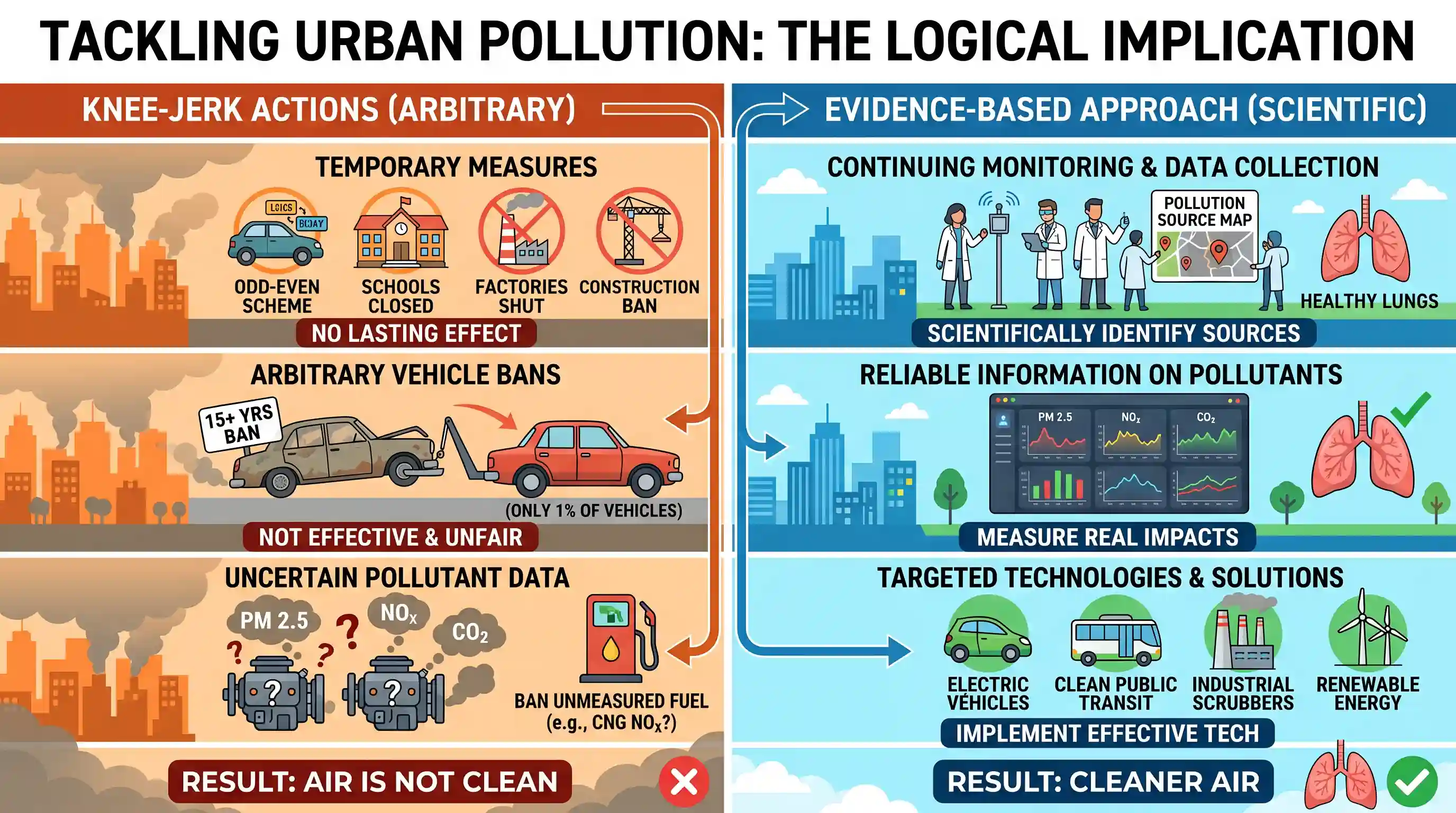
To tackle the problem of pollution in cities, policy makers think that drastic actions like temporary use of odd-even number scheme for vehicles, closing schools, factories, construction activities, and banning the use of certain type of vehicles are a way forward. Even then the air is not clean. Vehicles more than 15 years old comprise one percent of the total; and taking them off the road will not make any difference. Banning certain fuels and car types arbitrarily is not proper. Diesel engines produce more PM 2.5 and less CO2 than petrol or CNG engines. On the other hand, both diesel and CNG engines produce more NOx than petrol engines. No one has measured the amount of NOx that CNG engines are emitting. Arbitrary bans on vehicles that have passed mandated fitness tests and periodic pollution tests are unfair. What is needed is the scientific and reliable information about the source of pollutants on a continuing basis and the technologies that will work to reduce pollution from them. Which one of the following statements best reflects the most logical and rational implication conveyed by the passage?

- AArbitrary curbs on vehicles to reduce pollution are difficult to implement
- BKnee-jerk reactions cannot but an evidence-based approach will be more effectiveCorrect
- CA heavy penalty should be enforced on those driving without periodic pollution tests
- DIn the absence of laws to deal with the problem of pollution, the administration tends to make arbitrary decisions.
Explanation
The passage highlights that current measures like the odd-even scheme and arbitrary bans are drastic, temporary, and ineffective because they lack a scientific basis. It points out that even after these actions, the air remains unclean and the impact of certain vehicle types or fuels is often misunderstood or unmeasured.
Option B is the most logical implication because the text explicitly argues against arbitrary, knee-jerk reactions like banning 15-year-old cars or specific fuels without proper data. Instead, the final sentence of the passage directly advocates for what an evidence-based approach entails: using scientific and reliable information about pollutant sources and effective technologies to address the problem permanently.
Options A and C are incorrect because the passage focuses on the effectiveness and fairness of policies rather than the difficulty of implementation or the need for penalties. Option D is incorrect because the passage suggests the problem is a lack of scientific data and rational planning, not necessarily a lack of existing laws.
Related questions
More UPSC Prelims practice from the same subject and topic.
- Prelims 2024CSATReading Comprehension
According to the Food and Agriculture Organization, one-third of food produced for human consumption is lost or wasted globally. Food is lost or wasted throughout the supply chain, from initial agricu…
- Prelims 2024CSATReading Comprehension
As inflation rises, even governments previously committed to budget discipline are spending freely to help households. Higher interest rates announced by central banks are supposed to help produce mod…
- Prelims 2024CSATReading Comprehension
As inflation rises, even governments previously committed to budget discipline are spending freely to help households. Higher interest rates announced by central banks are supposed to help produce mod…
- Prelims 2024CSATReading Comprehension
How best can the problems of floods and droughts be addressed so that the losses are minimal and the system becomes resilient? In this context, one important point that needs to be noted is that India…
- Prelims 2024CSATReading Comprehension
"The social order is a sacred right which is the basis of all other rights. Nevertheless, this right does not come from nature, and must therefore be founded on conventions." With reference to the abo…
- Prelims 2024CSATReading Comprehension
In an economic organization, allowing mankind to benefit by the productivity of machines should lead to a very good life of leisure, and much leisure is apt to be tedious except to those who have inte…