Consider the following statements: Statement-I: The atmosphere is heated more by incoming solar radiation than by terrestrial radiation. Statement-II: Carbon dioxide and other greenhouse gases in the atmosphere are good absorbers of long wave radiation. Which one of the following is correct in respect of the above statements?

- ABoth Statement-I and Statement-II are correct and Statement-II explains Statement-I
- BBoth Statement-I and Statement-II are correct, but Statement-II does not explain Statement-I
- CStatement-I is correct, but Statement-II is incorrect
- DStatement-I is incorrect, but Statement-II is correctCorrect
Explanation
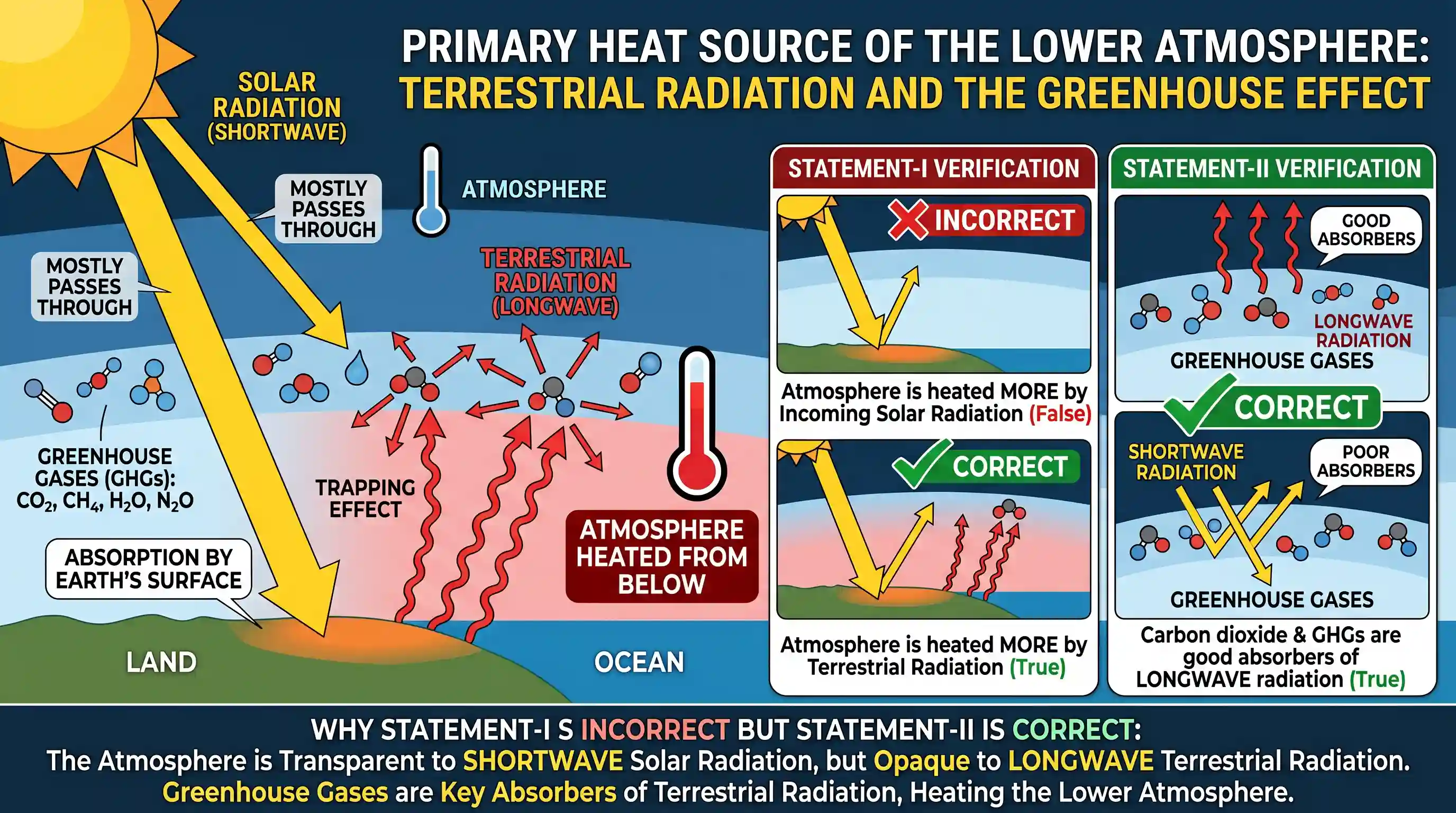
Statement-I is incorrect. The atmosphere is heated more by terrestrial radiation (longwave radiation) emitted from the Earth's surface than by incoming solar radiation (shortwave radiation). Greenhouse gases, like carbon dioxide, allow most of the incoming solar radiation to pass through but absorb and re-emit a significant portion of the outgoing longwave terrestrial radiation, thereby warming the atmosphere. This process is crucial for maintaining Earth's temperature.
Statement-II is correct. Carbon dioxide and other greenhouse gases (such as methane, nitrous oxide, and water vapor) are indeed very effective absorbers of longwave terrestrial radiation. This property is fundamental to the greenhouse effect, which keeps the Earth habitable. Without these gases, the Earth's surface would be much colder.
Therefore, Statement-I is incorrect, but Statement-II is correct.
Related questions
More UPSC Prelims practice from the same subject and topic.
- Prelims 2024GS1geography
Consider the following statements : Statement-I : Thickness of the troposphere at the equator is much greater as compared to poles. Statement-II: At the equator, heat is transported to great heights b…
- Prelims 2024GS1geography
Which of the following is/are correct inference/inferences from isothermal maps in the month of January? 1. The isotherms deviate to the north over the ocean and to the south over the continent. 2. Th…
- Prelims 2024GS1geography
With reference to "water vapour”, which of the following statements is/are correct? 1. It is a gas, the amount of which decreases with altitude. 2. Its percentage is maximum at the poles. Select the a…
- Prelims 2024GS1geography
Consider the following description : 1. Annual and daily range of temperatures is low. 2. Precipitation occurs throughout the year. 3. Precipitation varies between 50 cm 250 cm. What is this type of c…
- Prelims 2024GS1geography
With reference to "Coriolis force”, which of the following statements is/are correct? 1. It increases with increase in wind velocity. 2. It is maximum at the poles and is absent at the equator. Select…
- Prelims 2024GS1geography
On June 21 every year, which of the following latitude(s) experience(s) a sunlight of more than 12 hours? 1. Equator 2. Tropic of Cancer 3. Tropic of Capricorn 4. Arctic Circle Select the correct answ…