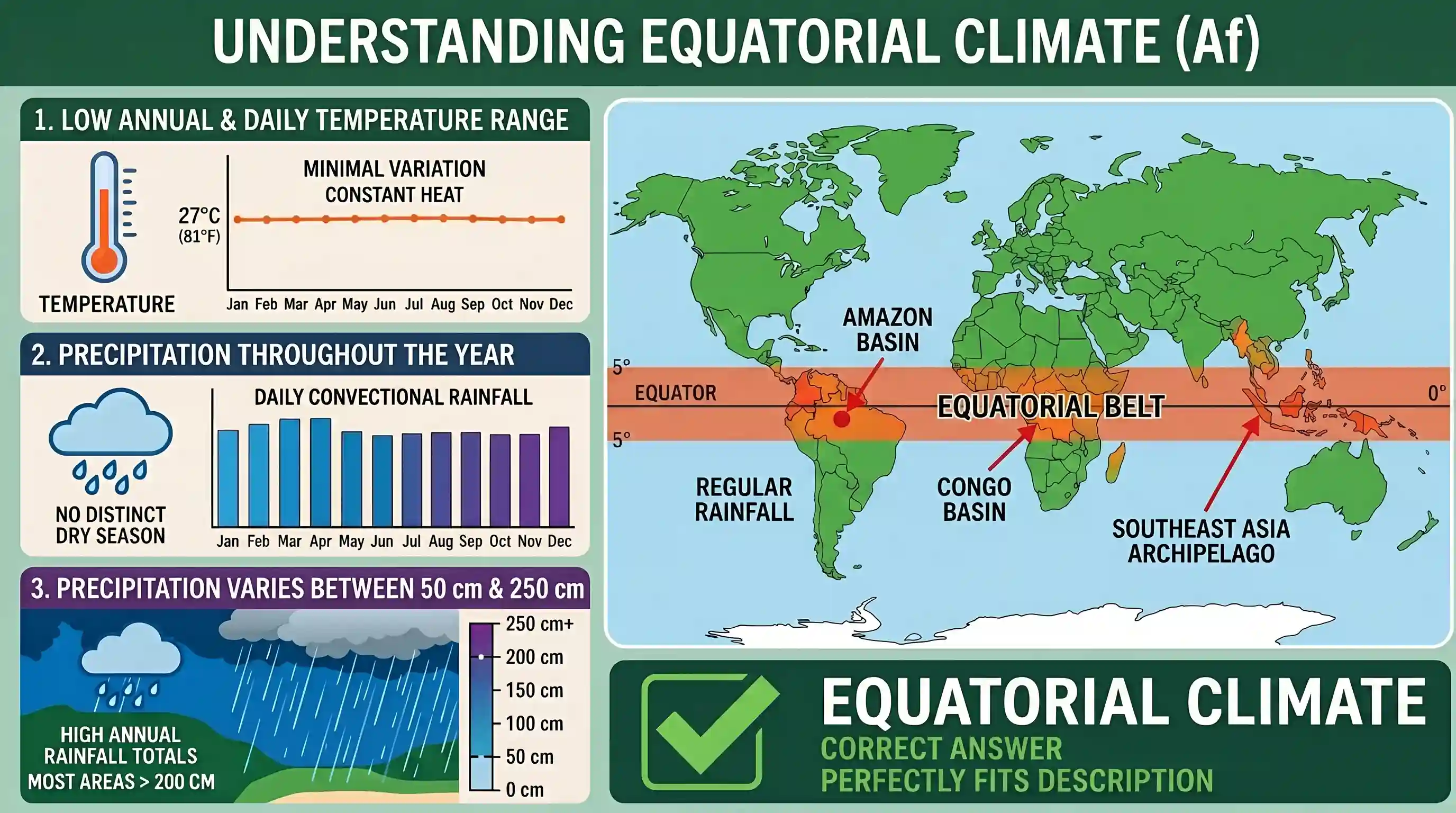
Consider the following description : 1. Annual and daily range of temperatures is low. 2. Precipitation occurs throughout the year. 3. Precipitation varies between 50 cm 250 cm. What is this type of climate?

- AEquatorial climateCorrect
- BChina type climate
- CHumid subtropical climate
- DMarine West coast climate
Explanation
Let's analyze the characteristics described:
-
Low annual and daily range of temperatures: This is a hallmark of equatorial climates. Due to consistent high solar insolation throughout the year and significant cloud cover and humidity, temperatures remain relatively stable, leading to minimal diurnal and annual temperature fluctuations.
-
Precipitation occurs throughout the year: Equatorial regions experience convectional rainfall almost daily due to intense heating and rising moist air. There is no distinct dry season.
-
Precipitation varies between 50 cm and 250 cm: While equatorial regions are known for high rainfall, the range can be quite broad, with some areas receiving over 200 cm annually. A range of 50-250 cm accommodates various equatorial zones, from drier rainforest fringes to extremely wet areas.
Comparing this with the options:
- Equatorial climate: Matches all three descriptions perfectly.
- China type climate (Humid Subtropical, Cwa): Has hot, wet summers and mild, dry winters. Temperature ranges are higher than equatorial, and precipitation is seasonal.
- Humid subtropical climate (Cfa/Cwa): Similar to China type, experiences seasonal precipitation and more distinct temperature variations.
- Marine West Coast climate (Cfb/Cfc): Characterized by mild temperatures, cool summers, and abundant precipitation throughout the year, but with higher annual temperature ranges than equatorial and distinct seasonality in temperature. The rainfall amounts can be significant, but the temperature characteristics don't fully align with 'very low range'.
Therefore, the description best fits an Equatorial climate.
Related questions
More UPSC Prelims practice from the same subject and topic.
- Prelims 2024GS1geography
Consider the following statements: Statement-I: The atmosphere is heated more by incoming solar radiation than by terrestrial radiation. Statement-II: Carbon dioxide and other greenhouse gases in the …
- Prelims 2024GS1geography
Consider the following statements : Statement-I : Thickness of the troposphere at the equator is much greater as compared to poles. Statement-II: At the equator, heat is transported to great heights b…
- Prelims 2024GS1geography
Which of the following is/are correct inference/inferences from isothermal maps in the month of January? 1. The isotherms deviate to the north over the ocean and to the south over the continent. 2. Th…
- Prelims 2024GS1geography
With reference to "water vapour”, which of the following statements is/are correct? 1. It is a gas, the amount of which decreases with altitude. 2. Its percentage is maximum at the poles. Select the a…
- Prelims 2024GS1geography
With reference to "Coriolis force”, which of the following statements is/are correct? 1. It increases with increase in wind velocity. 2. It is maximum at the poles and is absent at the equator. Select…
- Prelims 2024GS1geography
On June 21 every year, which of the following latitude(s) experience(s) a sunlight of more than 12 hours? 1. Equator 2. Tropic of Cancer 3. Tropic of Capricorn 4. Arctic Circle Select the correct answ…