On June 21 every year, which of the following latitude(s) experience(s) a sunlight of more than 12 hours? 1. Equator 2. Tropic of Cancer 3. Tropic of Capricorn 4. Arctic Circle Select the correct answer using the code given below:

- A1 only
- B2 only
- C3 and 4
- D2 and 4Correct
Explanation
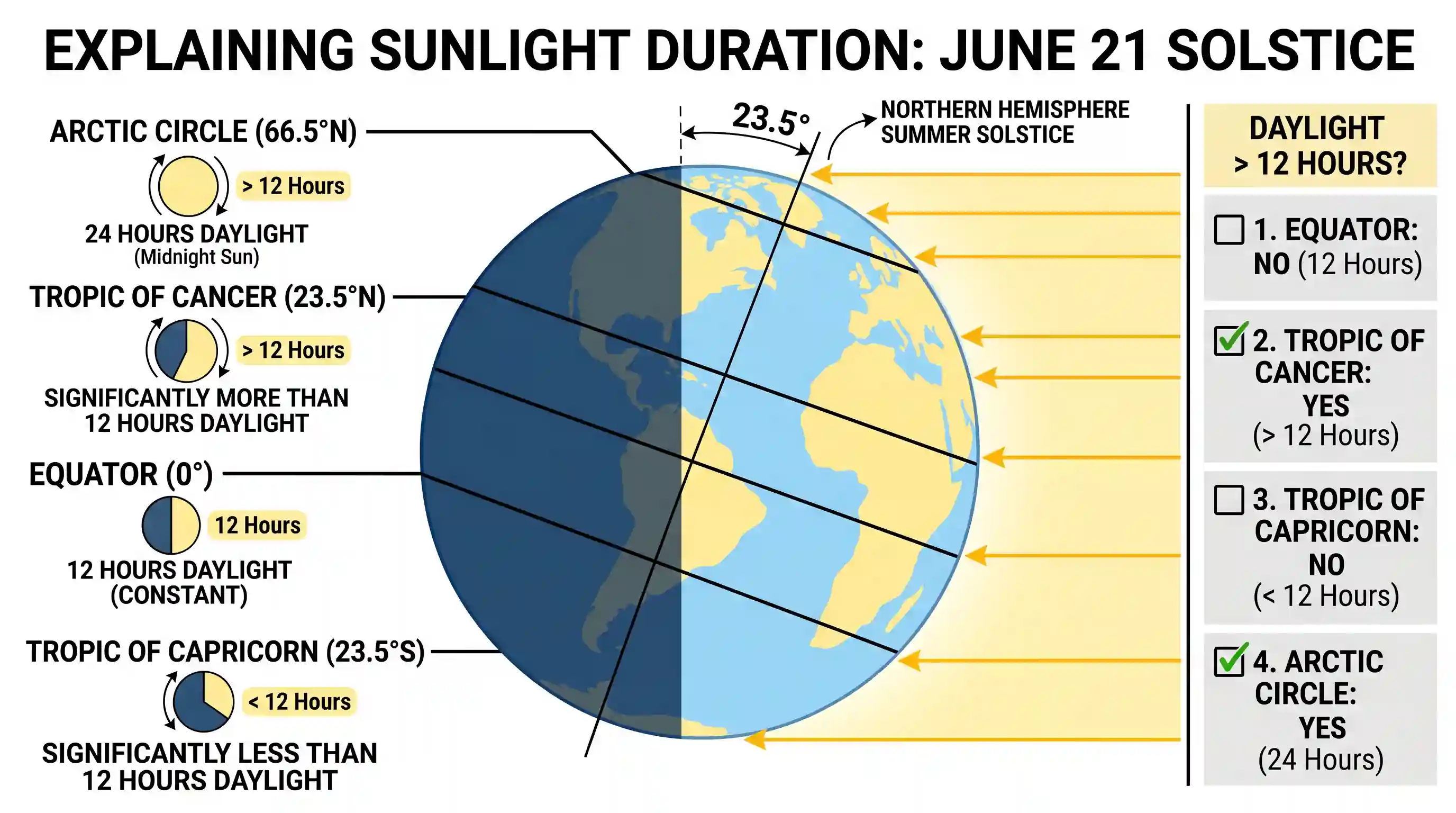
June 21 marks the Summer Solstice in the Northern Hemisphere. On this day:
-
Equator: The Equator always experiences approximately 12 hours of day and 12 hours of night throughout the year, regardless of the season or solstice. So, it does not experience more than 12 hours.
-
Tropic of Cancer: On June 21, the sun is directly overhead at the Tropic of Cancer (23.5° N). All locations in the Northern Hemisphere beyond the Equator experience increasingly longer days, reaching maximum day length at the Tropic of Cancer and further north. Thus, the Tropic of Cancer experiences significantly more than 12 hours of sunlight.
-
Tropic of Capricorn: The Tropic of Capricorn (23.5° S) is in the Southern Hemisphere. On June 21, it is winter in the Southern Hemisphere, and locations there experience their shortest days, meaning less than 12 hours of sunlight.
-
Arctic Circle: On June 21, the entire region north of the Arctic Circle (66.5° N) experiences 24 hours of daylight (the 'midnight sun'). This definitely means more than 12 hours of sunlight.
Therefore, the Tropic of Cancer and the Arctic Circle experience more than 12 hours of sunlight on June 21.
Related questions
More UPSC Prelims practice from the same subject and topic.
- Prelims 2024GS1geography
Consider the following statements: Statement-I: The atmosphere is heated more by incoming solar radiation than by terrestrial radiation. Statement-II: Carbon dioxide and other greenhouse gases in the …
- Prelims 2024GS1geography
Consider the following statements : Statement-I : Thickness of the troposphere at the equator is much greater as compared to poles. Statement-II: At the equator, heat is transported to great heights b…
- Prelims 2024GS1geography
Which of the following is/are correct inference/inferences from isothermal maps in the month of January? 1. The isotherms deviate to the north over the ocean and to the south over the continent. 2. Th…
- Prelims 2024GS1geography
With reference to "water vapour”, which of the following statements is/are correct? 1. It is a gas, the amount of which decreases with altitude. 2. Its percentage is maximum at the poles. Select the a…
- Prelims 2024GS1geography
Consider the following description : 1. Annual and daily range of temperatures is low. 2. Precipitation occurs throughout the year. 3. Precipitation varies between 50 cm 250 cm. What is this type of c…
- Prelims 2024GS1geography
With reference to "Coriolis force”, which of the following statements is/are correct? 1. It increases with increase in wind velocity. 2. It is maximum at the poles and is absent at the equator. Select…