Consider the following : 1. Cashew 2. Papaya 3. Red sanders How many of the above trees are actually native to India?

- AOnly oneCorrect
- BOnly two
- COnly three
- DNone
Explanation
Let's examine the origin of each tree:
-
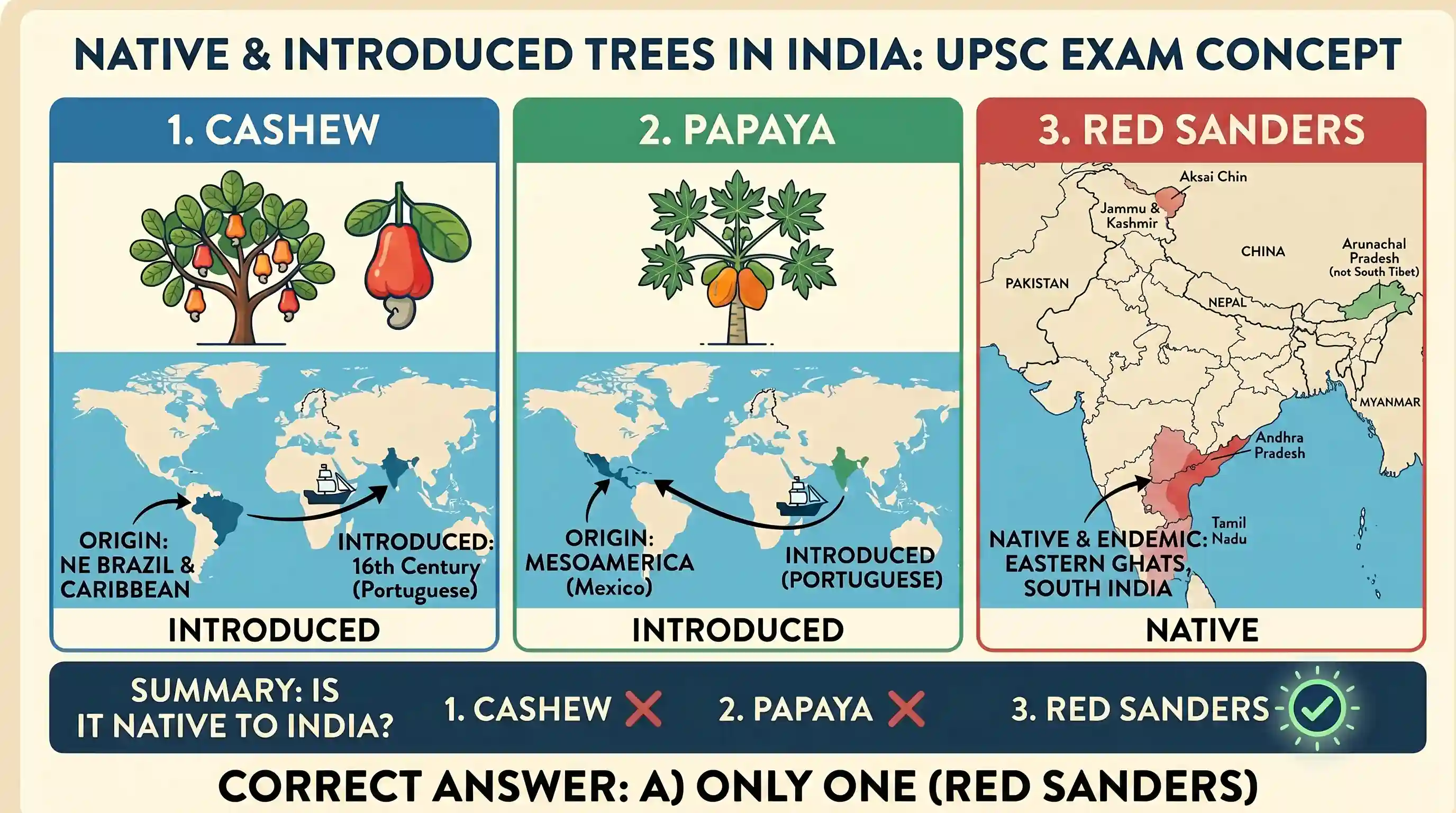
Cashew (Anacardium occidentale): The cashew tree is native to northeastern Brazil and parts of the Caribbean. It was introduced to India by the Portuguese in the 16th century, primarily to prevent soil erosion along the coast. It has since become widely cultivated in India.
-
Papaya (Carica papaya): Papaya is native to Mesoamerica (southern Mexico and Central America). It was also introduced to India, likely by the Portuguese, and is now widely cultivated in tropical and subtropical regions worldwide, including India.
-
Red Sanders (Pterocarpus santalinus): Red Sanders is indeed endemic to a small region of the Eastern Ghats in South India, specifically parts of Andhra Pradesh and Tamil Nadu. It is highly valued for its distinctive timber and medicinal properties and is a protected species due to its rarity and high demand.
Therefore, only Red Sanders is native to India among the given options.
Related questions
More UPSC Prelims practice from the same subject and topic.
- Prelims 2024GS1geography
With reference to the Himalayan rivers joining the Ganga downstream of Prayagraj from West to East, which one of the following sequences is correct? (a) Ghaghara – Gomati - Gandak – Kosi (b) Gomati - …
- Prelims 2024GS1geography
Consider the following information (Waterfall — Region — River): 1. Dhuandhar — Malwa — Narmada 2. Hundru — Chota Nagpur — Subarnarekha 3. Gersoppa — Western Ghats — Netravati In how many of the above…
- Prelims 2024GS1geography
Consider the following airports : 1. Donyi Polo Airport 2. Kushinagar International Airport 3. Vijayawada International Airport In the recent past, which of the above have been constructed as Greenfie…
- Prelims 2024GS1geography
Consider the following statements: Statement-I: The atmosphere is heated more by incoming solar radiation than by terrestrial radiation. Statement-II: Carbon dioxide and other greenhouse gases in the …
- Prelims 2024GS1geography
Consider the following statements : Statement-I : Thickness of the troposphere at the equator is much greater as compared to poles. Statement-II: At the equator, heat is transported to great heights b…
- Prelims 2024GS1geography
Consider the following: 1. Pyroclastic debris 2. Ash and dust 3. Nitrogen compounds 4. Sulphur compounds How many of the above are products of volcanic eruptions?