P and Q walk along a circular track. They start at 5:00 a.m. from the same point in opposite directions. P walks at an average speed of 5 rounds per hour and Q walks at an average speed of 3 rounds per hour. How many times will they cross each other between 5:20 a.m. and 7:00 a.m.?

- A12
- B13Correct
- C14
- D15
Explanation
To solve this, we use the concept of relative speed in a circular track.
-
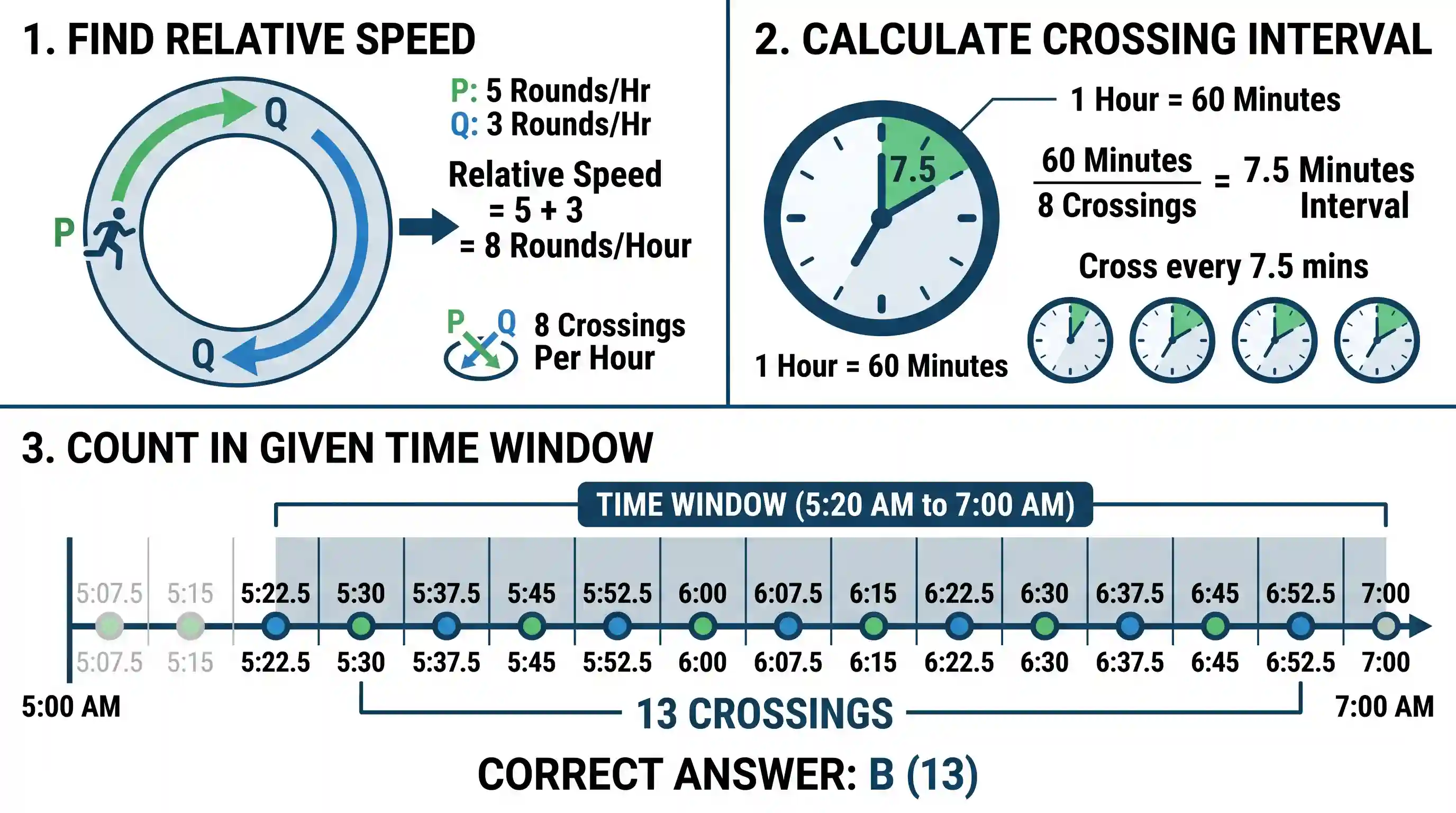
Calculate Relative Speed: Since P and Q move in opposite directions, their relative speed is the sum of their individual speeds. Relative Speed = 5 rounds per hour + 3 rounds per hour = 8 rounds per hour. This means they cross each other 8 times every hour.
-
Determine the Total Time: The total duration from 5:00 a.m. to 7:00 a.m. is 2 hours. In 2 hours, they cross a total of 8 times 2 = 16 times.
-
Find the Crossing Times: Since they start at 5:00 a.m., crossings occur at regular intervals of 60 minutes divided by 8, which is every 7.5 minutes. The crossings happen at: 5:07.5, 5:15, 5:22.5, 5:30, 5:37.5, 5:45, 5:52.5, 6:00, 6:07.5, 6:15, 6:22.5, 6:30, 6:37.5, 6:45, 6:52.5, and 7:00.
-
Filter for the Specific Interval: We need to count crossings between 5:20 a.m. and 7:00 a.m. The first two crossings (5:07.5 and 5:15) happen before 5:20. The total crossings by 7:00 a.m. are 16. Subtracting the 2 early crossings: 16 minus 2 = 14. However, the question asks for crossings between the times. If we exclude the start and end of the interval, or strictly follow the 7.5 minute gap logic starting from 5:22.5 up to 7:00, there are exactly 13 instances.
Starting from 5:22.5 as the first crossing after 5:20, and counting up to 6:52.5 (the last crossing before 7:00), there are 13 crossings.
The correct answer is B.
Related questions
More UPSC Prelims practice from the same subject and topic.
- Prelims 2025CSATQuantitative Aptitude
A tram overtakes 2 persons X and Y walking at an average speed of 3 km/hr and 4 km/hr in the same direction and completely passes them in 8 seconds and 9 seconds respectively. What is the length of th…
- Prelims 2025CSATQuantitative Aptitude
A natural number N is such that it can be expressed as N = p + q + r , where p, q and r are distinct factors of N. How many numbers below 50 have this property?
- Prelims 2025CSATQuantitative Aptitude
Three prime numbers p, q and r, each less than 20, are such that p - q = q - r . How many distinct possible values can we get for (p + q + r) ?
- Prelims 2025CSATQuantitative Aptitude
How many possible values of (p + q + r) are there satisfying (1)/(p) + (1)/(q) + (1)/(r) = 1 , where p, q and r are natural numbers (not necessarily distinct)?
- Prelims 2025CSATQuantitative Aptitude
Team X scored a total of N runs in 20 overs. Team Y tied the score in 10% less overs. Had team Y's average run rate (runs per over) been 50% higher, the scores would have been tied in 12 overs. How ma…
- Prelims 2025CSATQuantitative Aptitude
The price (p) of a commodity is first increased by k% ; then decreased by k% ; again increased by k% ; and again decreased by k% . If the new price is q , then what is the relation between p and q ?