What is X in the sequence 1, 3, 6, 11, 18, X, 42?

- A26
- B27
- C29Correct
- D30
Explanation
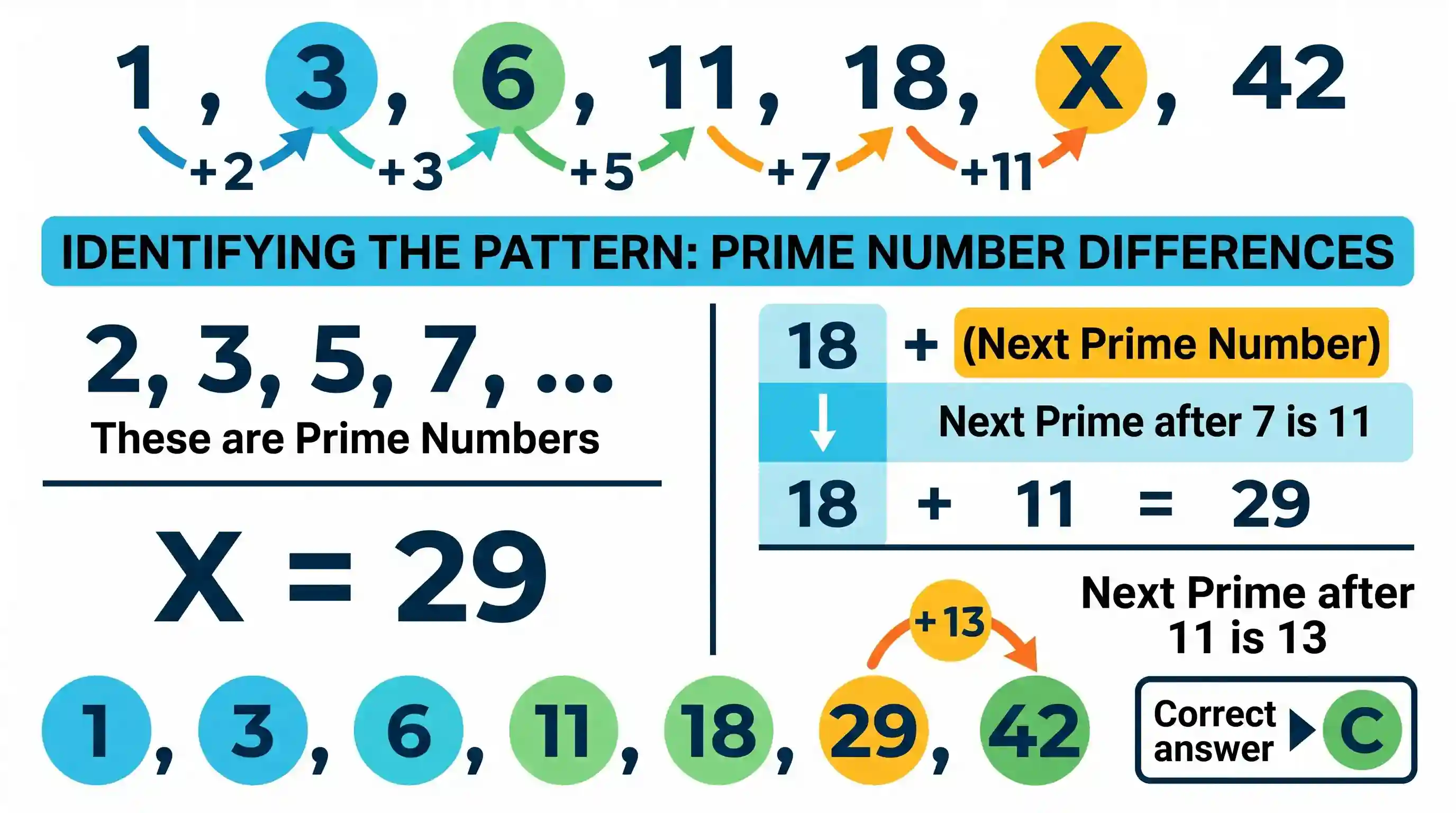
The pattern in the sequence is determined by the differences between consecutive terms.
Let's find the differences: 3 - 1 = 2 6 - 3 = 3 11 - 6 = 5 18 - 11 = 7
The differences are 2, 3, 5, 7. This is the sequence of prime numbers. Following this pattern, the next prime number after 7 is 11. So, X should be 18 + 11 = 29.
To verify, the next prime number after 11 is 13. If X is 29, then the next term should be 29 + 13 = 42. This matches the given sequence.
Therefore, X = 29.
Analyzing the options: A) 26: If X were 26, the difference from 18 would be 8, which is not a prime number in the sequence. B) 27: If X were 27, the difference from 18 would be 9, which is not a prime number in the sequence. C) 29: If X were 29, the difference from 18 would be 11, which is the next prime number in the sequence. This fits the pattern. D) 30: If X were 30, the difference from 18 would be 12, which is not a prime number in the sequence.
The final answer is C.
Related questions
More UPSC Prelims practice from the same subject and topic.
- Prelims 2025CSATLogical Reasoning
What comes at X and Y respectively in the following sequence? January, January, December, October, X, March, October, Y, September
- Prelims 2025CSATLogical Reasoning
Consider the sequence AB_CC_A_BCCC_BBC_C that follows a certain pattern. Which one of the following completes the sequence?
- Prelims 2025CSATLogical Reasoning
What is X in the sequence 24, X, 12, 18, 36, 90 ?
- Prelims 2025CSATLogical Reasoning
If 7*24 = 25 and 12*16 = 20 , then what is 16*63 equal to?
- Prelims 2025CSATLogical Reasoning
Consider the following statements: I. If A≤ B > C E > F≥ G = H ; then B is always greater than E. II. If P > Q = R≥ S = T≤ U = V > W ; then S is always less than V. Which of the statements given above…
- Prelims 2025CSATLogical Reasoning
If P = + , Q = - , R = × , S = ÷ , then insert the proper notations between the successive numbers in the equation 60\_ 15\_ 3\_ 20\_ 4 = 20 :