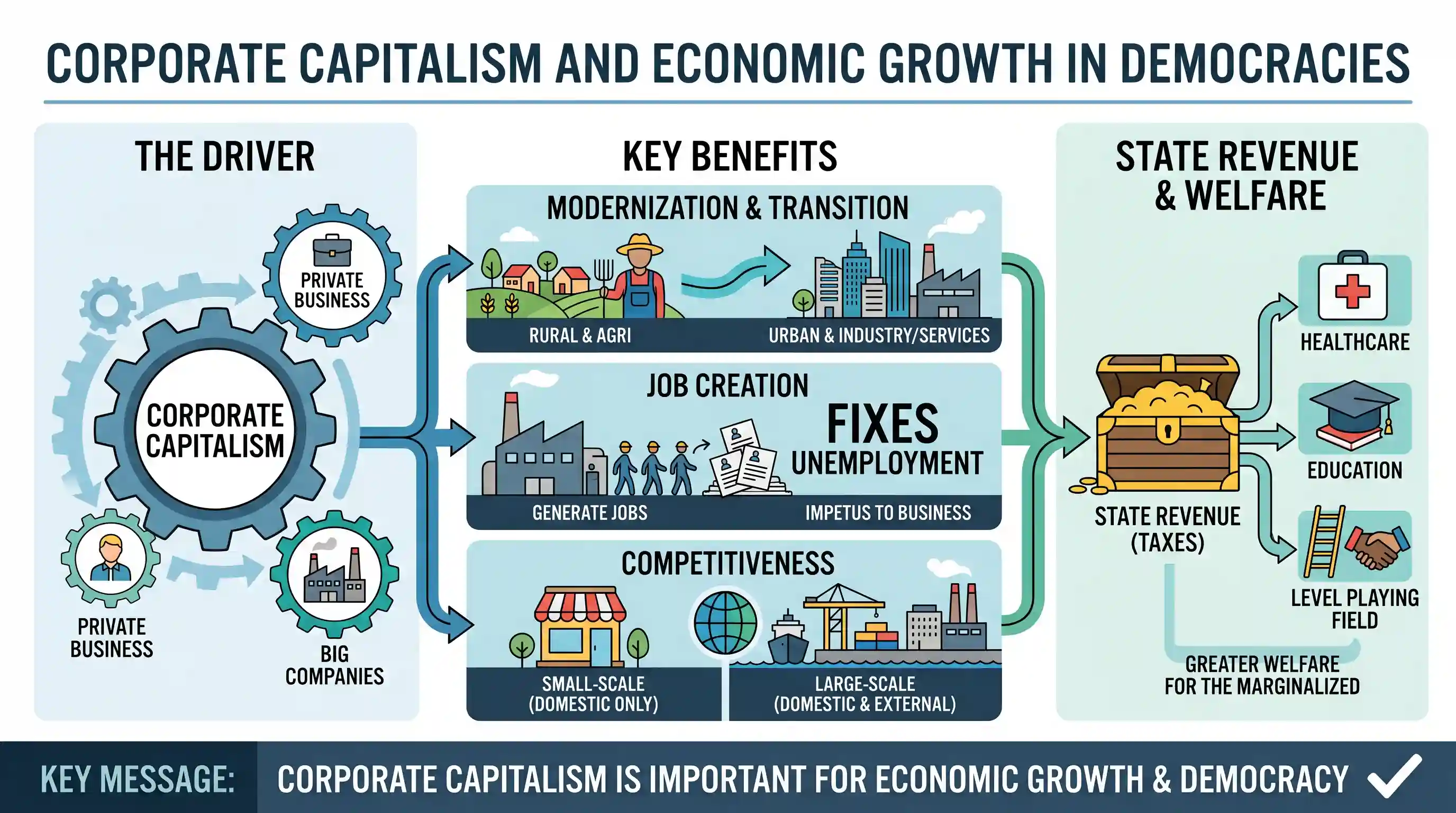
There has been no democracy that has grown economically without corporate capitalism. It helps in modernizing the economy and enabling the transition from rural to urban, and agriculture to industry and services, which are inevitable with growth. It generates jobs - and there is no other way to fix a country's unemployment challenge without a further impetus to private business. Big companies can operate on a large scale and become competitive both domestically and externally. A vibrant corporate capitalist base also leads to additional revenues for the State - which in turn, can be used for greater welfare for the marginalized and creating a more level playing field in terms of opportunities. Which one of the following statements best reflects the critical message conveyed by the author of the passage?

- ACorporate capitalism is important for economic growth of a State and also for democracy.Correct
- BCorporate capitalism is imperative for a modern State to achieve its political objectives.
- CNo State can ensure its economic survival for long without the role of corporate capitalism.
- DCorporate capitalism and democracy have mutual dependence for their continued existence.
Explanation
The critical message conveyed by the author is that corporate capitalism is essential for the economic growth of a state, particularly for democracies.
Let's analyze the options:
A) Corporate capitalism is important for economic growth of a State and also for democracy. This statement directly reflects the passage. The first sentence explicitly links democracy and economic growth to corporate capitalism ("no democracy that has grown economically without corporate corporate capitalism"). The rest of the passage details how corporate capitalism helps in modernizing the economy, creating jobs, increasing competitiveness, and generating state revenues for welfare, all contributing to economic growth. This option captures both key aspects mentioned.
B) Corporate capitalism is imperative for a modern State to achieve its political objectives. While the passage mentions that corporate capitalism can lead to revenues for "greater welfare for the marginalized" (which can be a political objective), the primary focus is on economic growth, modernization, and job creation, not all political objectives. The passage doesn't claim it's imperative for all political objectives, nor is this the central theme.
C) No State can ensure its economic survival for long without the role of corporate capitalism. The passage states "no democracy that has grown economically without corporate capitalism." This is about economic growth, not just bare economic survival. While growth implies survival, the emphasis is on advancement and prosperity, not merely avoiding collapse. The scope of "no State" is also broader than "no democracy" mentioned in the passage's strongest claim.
D) Corporate capitalism and democracy have mutual dependence for their continued existence. The passage indicates that democracies depend on corporate capitalism for economic growth. However, it does not state that corporate capitalism depends on democracy for its continued existence. The relationship is presented as one-sided in terms of economic growth for democracies, not a mutual dependence for continued existence.
Therefore, option A best reflects the critical message by encompassing both the importance of corporate capitalism for economic growth and its specific connection to democracies.
Related questions
More UPSC Prelims practice from the same subject and topic.
- Prelims 2025CSATReading Comprehension
Maintaining an ecosystem just to conserve biodiversity will affect its commercial potential as well as the livelihoods dependent on the ecosystem. There is also a conflict between using an ecosystem o…
- Prelims 2025CSATReading Comprehension
Maintaining an ecosystem just to conserve biodiversity will affect its commercial potential as well as the livelihoods dependent on the ecosystem. There is also a conflict between using an ecosystem o…
- Prelims 2025CSATReading Comprehension
]The history of renewable energy suggests there is a steep learning curve, meaning that, as more is produced, costs fall rapidly because of economies of scale and learning by doing. The firms' green i…
- Prelims 2025CSATReading Comprehension
]The history of renewable energy suggests there is a steep learning curve, meaning that, as more is produced, costs fall rapidly because of economies of scale and learning by doing. The firms' green i…
- Prelims 2025CSATReading Comprehension
Each State in India faces a distinctive set of challenges regarding the impact of warming, but also offers its own set of opportunities for reducing emissions depending on its natural resources. For e…
- Prelims 2025CSATReading Comprehension
Each State in India faces a distinctive set of challenges regarding the impact of warming, but also offers its own set of opportunities for reducing emissions depending on its natural resources. For e…