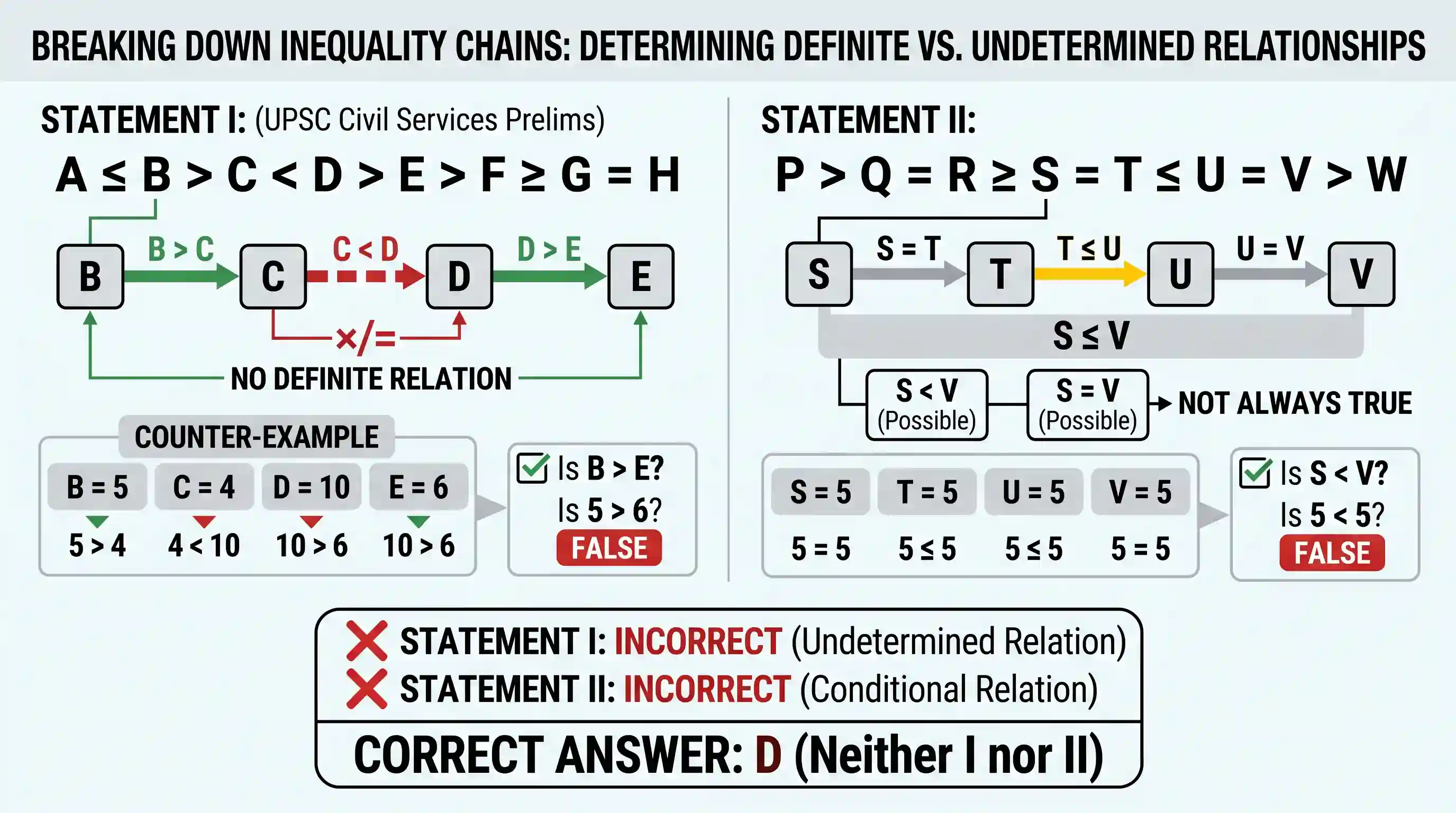
Consider the following statements: I. If A≤ B > C E > F≥ G = H ; then B is always greater than E. II. If P > Q = R≥ S = T≤ U = V > W ; then S is always less than V. Which of the statements given above is/are correct?

- AI only
- BII only
- CBoth I and II
- DNeither I nor IICorrect
Explanation
Statement I: A C E > F>= G = H ; then B is always greater than E. Let's analyze the path from B to E: B > C E. From B > C and D > E, we know B is greater than C and D is greater than E. However, the relationship between C and D is C C (5>4), CE (10>6). In this case, B (5) is not greater than E (6). Since B is not always greater than E, statement I is incorrect.
Statement II: P > Q = R>= S = T W ; then S is always less than V. Let's analyze the path from S to V: S = T<= U = V. Combining these, we get S <= V. This means S can be less than V (S < V) or S can be equal to V (S = V). For example: If S=5, T=5, U=6, V=6, then S < V (5 < 6). If S=5, T=5, U=5, V=5, then S = V (5 = 5). Since S can be equal to V, the conclusion "S is always less than V" is not always true. Therefore, statement II is incorrect.
Since both statements I and II are incorrect, the correct option is D.
The final answer is D
Related questions
More UPSC Prelims practice from the same subject and topic.
- Prelims 2025CSATLogical Reasoning
A mobile phone has been stolen. There are 3 suspects P, Q and R. They were questioned knowing that only one of them is guilty. Their responses are as follows: P: I did not steal. Q stole it. Q: R did …
- Prelims 2025CSATLogical Reasoning
A question is given followed by two 73. Statements I and II. Consider the Question and the Statements and mark the correct option. In a football match, team P playing against Q was behind by 3 goals w…
- Prelims 2025CSATLogical Reasoning
What comes at X and Y respectively in the following sequence? January, January, December, October, X, March, October, Y, September
- Prelims 2025CSATLogical Reasoning
If 7*24 = 25 and 12*16 = 20 , then what is 16*63 equal to?
- Prelims 2025CSATLogical Reasoning
Consider the sequence AB_CC_A_BCCC_BBC_C that follows a certain pattern. Which one of the following completes the sequence?
- Prelims 2025CSATLogical Reasoning
What is X in the sequence 24, X, 12, 18, 36, 90 ?