Who among the following rulers in ancient India had assumed the titles 'Mattavilasa', 'Vichitrachitta' and 'Gunabhara?

- AMahendravarman ICorrect
- BSimhavishnu
- CNarasimhavarman I
- DSimhavarman
Explanation
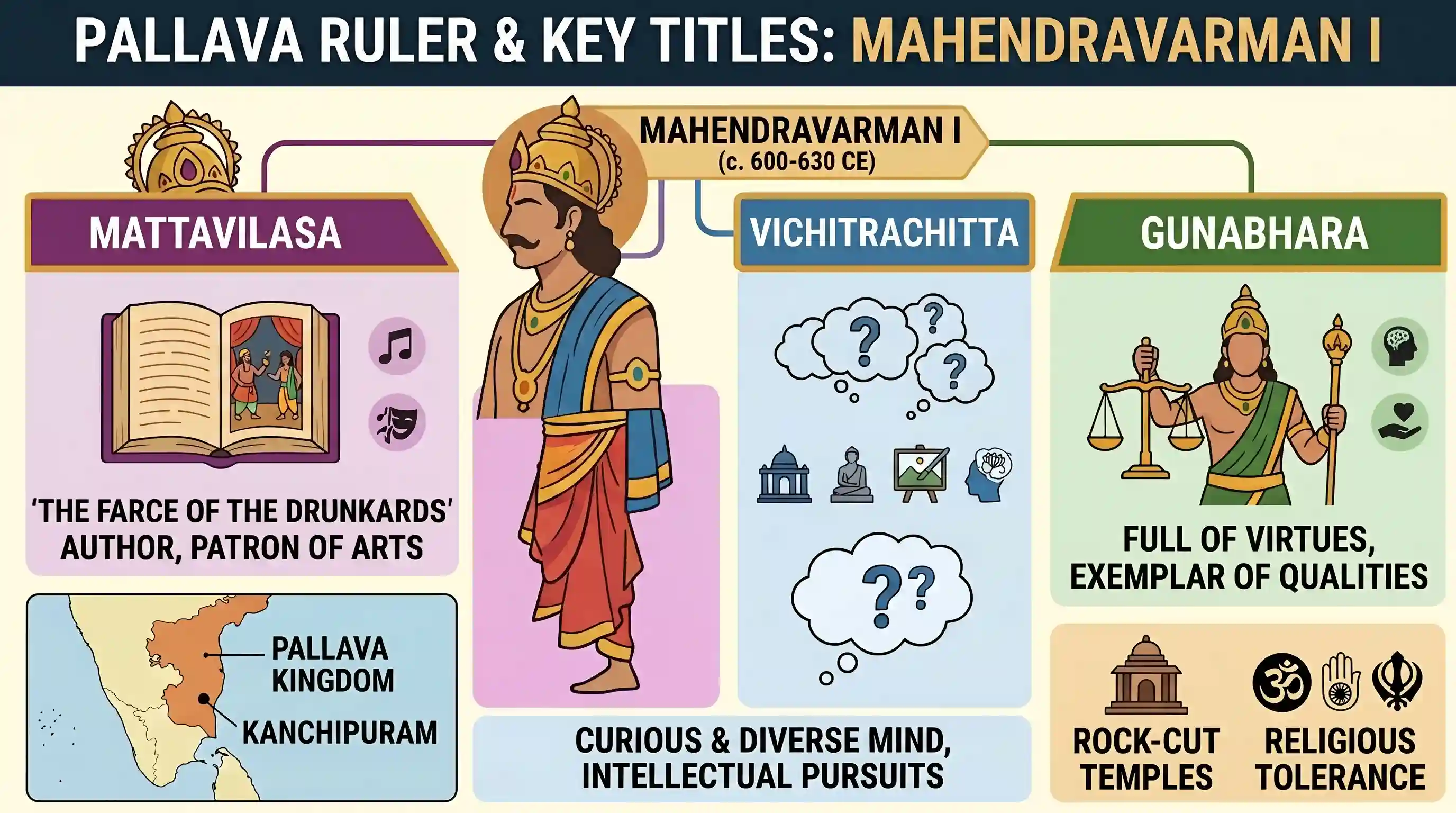
Mahendravarman I, the Pallava ruler (ruled c. 600-630 CE), had assumed the titles 'Mattavilasa', 'Vichitrachitta', and 'Gunabhara'.
Mattavilasa: This title reflects his patronage of arts and possibly his authorship of the Sanskrit play 'Mattavilasa Prahasana' (The Farce of the Drunkards).
Vichitrachitta: Meaning 'one with a curious mind' or 'having various thoughts', indicating his intellectual pursuits and artistic interests.
Gunabhara: Meaning 'one who is full of virtues', reflecting his qualities as a ruler.
Mahendravarman I was known for his literary accomplishments, architectural innovations (rock-cut temples), and religious tolerance, making him one of the most cultured rulers of ancient India.
Related questions
More UPSC Prelims practice from the same subject and topic.
- Prelims 2025GS1history
The irrigation device called 'Araghatta' was
- Prelims 2025GS1history
Fa-hien (Faxian), the Chinese pilgrim, travelled to India during the reign of
- Prelims 2025GS1history
Who among the following led a successful military campaign against the kingdom of Srivijaya, the powerful maritime State, which ruled the Malay Peninsula, Sumatra, Java and the neighbouring islands?
- Prelims 2025GS1history
With reference to ancient India (600-322 BC), consider the following pairs: Territorial region River flowing in the region I. Asmaka : Godavari II. Kamboja : Vipas III. Avanti : Mahanadi IV. Kosala : …
- Prelims 2025GS1history
Ashokan inscriptions suggest that the 'Pradeshika', 'Rajuka' and 'Yukta' were important officers at the
- Prelims 2025GS1history
The famous female figurine known as 'Dancing Girl', found at Mohenjo-daro, is made of