Fa-hien (Faxian), the Chinese pilgrim, travelled to India during the reign of

- ASamudragupta
- BChandragupta IICorrect
- CKumaragupta I
- DSkandagupta
Explanation
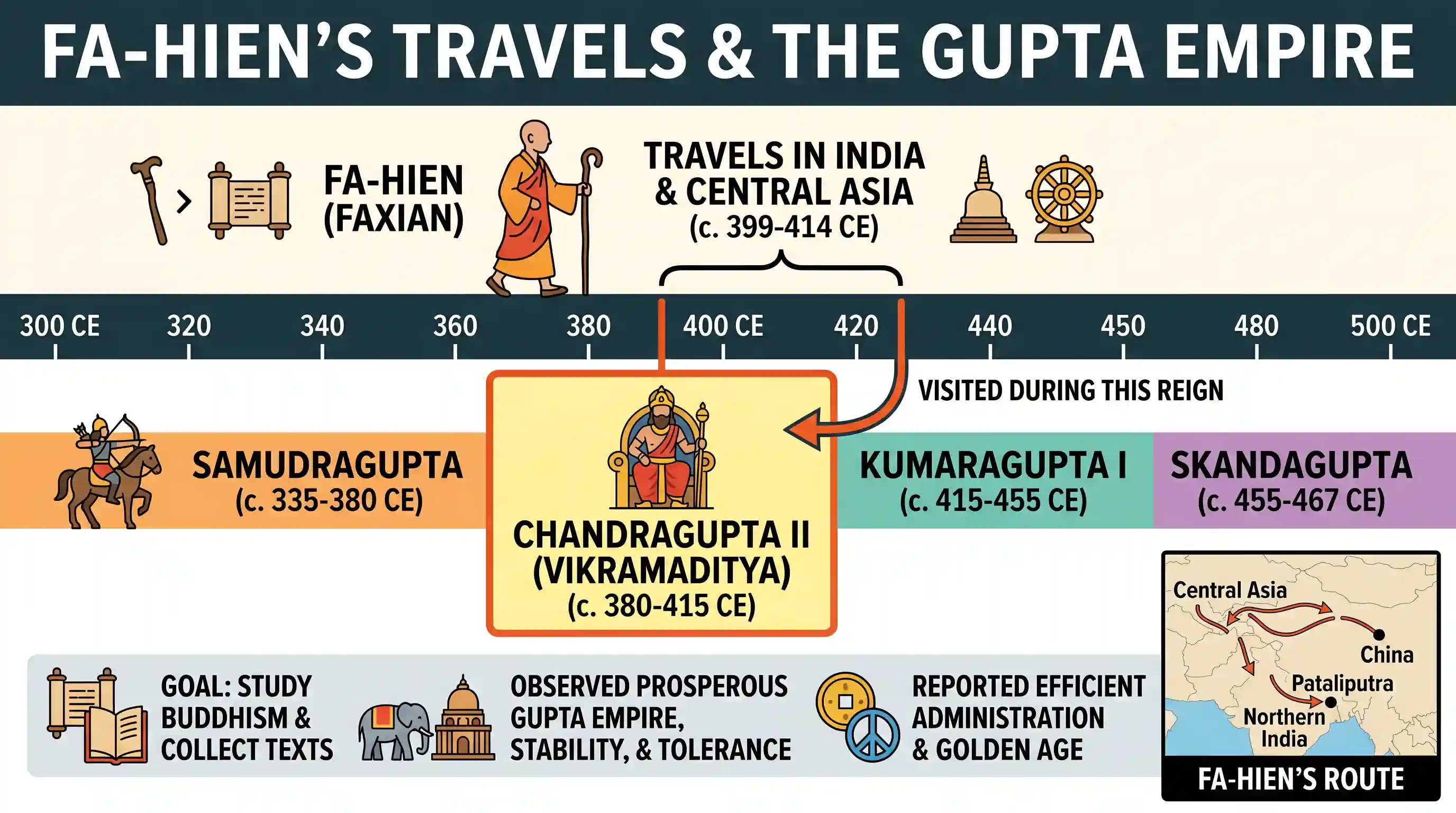
Fa-hien (Faxian), the Chinese Buddhist pilgrim, traveled to India during the reign of Chandragupta II (ruled c. 380-415 CE), also known as Chandragupta Vikramaditya.
Fa-hien visited India between 399-414 CE to study Buddhism and collect Buddhist texts. His account provides valuable insights into the Gupta period, describing a prosperous and well-administered empire with religious tolerance and cultural flourishing.
During Chandragupta II's reign, the Gupta Empire reached its zenith in terms of territorial extent, economic prosperity, and cultural achievements. Fa-hien's writings particularly praised the efficiency of administration, the absence of harsh punishments, and the general prosperity of the people during this 'Golden Age' of Indian history.
Related questions
More UPSC Prelims practice from the same subject and topic.
- Prelims 2025GS1history
The irrigation device called 'Araghatta' was
- Prelims 2025GS1history
Who among the following rulers in ancient India had assumed the titles 'Mattavilasa', 'Vichitrachitta' and 'Gunabhara?
- Prelims 2025GS1history
Who among the following led a successful military campaign against the kingdom of Srivijaya, the powerful maritime State, which ruled the Malay Peninsula, Sumatra, Java and the neighbouring islands?
- Prelims 2025GS1history
With reference to ancient India (600-322 BC), consider the following pairs: Territorial region River flowing in the region I. Asmaka : Godavari II. Kamboja : Vipas III. Avanti : Mahanadi IV. Kosala : …
- Prelims 2025GS1history
Ashokan inscriptions suggest that the 'Pradeshika', 'Rajuka' and 'Yukta' were important officers at the
- Prelims 2025GS1history
The famous female figurine known as 'Dancing Girl', found at Mohenjo-daro, is made of