Consider the following statements : Statement I: In the context of effect of water on rocks, chalk is known as a very permeable rock whereas clay is known as quite an impermeable or least permeable rock. Statement II : Chalk is porous and hence can absorb water. Statement III : Clay is not at all porous. Which one of the following is correct in respect of the above statements?

- ABoth Statement II and Statement III are correct and both of them explain Statement I
- BBoth Statement II and Statement III are correct but only one of them explains Statement I
- COnly one of the Statements II and III is correct and that explains Statement ICorrect
- DNeither Statement II nor Statement III is correct
Explanation
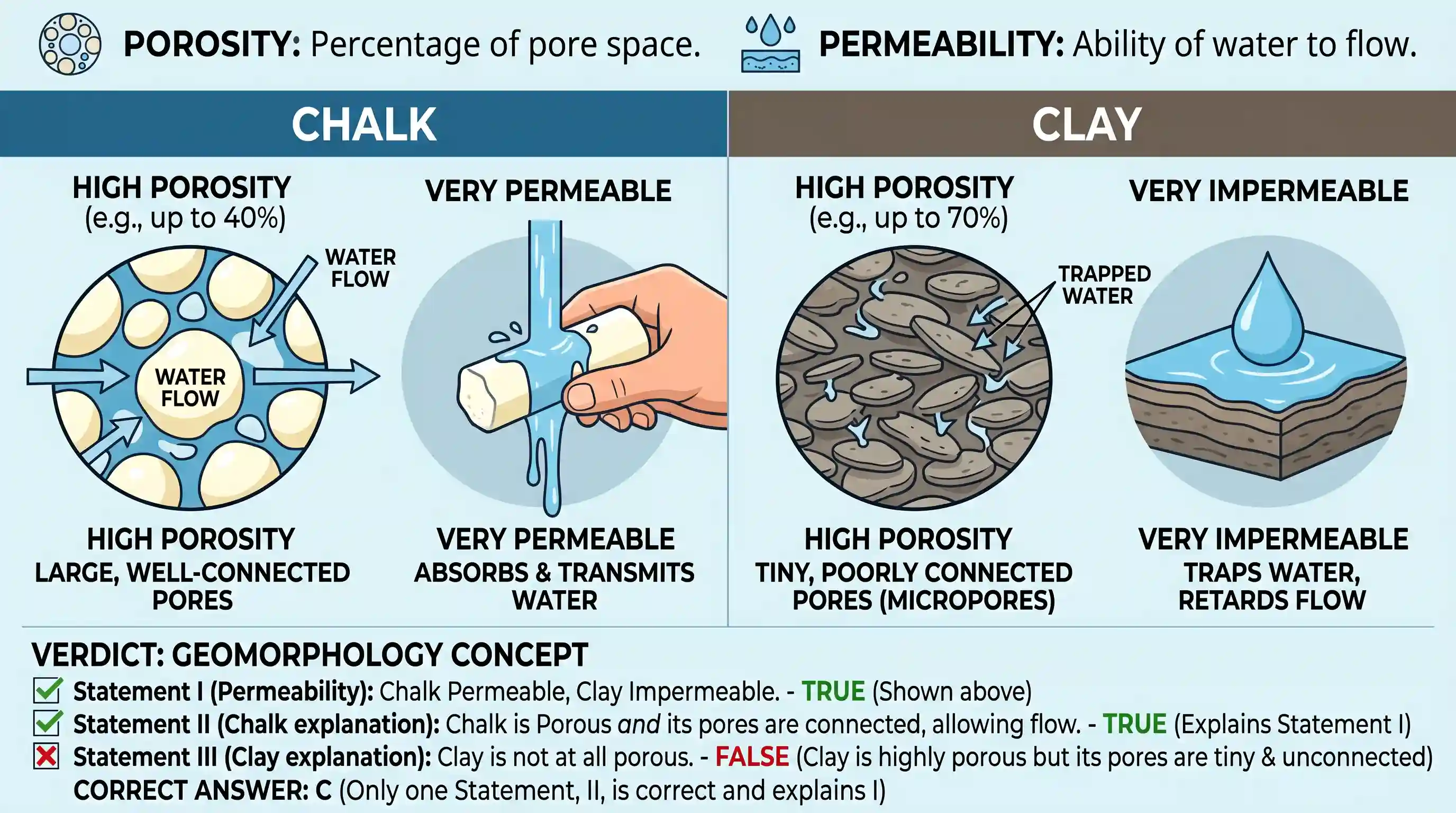
Statement I: Correct. Chalk is indeed very permeable (allows water to pass through) while clay is quite impermeable (prevents water movement).
Statement II: Correct and explains Statement I. Chalk is porous with numerous interconnected pore spaces that allow water absorption and movement, making it highly permeable despite being a solid rock.
Statement III: Incorrect. Clay is actually quite porous, but its pores are extremely small (micropores) and poorly connected, which prevents water movement. It's the size and connectivity of pores, not the absence of porosity, that makes clay impermeable.
Only Statement II correctly explains the permeability difference, as chalk's effective porosity allows water flow while clay's microporous structure restricts it.
Related questions
More UPSC Prelims practice from the same subject and topic.
- Prelims 2025GS1geography
Which of the following are the evidences of the phenomenon of continental drift? I. The belt of ancient rocks from Brazil coast matches with those from Western Africa. II. The gold deposits of Ghana a…
- Prelims 2025GS1geography
Consider the following statements : Statement I: Circular economy reduces the emissions of greenhouse gases. Statement II: Circular economy reduces the use of raw materials as inputs. Statement III : …
- Prelims 2025GS1geography
Consider the following countries : I. Bolivia II. Brazil III. Colombia IV. Ecuador V. Paraguay VI. Venezuela Andes mountains pass through how many of the above countries?
- Prelims 2025GS1geography
Consider the following water bodies : I. Lake Tanganyika II. Lake Tonlé Sap III. Patos Lagoon Through how many of them does the equator pass?
- Prelims 2025GS1geography
Consider the following statements : Statement I: The amount of dust particles in the atmosphere is more in subtropical and temperate areas than in equatorial and polar regions. Statement II: Subtropic…
- Prelims 2025GS1geography
Consider the following statements : Statement I: In January, in the Northern Hemisphere, the isotherms bend equatorward while crossing the landmasses, and poleward while crossing the oceans. Statement…