Which of the following benefits are likely to accrue to India from the World Trade Organisation? I. India’s share in the world trade is to go up from the present 600 million US dollars to 5 billion US dollars by 2000 A.D. II. It will help boost exports of agricultural commodities from India. III. India’s share in the world trade is likely to triple by the year 2000 A.D. Select the correct answer using the codes given below: Codes:

- AI, II and III
- BI and II
- CI and III
- DII and IIICorrect
Explanation
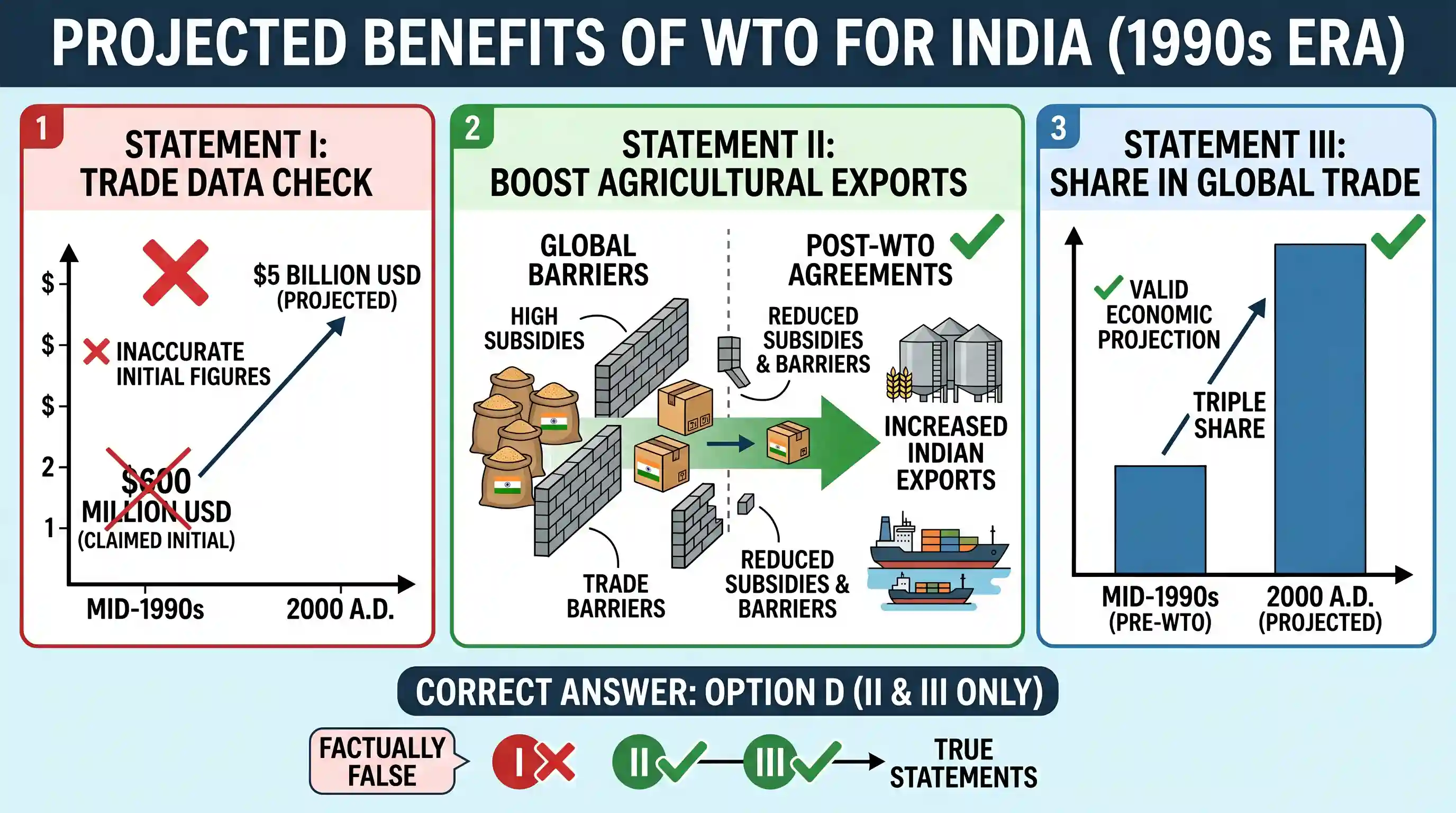
The correct option is D because statement I is factually incorrect while statements II and III represent the projected benefits of the WTO regime for India during the 1990s.
Regarding statement I, the figures provided are inaccurate. At the time this question was framed, Indias annual exports were already significantly higher than 600 million dollars, making the projection unrealistic.
Regarding statement II, the WTO agreement on agriculture aimed to reduce trade barriers and subsidies in developed nations. This was expected to make Indian agricultural products more competitive in the global market, thereby boosting exports.
Regarding statement III, it was a common economic projection during the post 1991 liberalization era that with the implementation of WTO norms and the phasing out of the Multi Fibre Agreement, Indias share in world trade would grow rapidly and potentially triple by the turn of the century.
Since statement I is false and statements II and III are valid economic expectations of that period, option D is the correct choice.
Related questions
More UPSC Prelims practice from the same subject and topic.
- Prelims 1995GS1economy
Which of the following pairs are correctly matched? I. Increase in foreign exchange reserves Monetary expansion II. Low import growth rate in India Recession in Indian Industry III. Euro issues Shares…
- Prelims 1995GS1economy
To prevent recurrence of scams in Indian Capital Market, the Government of India has assigned regulatory powers to
- Prelims 1995GS1economy
Which one of the following Five-Year Plans recognised human development as the core of all developmental efforts?
- Prelims 1995GS1economy
Which of the following are the objectives of the Commission for Agricultural Costs and Prices (CACP)? I. To stabilise agricultural prices. II. To ensure meaningful real income levels to the farmers. I…
- Prelims 1995GS1economy
As part of the liberalisation programme and with a view to attracting foreign exchange, the Government and the RBI have devised two schemes known as FCNR-’A’ and FCNR-’B’. Which of the following is/ar…
- Prelims 1995GS1economy
Which of the following are among the non-plan expenditures of the Government of India? I. Defence expenditure II. Subsidies III. All expenditures linked with the previous plan periods IV. Interest pay…