Which of the following pairs are correctly matched? I. Increase in foreign exchange reserves Monetary expansion II. Low import growth rate in India Recession in Indian Industry III. Euro issues Shares held by Indian companies in European countries IV. Portfolio investment Foreign institutional investors Select the correct answer by using the following codes: Codes:

- AI, II and IVCorrect
- BIII and IV
- CI, II and III
- DI, II, III and IV
Explanation
Explanation of why Option A is correct:
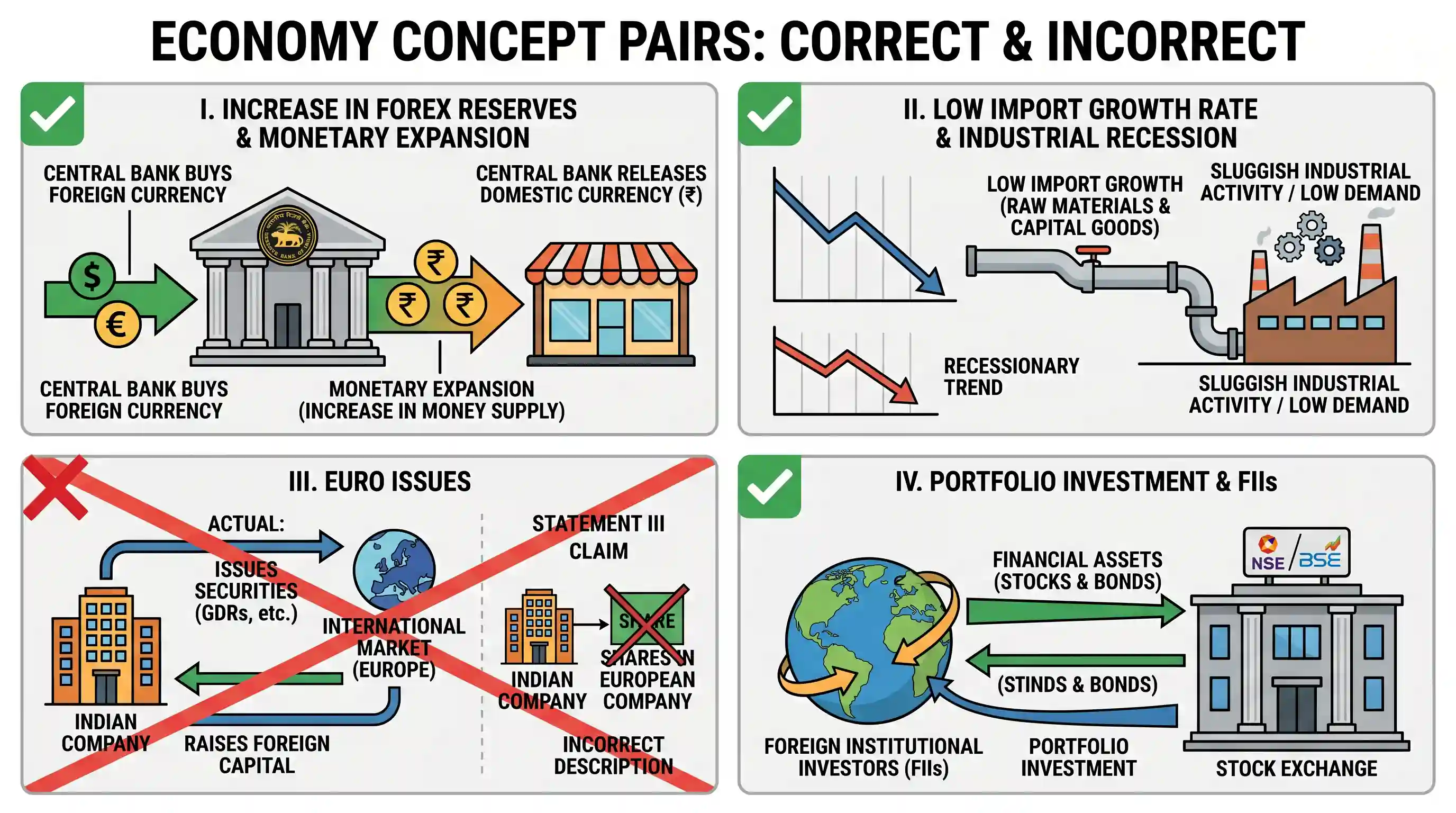
Statement I is correct because when foreign exchange reserves increase, the central bank buys foreign currency and releases equivalent domestic currency into the economy, leading to monetary expansion.
Statement II is correct because a significant portion of Indian imports consists of raw materials and capital goods. A low import growth rate often indicates sluggish manufacturing activity and low demand, which are signs of a recession in industry.
Statement III is incorrect because Euro issues refer to securities like Global Depository Receipts issued by Indian companies in the international market to raise foreign capital. They are not shares held by Indian companies in European countries.
Statement IV is correct because investments by Foreign Institutional Investors in the Indian stock market are a primary component of portfolio investment.
Since statements I, II, and IV are correct, Option A is the right answer.
Related questions
More UPSC Prelims practice from the same subject and topic.
- Prelims 1995GS1economy
Which of the following benefits are likely to accrue to India from the World Trade Organisation? I. India’s share in the world trade is to go up from the present 600 million US dollars to 5 billion US…
- Prelims 1995GS1economy
To prevent recurrence of scams in Indian Capital Market, the Government of India has assigned regulatory powers to
- Prelims 1995GS1economy
Which one of the following Five-Year Plans recognised human development as the core of all developmental efforts?
- Prelims 1995GS1economy
Which of the following are the objectives of the Commission for Agricultural Costs and Prices (CACP)? I. To stabilise agricultural prices. II. To ensure meaningful real income levels to the farmers. I…
- Prelims 1995GS1economy
As part of the liberalisation programme and with a view to attracting foreign exchange, the Government and the RBI have devised two schemes known as FCNR-’A’ and FCNR-’B’. Which of the following is/ar…
- Prelims 1995GS1economy
Which of the following are among the non-plan expenditures of the Government of India? I. Defence expenditure II. Subsidies III. All expenditures linked with the previous plan periods IV. Interest pay…