Examine the following statements: I watch TV only if I am bored. I am never bored when I have my brother’s company. Whenever I go to the theatre, I take my brother along. Which one of the following conclusions is valid in the context of the above statements?

- AIf I am bored, I watch TV
- BIf I am bored, I seek my brother’s company
- CIf I am not with my brother, then I watch TV
- DIf I am not bored, I do not watch TVCorrect
Explanation
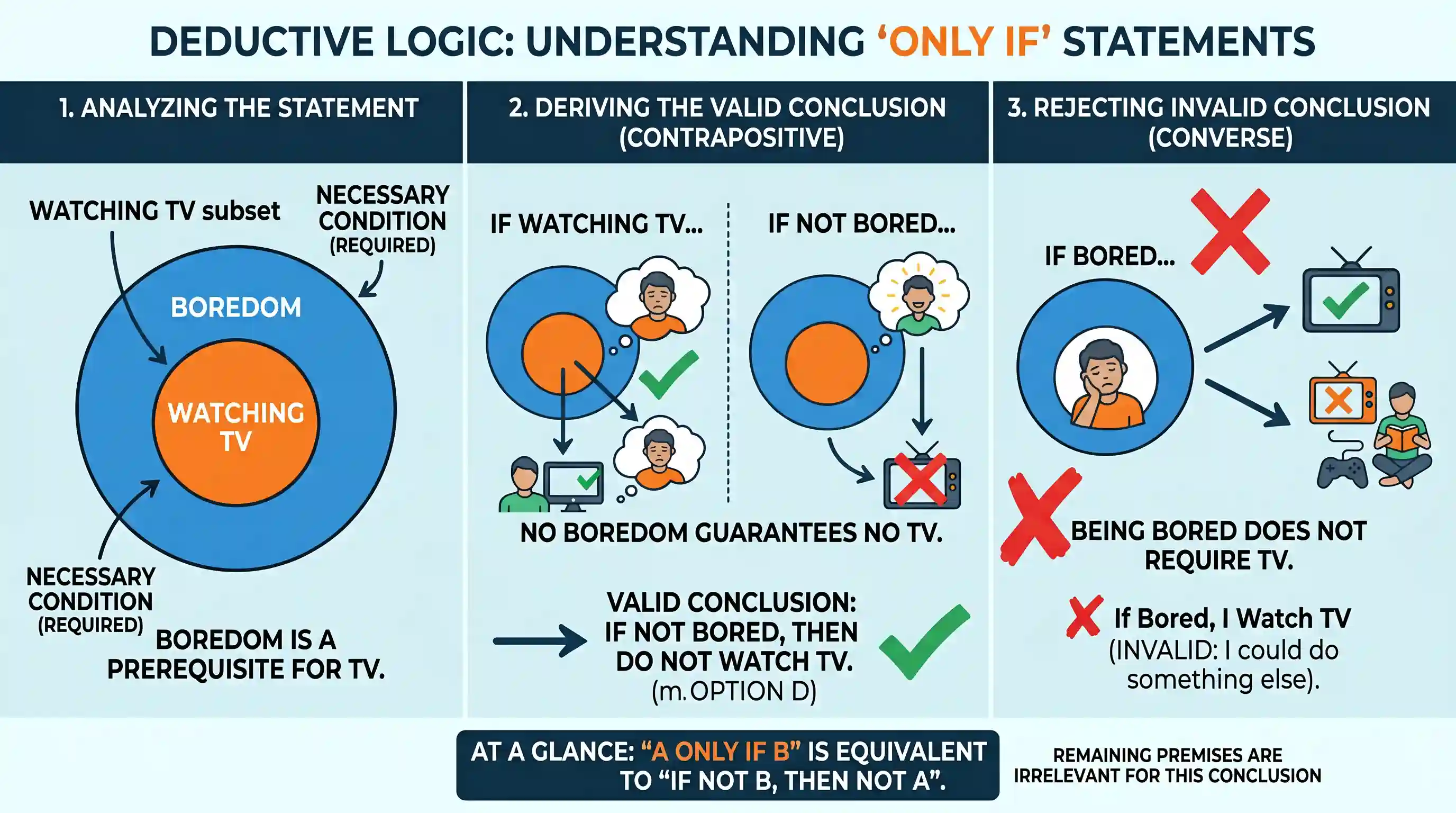
To solve this logic based question, we must analyze the first statement: I watch TV only if I am bored.
In formal logic, the phrase only if introduces a necessary condition. This means that being bored is a requirement for watching TV. If the requirement of being bored is not met, then the action of watching TV cannot occur.
Therefore, if I am not bored, I do not watch TV. This makes Option D the only valid conclusion.
Option A is incorrect because being bored does not force me to watch TV; it just means I only do it when I am bored. Options B and C introduce assumptions about seeking company or watching TV that are not strictly supported by the logical structure of the given premises.
Related questions
More UPSC Prelims practice from the same subject and topic.
- Prelims 1995GS1polity-and-governance
In which one of the following States of India it is legal for a Hindu male and illegal for a Muslim male to have more than one living wife?
- Prelims 1995GS1polity-and-governance
Which one of the following is not explicitly stated in the Constitution of India but followed as a convention?
- Prelims 1995GS1polity-and-governance
Which of the following are the States in which the Lok Ayukta Act includes the Chief Minister in its ambit?
- Prelims 1995GS1polity-and-governance
Which one of the following is incorrect in respect of Local Government in India?
- Prelims 1995GS1polity-and-governance
Seven men, A, B, C, D, E, F and G are standing in a queue in that order. Each one is wearing a cap of a different colour like violet, indigo, blue, green, yellow, orange and red. D is able to see in f…
- Prelims 1995GS1polity-and-governance
Consider the table given below providing some details of the results of the election to the Karnataka State Legislative: Assembly held in December, 1994. In terms of electoral analysis, the voter seat…