Which one of the following is not explicitly stated in the Constitution of India but followed as a convention?

- AThe finance minister is to be a Member of the Lower House
- BThe Prime Minister has to resign if he loses majority in the Lower House
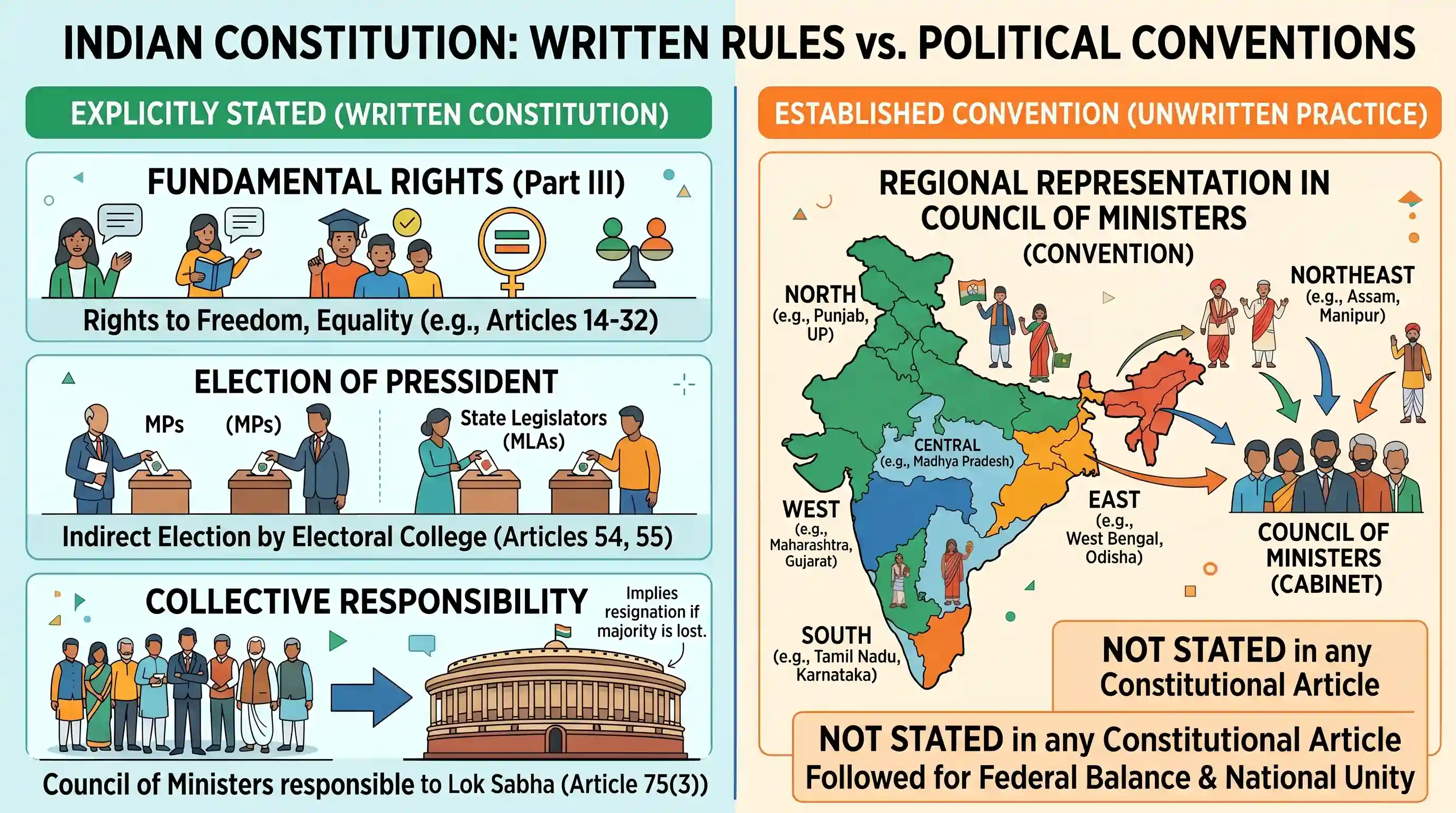
- CAll the parts of India are to be represented in the Council of MinistersCorrect
- DIn the event of both the President and the Vice-president demitting office simultaneously before the end of their tenure the Speaker of the Lower House of the Parliament will officiate as the President
Explanation
The correct answer is C because the Constitution of India does not mandate that every state or region must have representation in the Council of Ministers. There is no specific article requiring a geographical balance in the cabinet. However, it is followed as a long standing political convention to ensure that different parts of the country are represented to maintain federal balance and national integration.
Regarding the other options: Option A is incorrect because a Finance Minister can be a member of either the Lok Sabha or the Rajya Sabha. Option B is technically incorrect in this context because Article 75 states that the Council of Ministers is collectively responsible to the Lok Sabha, which implies the Prime Minister must resign if majority is lost. Option D is incorrect because according to the President Discharge of Functions Act 1969, the Chief Justice of India officiates as President in such a scenario, not the Speaker.
Related questions
More UPSC Prelims practice from the same subject and topic.
- Prelims 1995GS1polity-and-governance
In which one of the following States of India it is legal for a Hindu male and illegal for a Muslim male to have more than one living wife?
- Prelims 1995GS1polity-and-governance
Which of the following are the States in which the Lok Ayukta Act includes the Chief Minister in its ambit?
- Prelims 1995GS1polity-and-governance
Which one of the following is incorrect in respect of Local Government in India?
- Prelims 1995GS1polity-and-governance
Examine the following statements: I watch TV only if I am bored. I am never bored when I have my brother’s company. Whenever I go to the theatre, I take my brother along. Which one of the following co…
- Prelims 1995GS1polity-and-governance
Seven men, A, B, C, D, E, F and G are standing in a queue in that order. Each one is wearing a cap of a different colour like violet, indigo, blue, green, yellow, orange and red. D is able to see in f…
- Prelims 1995GS1polity-and-governance
Consider the table given below providing some details of the results of the election to the Karnataka State Legislative: Assembly held in December, 1994. In terms of electoral analysis, the voter seat…