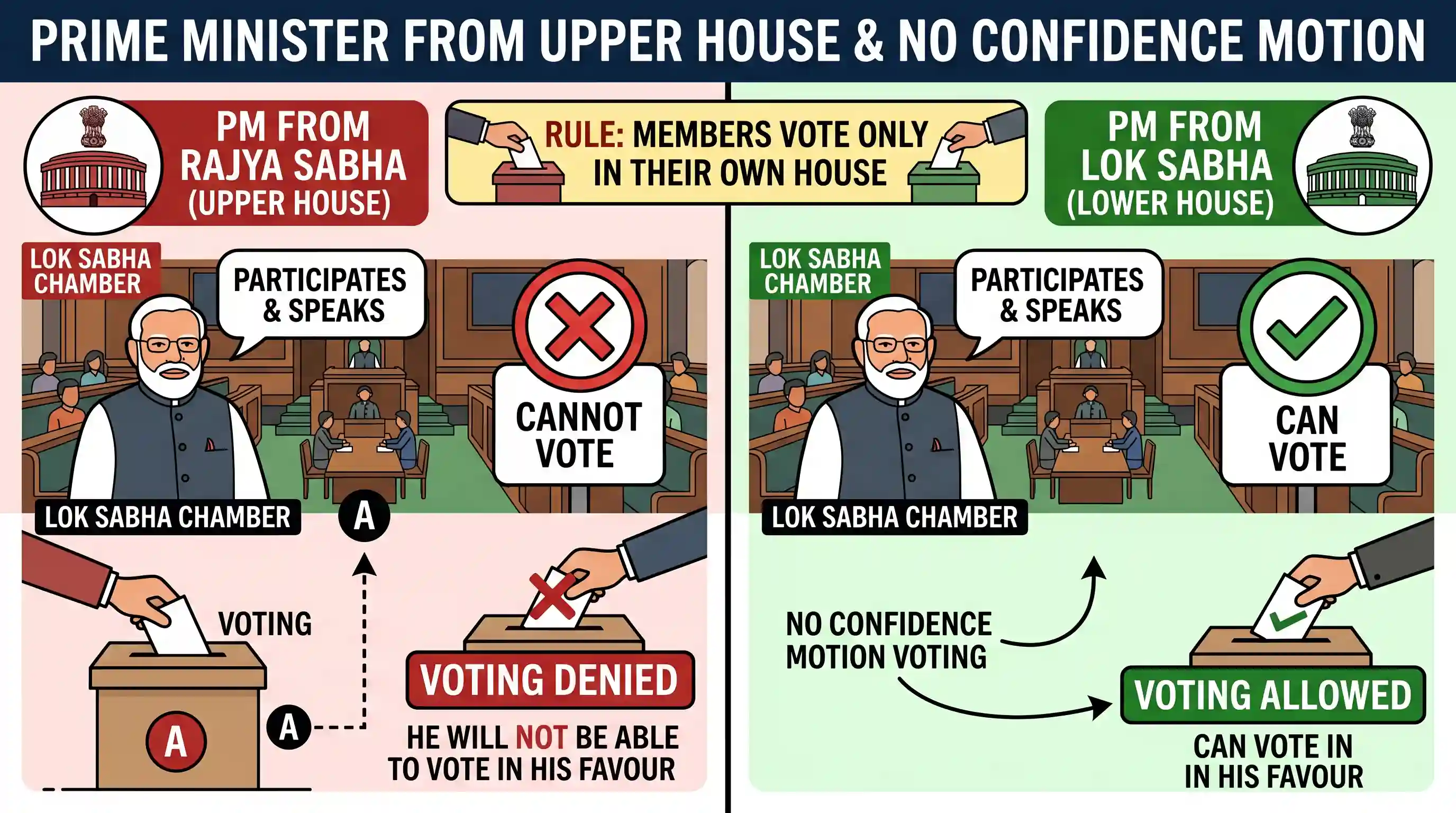
If the Prime Minister of India belonged to the Upper House of Parliament

- Ahe will not be able to vote in his favour in the event of a no confidence motionCorrect
- Bhe will not be able to speak on the Budget in the Lower House
- Che can make statements only on the Upper House
- Dhe has to become a member of the Lower House within six months after being sworn in as the Prime Minister
Explanation
The correct answer is A because a No Confidence Motion can only be introduced and voted upon in the Lok Sabha or the Lower House. According to parliamentary rules, a member of Parliament can only vote in the House to which they belong. Therefore, if the Prime Minister is a member of the Rajya Sabha or the Upper House, they can participate in the proceedings of the Lok Sabha but do not have the right to vote there. Consequently, they would be unable to cast a vote in their own favor during a No Confidence Motion.
Regarding the other options, a Prime Minister from the Upper House can still speak on the Budget in the Lower House, can make statements in both Houses, and is not required to move to the Lower House as long as they remain a member of either House of Parliament.
Related questions
More UPSC Prelims practice from the same subject and topic.
- Prelims 1997GS1polity-and-governance
In which of the following countries will the no confidence motion to bring down the government passed by the legislature be valid only when the legislature is able to find simultaneously a majority to…
- Prelims 1997GS1polity-and-governance
Which one of the following was NOT proposed by the 73rd Constitutional Amendment in the area of Panchayati Raj?
- Prelims 1997GS1polity-and-governance
Which one of the following States of India has passed a legislation (in 1996) making the maintenance of one’s parents mandatory?
- Prelims 1997GS1polity-and-governance
Proportional representation is NOT necessary in a country where
- Prelims 1997GS1polity-and-governance
The Prime Minister of which one of the following countries is chosen by the ruling prince from a slate of three candidates put up to him by the President of France?
- Prelims 1997GS1polity-and-governance
The Basque separatist organisation is active in