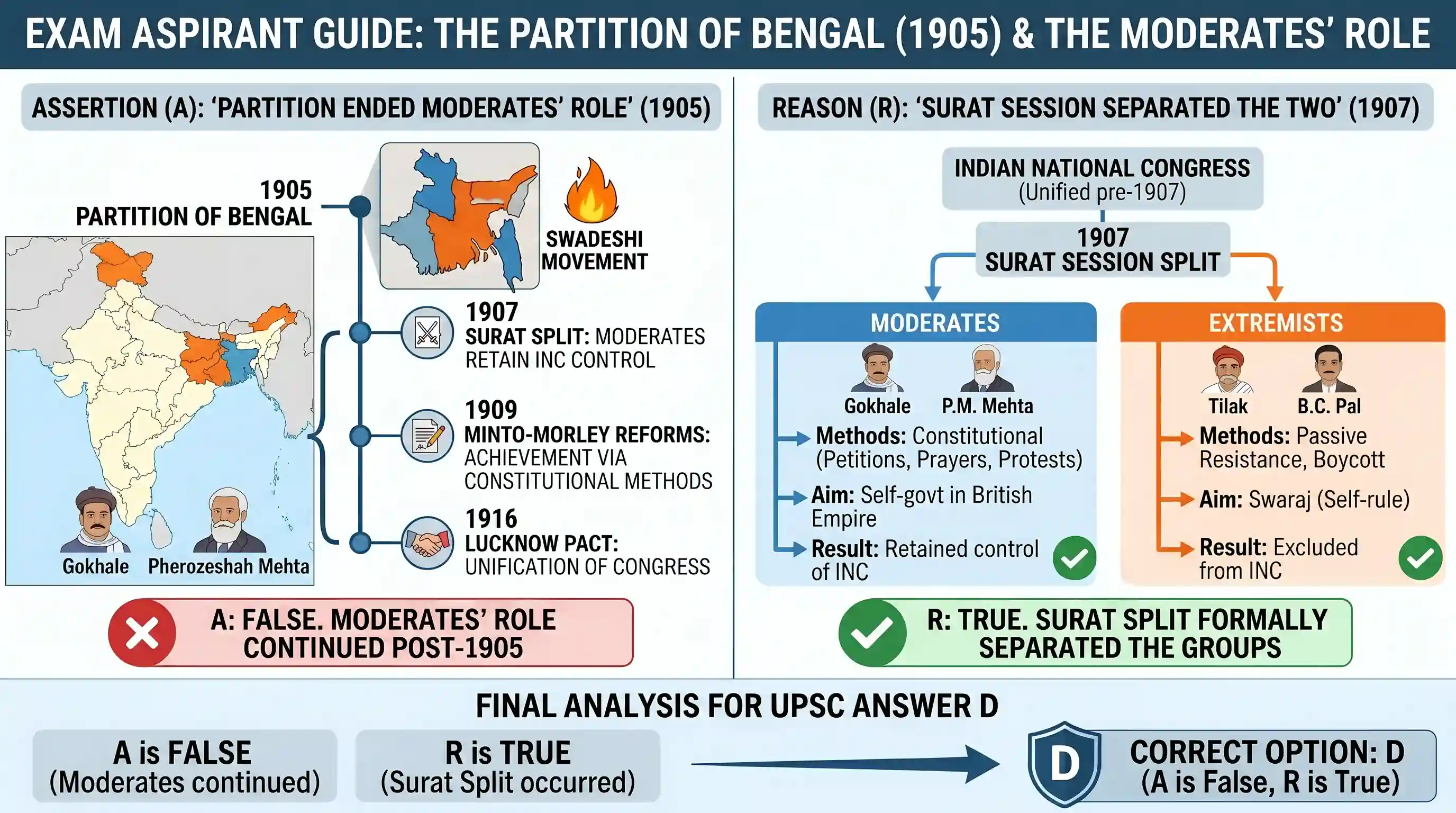
Assertion (A): Partition of Bengal in 1905 brought to an end the Moderates’ role in the Indian freedom movement. Reason (R): The Surat session of Indian National Congress separated the Extremists from the Moderates.

- ABoth A and R are true, and R is the correct explanation of A
- BBoth A and R are true, but R is NOT a correct explanation of A
- CA is true, but R is false
- DA is false, but R is trueCorrect
Explanation
The correct answer is D because Assertion A is false and Reason R is true.
Assertion A is false because the Partition of Bengal did not end the role of the Moderates. While it led to the rise of Extremist influence and the Swadeshi Movement, the Moderates remained active in the Indian National Congress and even regained full control of the organization after the 1907 split until the Lucknow Pact of 1916. Their influence declined gradually, but it did not end in 1905.
Reason R is true because the Surat session of the Indian National Congress in 1907 did indeed result in a formal split between the Extremists, led by Tilak, and the Moderates, led by Gokhale and Pherozeshah Mehta.
Since the assertion is incorrect and the reason is a factual historical statement, the only valid option is D.
Related questions
More UPSC Prelims practice from the same subject and topic.
- Prelims 1998GS1history
The educated middle class in India
- Prelims 1998GS1history
Lord Mountbatten came to India as Viceroy along with specific instructions to
- Prelims 1998GS1history
Assertion (A): The Khilafat movement did bring the urban Muslims into the fold of the National Movement. Reason (R): There was a predominant element of anti-imperialism in both the National and Khilaf…
- Prelims 1998GS1history
Assertion (A): The first ever Bill to make primary education compulsory in India was rejected in 1911. Reason (R): Discontent would have increased if every cultivator could read.
- Prelims 1998GS1history
Assertion (A): The Congress rejected the Cripps proposals. Reason (R): The Cripps Mission consisted solely of whites.
- Prelims 1998GS1history
Assertion (A): Gandhi stopped the Non-cooperation Movement in 1922. Reason (R): Violence at Chauri-Chaura led him to stop the movement.