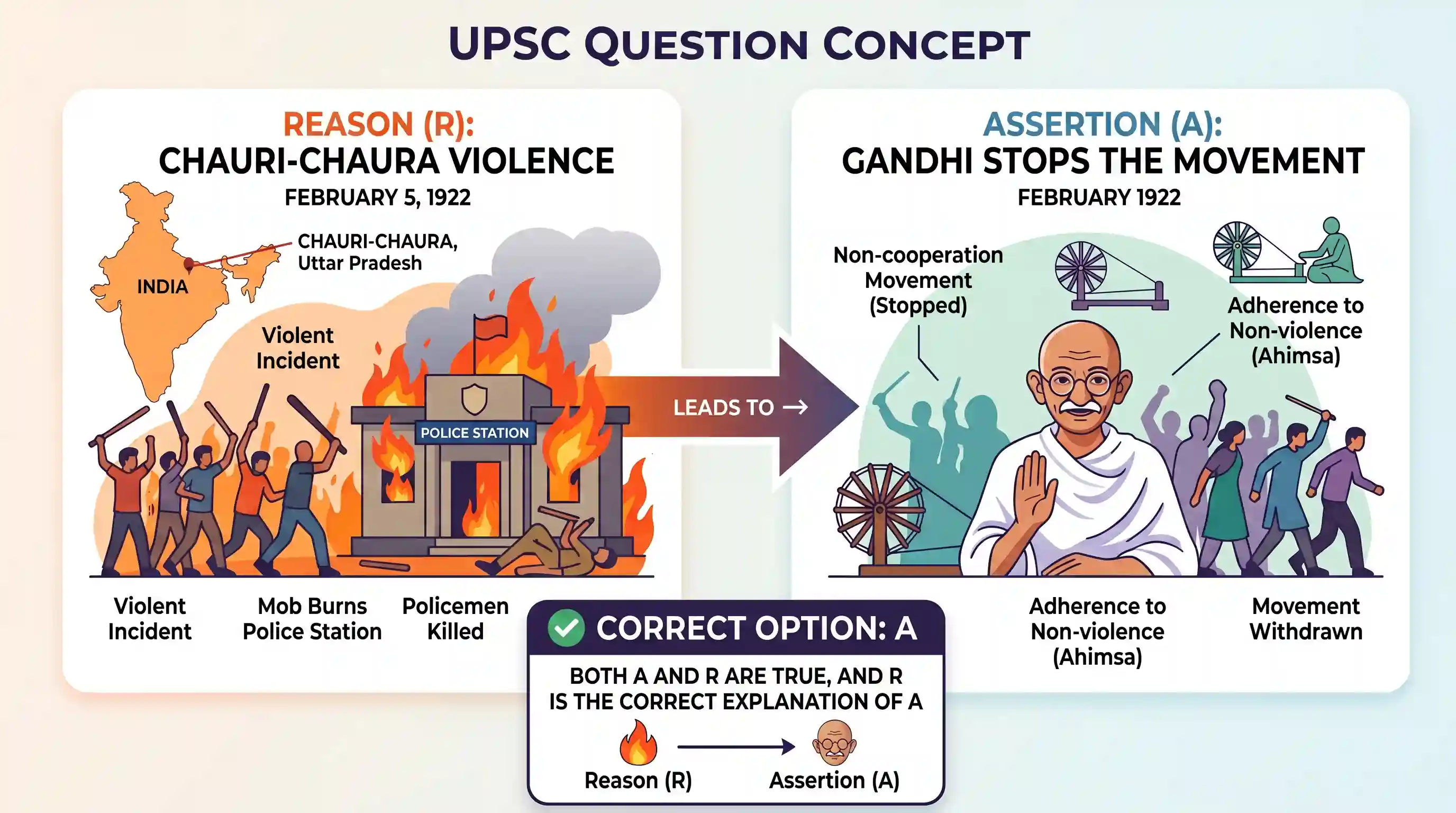
Assertion (A): Gandhi stopped the Non-cooperation Movement in 1922. Reason (R): Violence at Chauri-Chaura led him to stop the movement.

- ABoth A and R are true, and R is the correct explanation of ACorrect
- BBoth A and R are true, but R is NOT a correct explanation of A
- CA is true, but R is false
- DA is false, but R is true
Explanation
The correct option is A because both statements are historically accurate and directly linked. Mahatma Gandhi launched the Non cooperation Movement based on the principle of non violence. However, on February 5, 1922, a violent incident occurred at Chauri Chaura in Uttar Pradesh, where a mob set fire to a police station, killing 22 policemen. Disturbed by this shift toward violence and believing the country was not yet ready for a non violent struggle, Gandhi decided to withdraw the movement immediately. Therefore, the violence at Chauri Chaura was the specific reason that led to the cessation of the movement in 1922.
Related questions
More UPSC Prelims practice from the same subject and topic.
- Prelims 1998GS1history
The educated middle class in India
- Prelims 1998GS1history
Lord Mountbatten came to India as Viceroy along with specific instructions to
- Prelims 1998GS1history
Assertion (A): The Khilafat movement did bring the urban Muslims into the fold of the National Movement. Reason (R): There was a predominant element of anti-imperialism in both the National and Khilaf…
- Prelims 1998GS1history
Assertion (A): Partition of Bengal in 1905 brought to an end the Moderates’ role in the Indian freedom movement. Reason (R): The Surat session of Indian National Congress separated the Extremists from…
- Prelims 1998GS1history
Assertion (A): The first ever Bill to make primary education compulsory in India was rejected in 1911. Reason (R): Discontent would have increased if every cultivator could read.
- Prelims 1998GS1history
Assertion (A): The Congress rejected the Cripps proposals. Reason (R): The Cripps Mission consisted solely of whites.