Which one of the following defines extremist ideology during the early phase of Indian freedom movement?

- AStimulating the production of indigenous articles by giving them preference over imported commodities
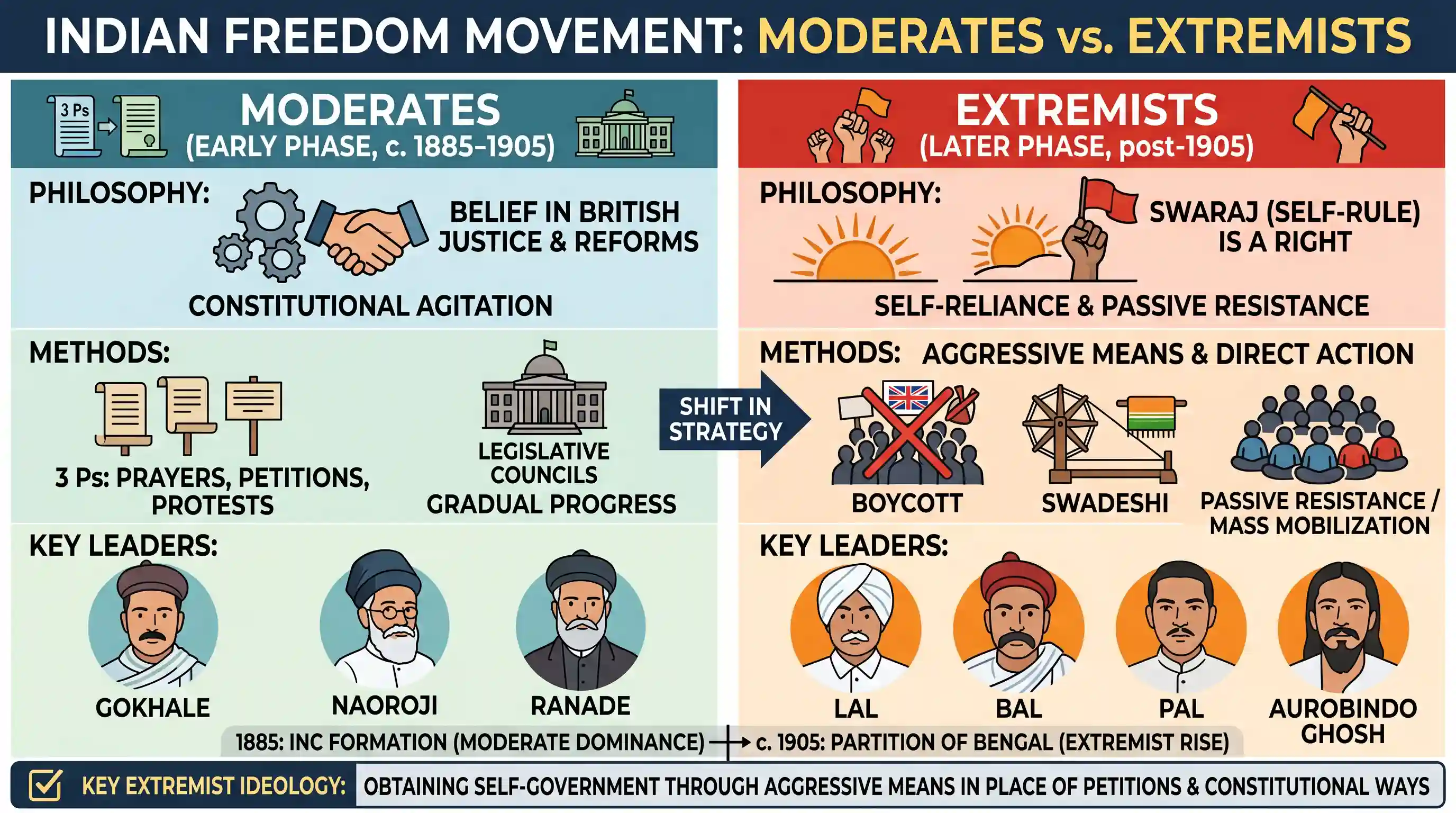
- BObtaining self-government by aggressive means in place of petitions and constitutional waysCorrect
- CProviding national education according to the requirements of the country
- DOrganising coups against the British empire through military revolt
Explanation
The correct answer is B because it accurately captures the fundamental shift in political strategy introduced by the extremist leaders like Lal, Bal, and Pal. Unlike the Moderates, who relied on the policy of three Ps—Prayers, Petitions, and Protests—the Extremists believed that political rights could not be obtained through constitutional appeals to the British government. They advocated for self-reliance and the use of more forceful methods such as mass mobilization, boycotts, and passive resistance to achieve Swaraj or self-rule. While options A and C were indeed parts of their program, they were specific tools or methods used to achieve the larger goal of self-government through aggressive political action. Option D is incorrect as the Extremists focused on mass movements rather than military coups or underground revolts.
Related questions
More UPSC Prelims practice from the same subject and topic.
- Prelims 1998GS1history
The educated middle class in India
- Prelims 1998GS1history
Lord Mountbatten came to India as Viceroy along with specific instructions to
- Prelims 1998GS1history
Assertion (A): The Khilafat movement did bring the urban Muslims into the fold of the National Movement. Reason (R): There was a predominant element of anti-imperialism in both the National and Khilaf…
- Prelims 1998GS1history
Assertion (A): Partition of Bengal in 1905 brought to an end the Moderates’ role in the Indian freedom movement. Reason (R): The Surat session of Indian National Congress separated the Extremists from…
- Prelims 1998GS1history
Assertion (A): The first ever Bill to make primary education compulsory in India was rejected in 1911. Reason (R): Discontent would have increased if every cultivator could read.
- Prelims 1998GS1history
Assertion (A): The Congress rejected the Cripps proposals. Reason (R): The Cripps Mission consisted solely of whites.