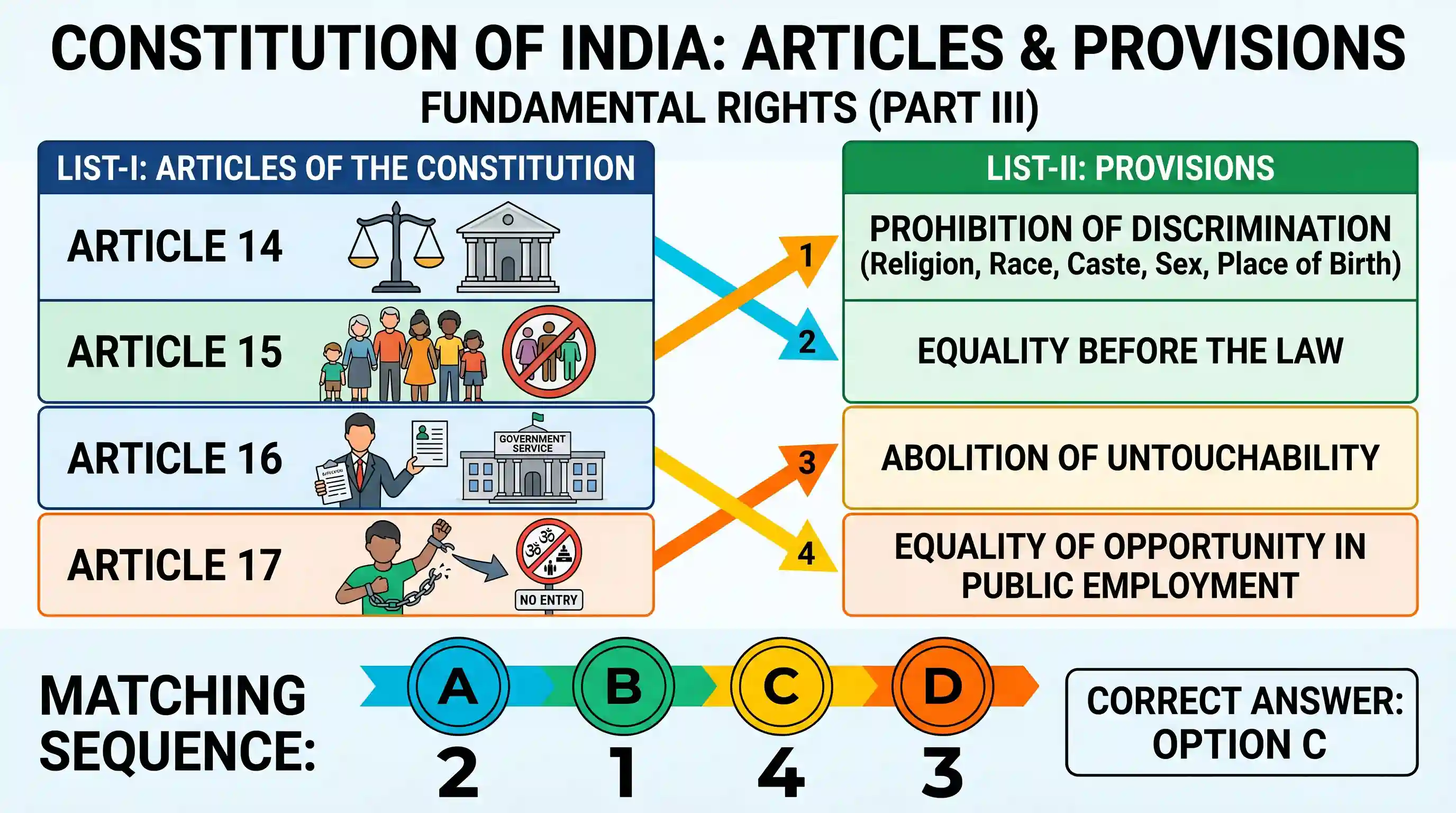
Match List-I (Articles of the Constitution of India) with List-II (Provision) and select the correct answer using the codes given below the Lists: List-I List-II ((Articles of the Constitution of India) (Provision)

- A2 4 1 3
- B3 1 4 2
- C2 1 4 3Correct
- D3 4 1 2
Explanation
The correct option is C because it accurately matches the specific Constitutional Articles with their respective provisions as follows.
Article 14 corresponds to Equality before the Law. This ensures that every citizen is treated equally by the legal system regardless of status.
Article 15 corresponds to Prohibition of Discrimination. This prevents the state from discriminating against any citizen on grounds only of religion, race, caste, sex, or place of birth.
Article 16 corresponds to Equality of Opportunity in Public Employment. This guarantees that all citizens have an equal chance to apply for and hold government positions.
Article 17 corresponds to Abolition of Untouchability. This bans the practice of untouchability in any form and makes its practice a punishable offense.
Matching these pairs gives the sequence 2 1 4 3 which aligns with Option C.
Related questions
More UPSC Prelims practice from the same subject and topic.
- Prelims 2004GS1polity-and-governance
Which one of the following statements is correct?
- Prelims 2004GS1polity-and-governance
Which one of the following statements correctly describes the Fourth Schedule of the Constitution of India?
- Prelims 2004GS1polity-and-governance
Which Article of the Constitution of India says, ‘No child below the age of fourteen years shall be employed to work in any factory or mine or engaged in any other hazardous employment’?
- Prelims 2004GS1polity-and-governance
Consider the following statements: 1. Abolition of diarchy in the Governors’ provinces 2. Power of the Governors to veto legislative action and to legislate on their own 3. Abolition of the principle …
- Prelims 2004GS1polity-and-governance
Consider the following statements: 1. The highest criminal court of the district is the Court of District and Sessions Judge. 2. The District Judges are appointed by the Governor in consultation with …
- Prelims 2004GS1polity-and-governance
Consider the following statements: 1. The Speaker of Lok Sabha has the power to adjourn the House sine die but, on prorogation, it is only the President who can summon the House. 2. Unless sooner diss…