A train travels at a certain average speed for a distance of 63 km and then travels a distance of 72 km at an average speed of 6 km/hr more than its original speed. If it takes 3 hours to complete the total journey, what is the original speed of the train in km/hr?

- A24
- B33
- C42Correct
- D66
Explanation
Let the original speed of the train be 's' km/hr.
The journey is divided into two parts:
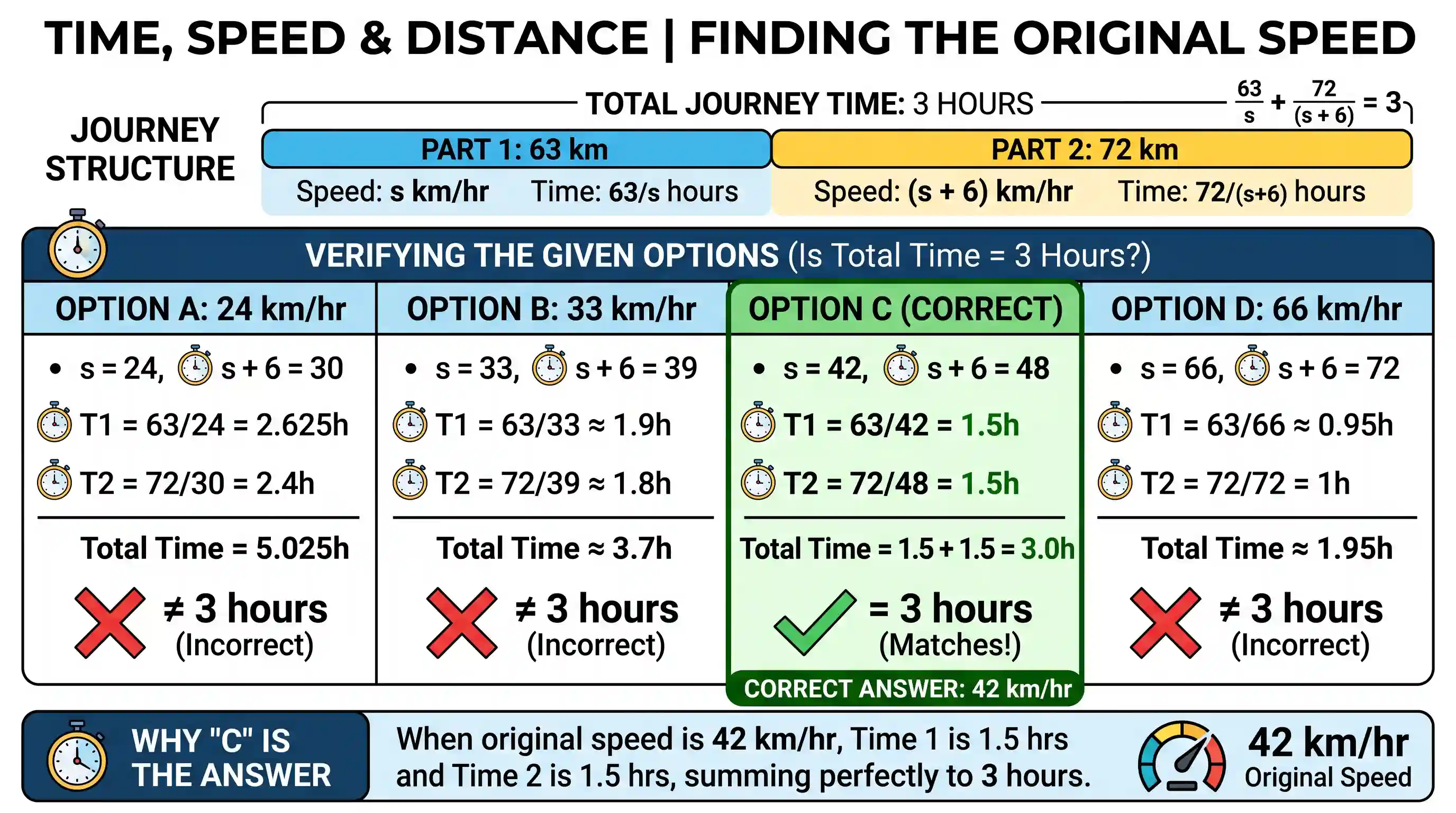
Part 1: Distance = 63 km Speed = s km/hr Time taken (T1) = Distance / Speed = 63/s hours
Part 2: Distance = 72 km Speed = (s + 6) km/hr (6 km/hr more than original speed) Time taken (T2) = Distance / Speed = 72/(s+6) hours
The total journey time is given as 3 hours. So, T1 + T2 = 3 63/s + 72/(s+6) = 3
To find the original speed 's', we can test the given options.
Let's test Option C) 42 km/hr: If s = 42 km/hr, then:
Time for Part 1 (T1) = 63/42 = 3/2 = 1.5 hours Speed for Part 2 = 42 + 6 = 48 km/hr Time for Part 2 (T2) = 72/48 = 3/2 = 1.5 hours
Total time = T1 + T2 = 1.5 + 1.5 = 3 hours.
This matches the given total journey time of 3 hours. Therefore, the original speed of the train is 42 km/hr.
Analysis of other options: A) If s = 24 km/hr, T1 = 63/24 = 2.625 hours. T2 = 72/(24+6) = 72/30 = 2.4 hours. Total time = 2.625 + 2.4 = 5.025 hours (Incorrect). B) If s = 33 km/hr, T1 = 63/33 approx 1.9 hours. T2 = 72/(33+6) = 72/39 approx 1.8 hours. Total time approx 3.7 hours (Incorrect). D) If s = 66 km/hr, T1 = 63/66 approx 0.95 hours. T2 = 72/(66+6) = 72/72 = 1 hour. Total time approx 1.95 hours (Incorrect).
The final answer is C.
Related questions
More UPSC Prelims practice from the same subject and topic.
- Prelims 2013CSATQuantitative Aptitude
A person can walk a certain distance and drive back in six hours. He can also walk both ways in 10 hours. How much time will he take to drive both ways?
- Prelims 2013CSATQuantitative Aptitude
A thief running at 8 km/hr is chased by a policeman whose speed is 10 km/hr. If the thief is 100 m ahead of the policeman, then the time required for the policeman to catch the thief will be
- Prelims 2013CSATQuantitative Aptitude
In a rare coin collection, there is one gold coin for every three non-gold coins. 10 more gold coins are added to the collection and the ratio of gold coins to non-gold coins would be 1: 2. Based on t…
- Prelims 2013CSATQuantitative Aptitude
A gardener has 1000 plants: He wants to plant them in such a way that the number of rows and the number of columns remains the same. What is the minimum number of plants that he needs more for this pu…
- Prelims 2013CSATQuantitative Aptitude
A sum of Rs. 700 has to be used to give seven cash prizes to the students of a school for their overall academic performance. If each prize is Rs. 20 less than its preceding prize, what is the least v…
- Prelims 2013CSATQuantitative Aptitude
Out of 120 applications for a post, 70 are male and 80 have a driver's license. What is the ratio between the minimum to maximum number of males having driver's license?