Which one of the following is likely to be the most inflationary in its effect?

- ARepayment of public debt
- BBorrowing from the public to finance a budget deficit
- CBorrowing from banks to finance a budget deficit
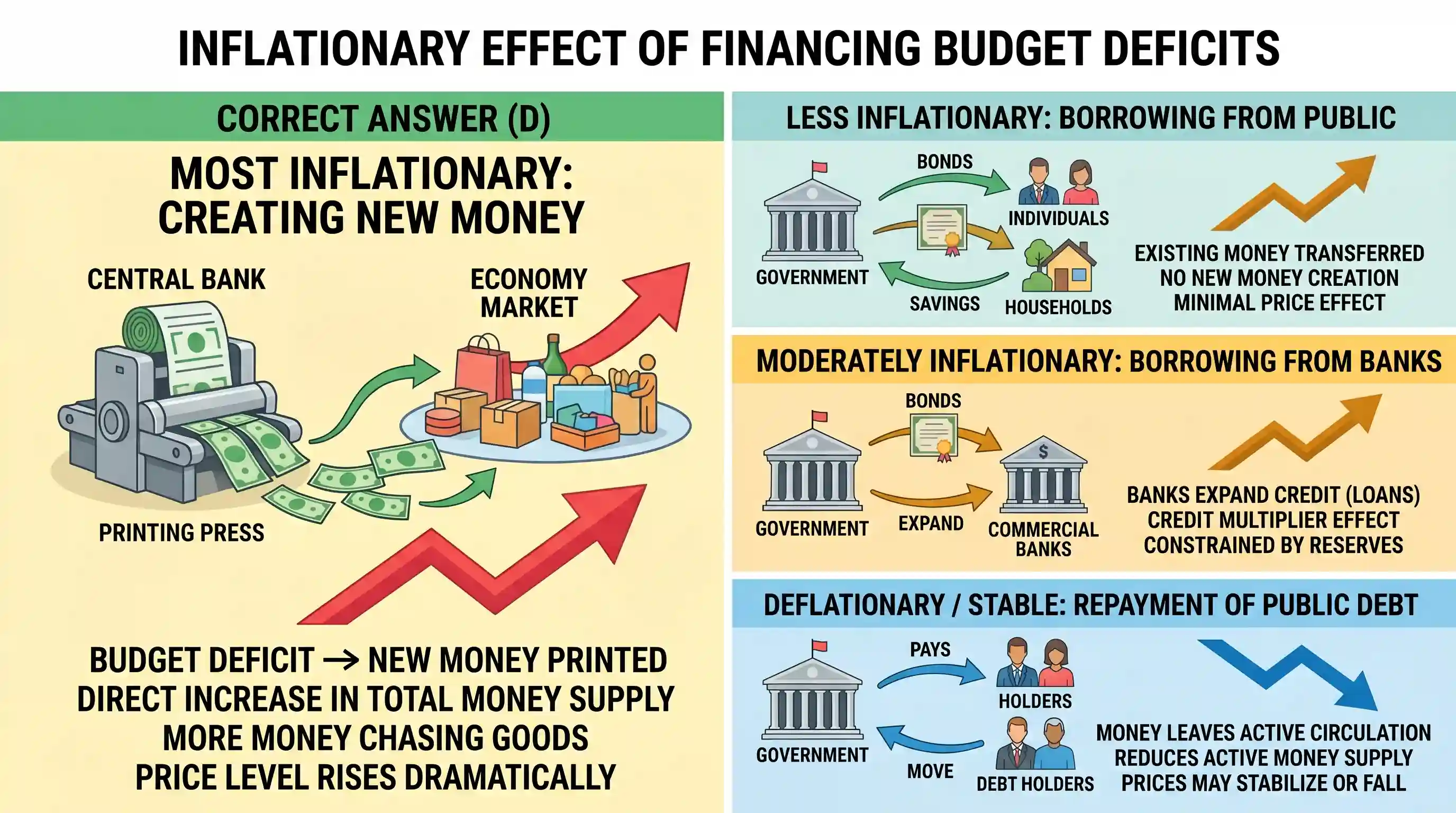
- DCreating new money to finance a budget deficitCorrect
Explanation
The correct answer is D) Creating new money to finance a budget deficit. This is the most inflationary option because it directly increases the money supply. When the government creates new money to cover its spending, it leads to 'money supply inflation'. More money chasing the same amount of goods and services inevitably pushes prices up.
A) Repayment of public debt: This reduces the amount of money in circulation as funds move from the government to debt holders, potentially having a deflationary effect.
B) Borrowing from the public to finance a budget deficit: This transfers funds from the public to the government. While it increases government debt, it doesn't necessarily increase the overall money supply. The public may use existing savings or reduce consumption to lend to the government.
C) Borrowing from banks to finance a budget deficit: This increases government debt, but banks typically create credit (loans) based on existing reserves. While it can have some inflationary pressure through credit expansion, it's less direct and potent than creating new money. Banks are constrained by reserve requirements and lending capacity.
Therefore, directly increasing the money supply through printing new money is the most direct and powerful driver of inflation.
Related questions
More UPSC Prelims practice from the same subject and topic.
- Prelims 2013GS1economy
In India, deficit financing is used for raising resources for
- Prelims 2013GS1economy
The balance of payments of a country is a systematic record of
- Prelims 2013GS1economy
The Reserve Bank of India regulates the commercial banks in matters of 1. liquidity of assets 2. branch expansion 3. merger of banks 4. winding-up of banks Select the correct answer using the codes gi…
- Prelims 2013GS1economy
An increase in the Bank Rate generally indicates that the
- Prelims 2013GS1economy
Which of the following constitute Capital Account? 1. Foreign Loans 2. Foreign Direct Investment 3. Private Remittances 4. Portfolio Investment Select the correct answer using the codes given below.
- Prelims 2013GS1economy
Consider the following statements : 1. Inflation benefits the debtors. 2. Inflation benefits the bond-holders. Which of the statements given above is/are correct?