Which one of the following groups of items is included in India's foreign-exchange reserves?

- AForeign-currency assets, Special Drawing Rights (SDRs) and loans from foreign countries
- BForeign-currency assets, gold holdings of the RBI and SDRsCorrect
- CForeign-currency assets, loans from the World Bank and SDRs
- DForeign-currency assets, gold holdings of the RBI and loans from the World Bank
Explanation
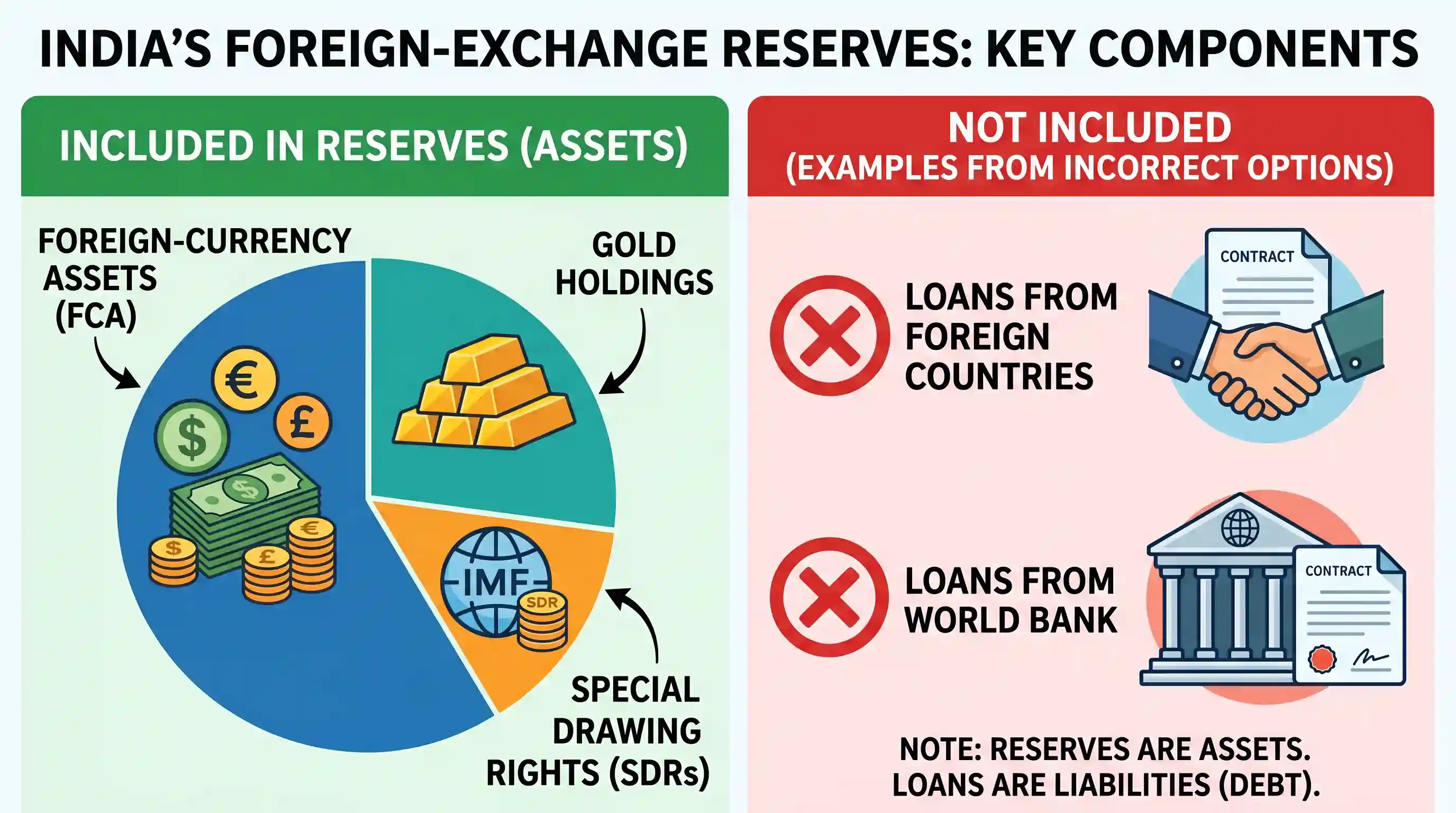
The correct answer is B) Foreign-currency assets, gold holdings of the RBI and SDRs. India's foreign exchange reserves consist of these three main components:
Foreign-currency assets: This is the largest component, comprising currencies like US dollars, Euros, and British Pounds held by the RBI.
Gold holdings of the RBI: India holds a significant amount of gold as part of its reserves, stored both domestically and abroad.
Special Drawing Rights (SDRs): These are international reserve assets created by the International Monetary Fund (IMF). They represent a claim to currency held by IMF member countries.
Let's examine why the other options are incorrect:
A) Loans from foreign countries are a form of external debt, not part of the reserves. Reserves are assets, while loans are liabilities.
C) Loans from the World Bank are also external debt and not considered reserves.
D) While gold holdings are correct, loans from the World Bank are incorrect, making this option wrong.
Understanding the composition of foreign exchange reserves is crucial for analyzing India's economic stability and its ability to manage external shocks.
Related questions
More UPSC Prelims practice from the same subject and topic.
- Prelims 2013GS1economy
The Reserve Bank of India regulates the commercial banks in matters of 1. liquidity of assets 2. branch expansion 3. merger of banks 4. winding-up of banks Select the correct answer using the codes gi…
- Prelims 2013GS1economy
An increase in the Bank Rate generally indicates that the
- Prelims 2013GS1economy
Consider the following liquid assets: 1. Demand deposits with the banks 2. Time deposits with the banks 3. Savings deposits with the banks 4. Currency The correct sequence of these assets in the decre…
- Prelims 2013GS1economy
In the context of Indian economy, 'Open Market Operations' refers to
- Prelims 2013GS1economy
Priority Sector Lending by banks in India constitutes the lending to
- Prelims 2013GS1economy
The balance of payments of a country is a systematic record of