Consider the following liquid assets: 1. Demand deposits with the banks 2. Time deposits with the banks 3. Savings deposits with the banks 4. Currency The correct sequence of these assets in the decreasing order of liquidity is

- A(a) 1-4-3-2
- B(b) 4-3-2-1
- C(c) 2-3-1-4
- D(d) 4-1-3-2Correct
Explanation
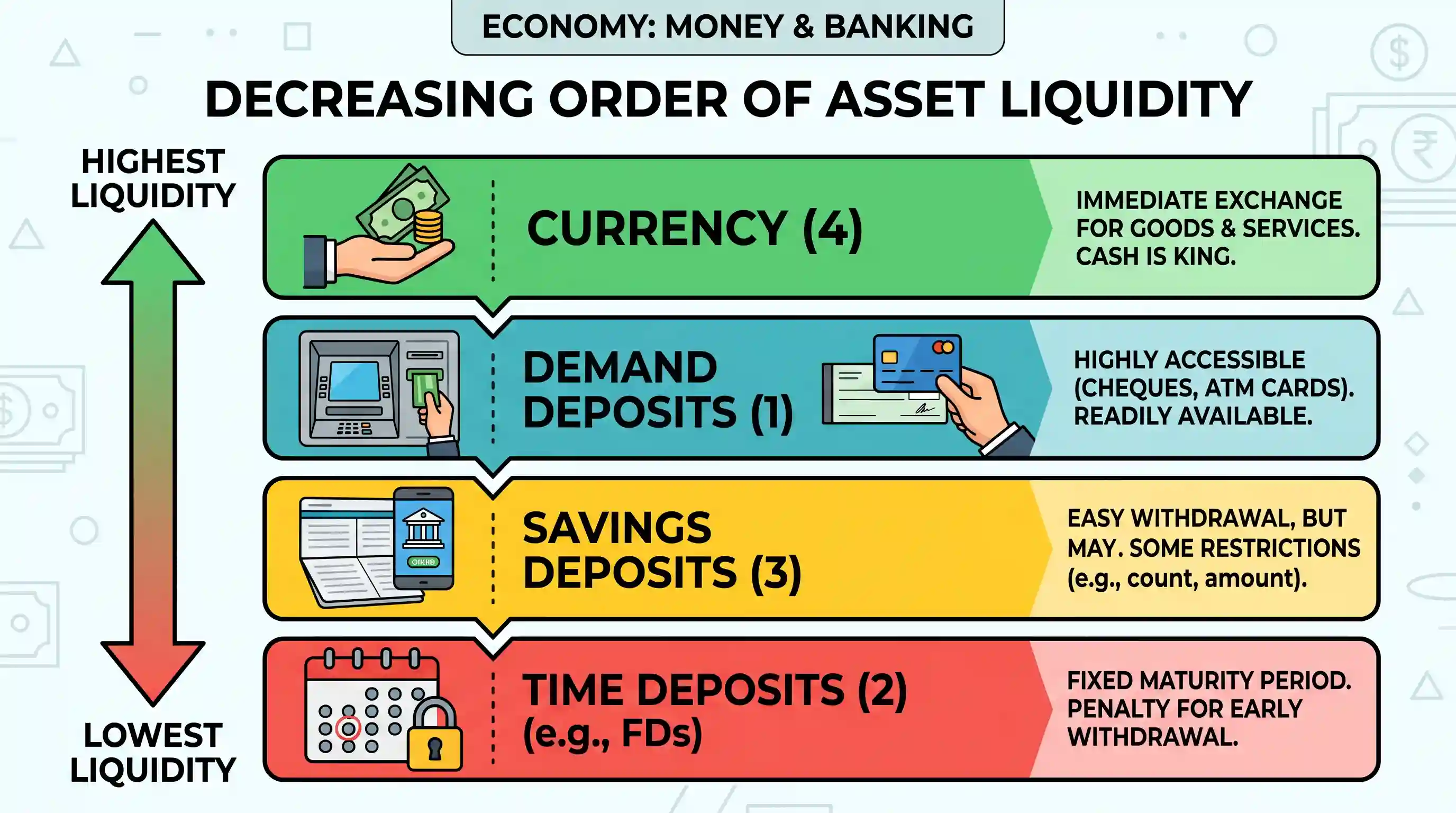
Liquidity refers to the ease with which an asset can be converted into cash without a significant loss in value. Let's analyze each asset:
-
Currency: This is the most liquid asset as it is cash.
-
Demand Deposits with Banks: These are funds readily available for withdrawal (checking accounts) and are highly liquid, almost as good as cash.
-
Savings Deposits with Banks: These are liquid, but may have some restrictions or require a short notice period for large withdrawals, making them less liquid than demand deposits.
-
Time Deposits with Banks: These are fixed deposits (FDs) with a specific maturity period. Withdrawing before maturity often incurs a penalty, making them the least liquid of the four.
Therefore, the correct sequence in decreasing order of liquidity is 4-1-3-2.
Why other options are incorrect:
A) 1-4-3-2: Incorrect because currency (4) is more liquid than demand deposits (1).
B) 4-3-2-1: Incorrect because demand deposits (1) are more liquid than savings deposits (3) and time deposits (2).
C) 2-3-1-4: Incorrect as time deposits (2) are the least liquid and currency (4) is the most.
Related questions
More UPSC Prelims practice from the same subject and topic.
- Prelims 2013GS1economy
The Reserve Bank of India regulates the commercial banks in matters of 1. liquidity of assets 2. branch expansion 3. merger of banks 4. winding-up of banks Select the correct answer using the codes gi…
- Prelims 2013GS1economy
An increase in the Bank Rate generally indicates that the
- Prelims 2013GS1economy
In the context of Indian economy, 'Open Market Operations' refers to
- Prelims 2013GS1economy
Priority Sector Lending by banks in India constitutes the lending to
- Prelims 2013GS1economy
Which one of the following groups of items is included in India's foreign-exchange reserves?
- Prelims 2013GS1economy
The balance of payments of a country is a systematic record of