An increase in the Bank Rate generally indicates that the

- Amarket rate of interest is likely to fall
- BCentral Bank is no longer making loans to commercial banks
- CCentral Bank is following an easy money policy
- DCentral Bank is following a tight money policyCorrect
Explanation
The correct answer is D) Central Bank is following a tight money policy.
Here's a detailed explanation:
Bank Rate: The Bank Rate is the rate of interest at which a central bank (like the Reserve Bank of India) lends money to commercial banks.
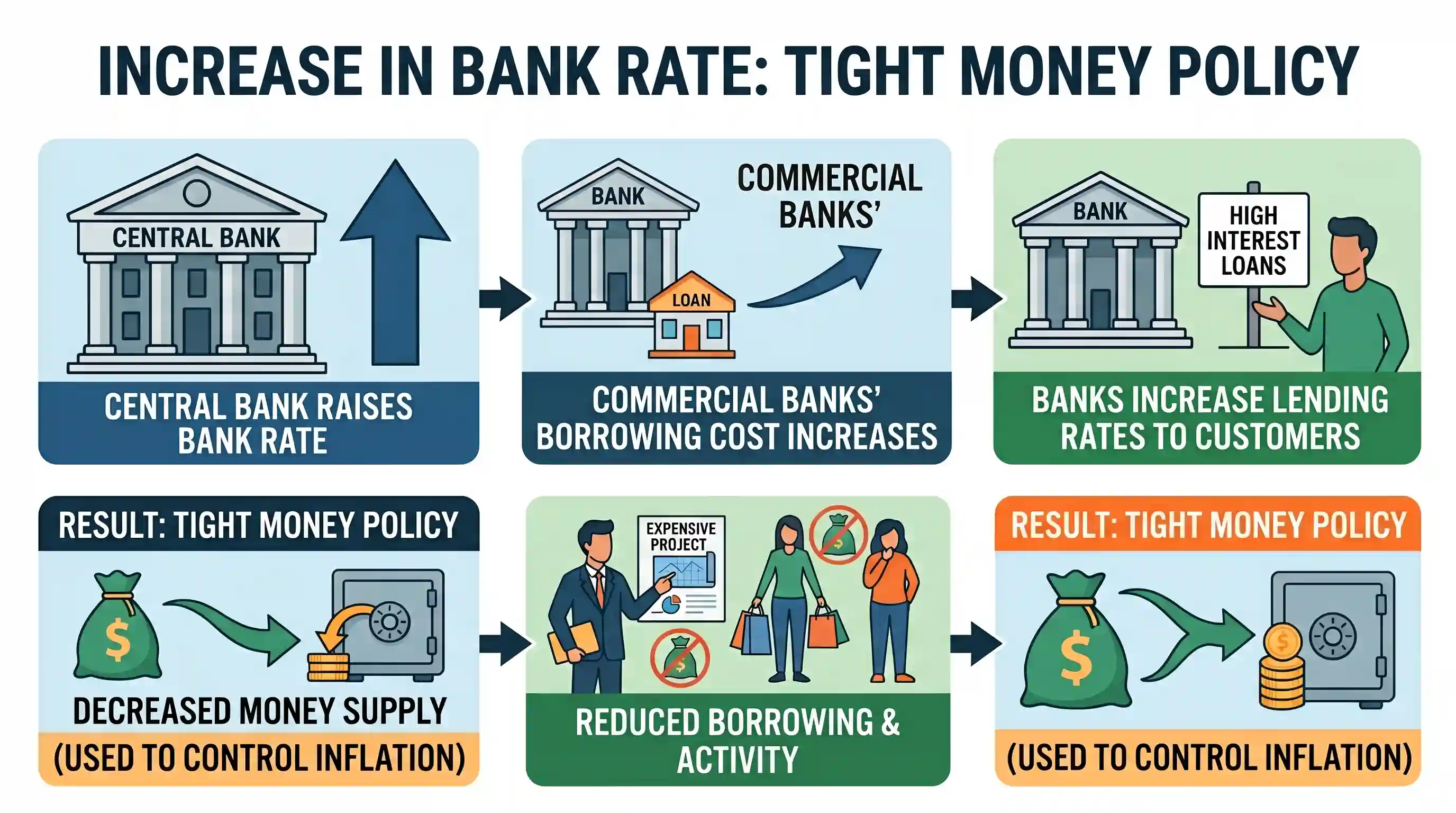
Tight Money Policy: When the central bank increases the Bank Rate, it becomes more expensive for commercial banks to borrow money. This, in turn, leads to commercial banks increasing their lending rates to customers. Higher lending rates discourage borrowing and investment, thus reducing the money supply in the economy. This is known as a 'tight money policy' and is used to control inflation.
Why other options are incorrect:
A) market rate of interest is likely to fall: This is incorrect. An increase in the Bank Rate generally leads to an increase in market interest rates.
B) Central Bank is no longer making loans to commercial banks: This is incorrect. The Bank Rate refers to the rate of lending, not the cessation of lending. The central bank continues to lend, but at a higher cost.
C) Central Bank is following an easy money policy: This is the opposite of what happens when the Bank Rate is increased. An easy money policy involves lowering interest rates to encourage borrowing and investment.
Related questions
More UPSC Prelims practice from the same subject and topic.
- Prelims 2013GS1economy
The Reserve Bank of India regulates the commercial banks in matters of 1. liquidity of assets 2. branch expansion 3. merger of banks 4. winding-up of banks Select the correct answer using the codes gi…
- Prelims 2013GS1economy
Consider the following liquid assets: 1. Demand deposits with the banks 2. Time deposits with the banks 3. Savings deposits with the banks 4. Currency The correct sequence of these assets in the decre…
- Prelims 2013GS1economy
In the context of Indian economy, 'Open Market Operations' refers to
- Prelims 2013GS1economy
Priority Sector Lending by banks in India constitutes the lending to
- Prelims 2013GS1economy
Which one of the following groups of items is included in India's foreign-exchange reserves?
- Prelims 2013GS1economy
The balance of payments of a country is a systematic record of