The Reserve Bank of India regulates the commercial banks in matters of 1. liquidity of assets 2. branch expansion 3. merger of banks 4. winding-up of banks Select the correct answer using the codes given below.

- A1 and 4 only
- B2, 3 and 4 only
- C1, 2 and 3 only
- D1, 2, 3 and 4Correct
Explanation
The Reserve Bank of India (RBI) is the primary regulator of commercial banks in India, exercising comprehensive control over their operations to ensure financial stability and protect depositors' interests.
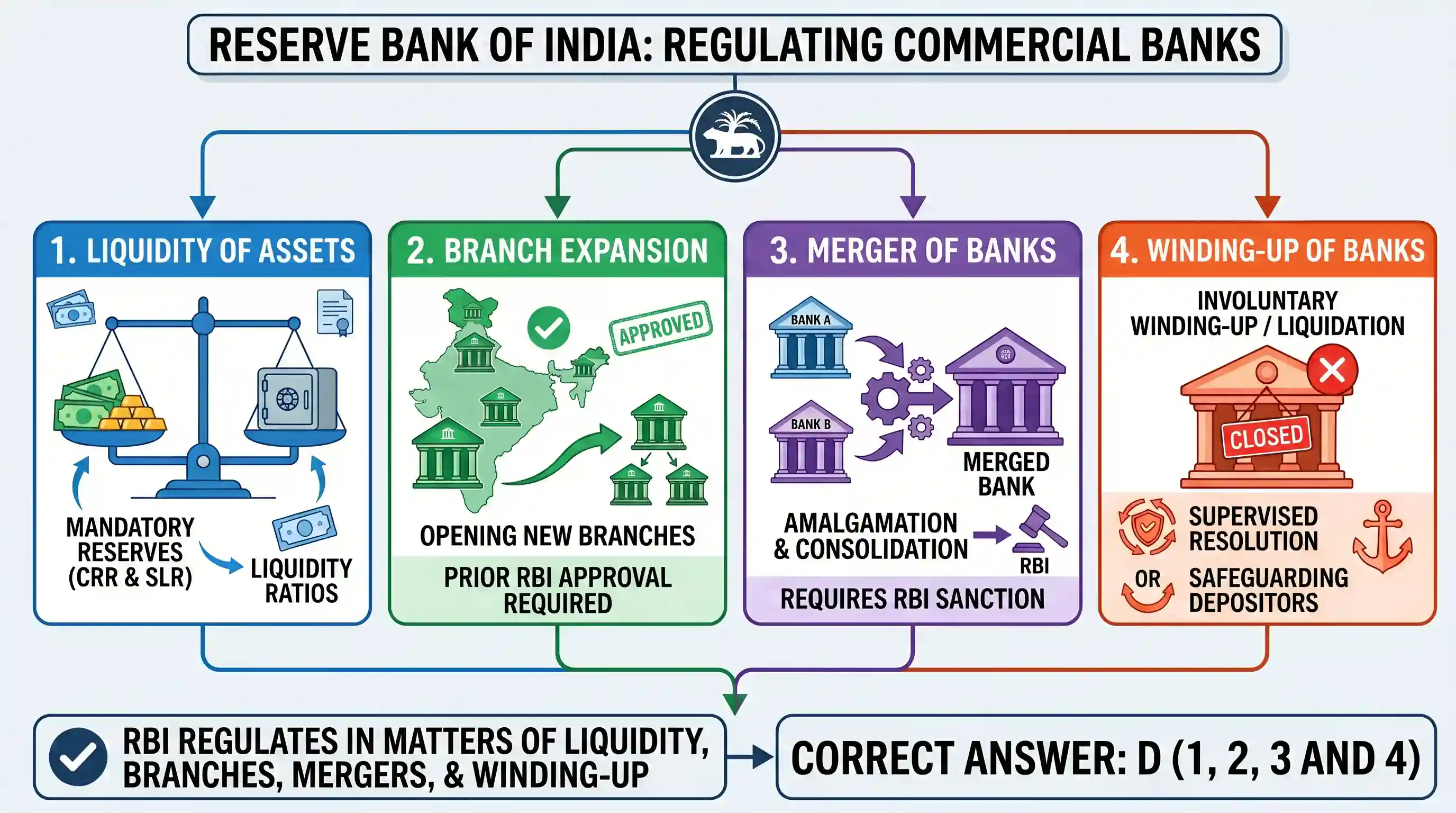
- liquidity of assets: The RBI mandates banks to maintain certain levels of liquidity through measures like the Cash Reserve Ratio (CRR), Statutory Liquidity Ratio (SLR), and Liquidity Coverage Ratio (LCR), and monitors their asset-liability management. This is a core regulatory function.
- branch expansion: Banks require prior approval from the RBI to open new branches, shift existing ones, or close them, as part of the RBI's efforts to ensure balanced banking development and financial inclusion.
- merger of banks: Any merger, amalgamation, or reconstruction involving banks requires the explicit approval of the RBI, which assesses the financial health, systemic impact, and competitive implications of such proposals.
- winding-up of banks: In cases of financial distress or insolvency, the RBI has powers under the Banking Regulation Act to oversee the winding-up process of banks, including liquidation, or to facilitate their amalgamation with other banks to safeguard depositors' funds.
Since the RBI regulates commercial banks in all four mentioned aspects, option D is correct.
Related questions
More UPSC Prelims practice from the same subject and topic.
- Prelims 2013GS1economy
An increase in the Bank Rate generally indicates that the
- Prelims 2013GS1economy
Consider the following liquid assets: 1. Demand deposits with the banks 2. Time deposits with the banks 3. Savings deposits with the banks 4. Currency The correct sequence of these assets in the decre…
- Prelims 2013GS1economy
In the context of Indian economy, 'Open Market Operations' refers to
- Prelims 2013GS1economy
Priority Sector Lending by banks in India constitutes the lending to
- Prelims 2013GS1economy
Which one of the following groups of items is included in India's foreign-exchange reserves?
- Prelims 2013GS1economy
The balance of payments of a country is a systematic record of