Many transplanted seedlings do not grow because

- AThe new soil does not contain favourable minerals
- BMost of the root hairs grip the new soil too hard
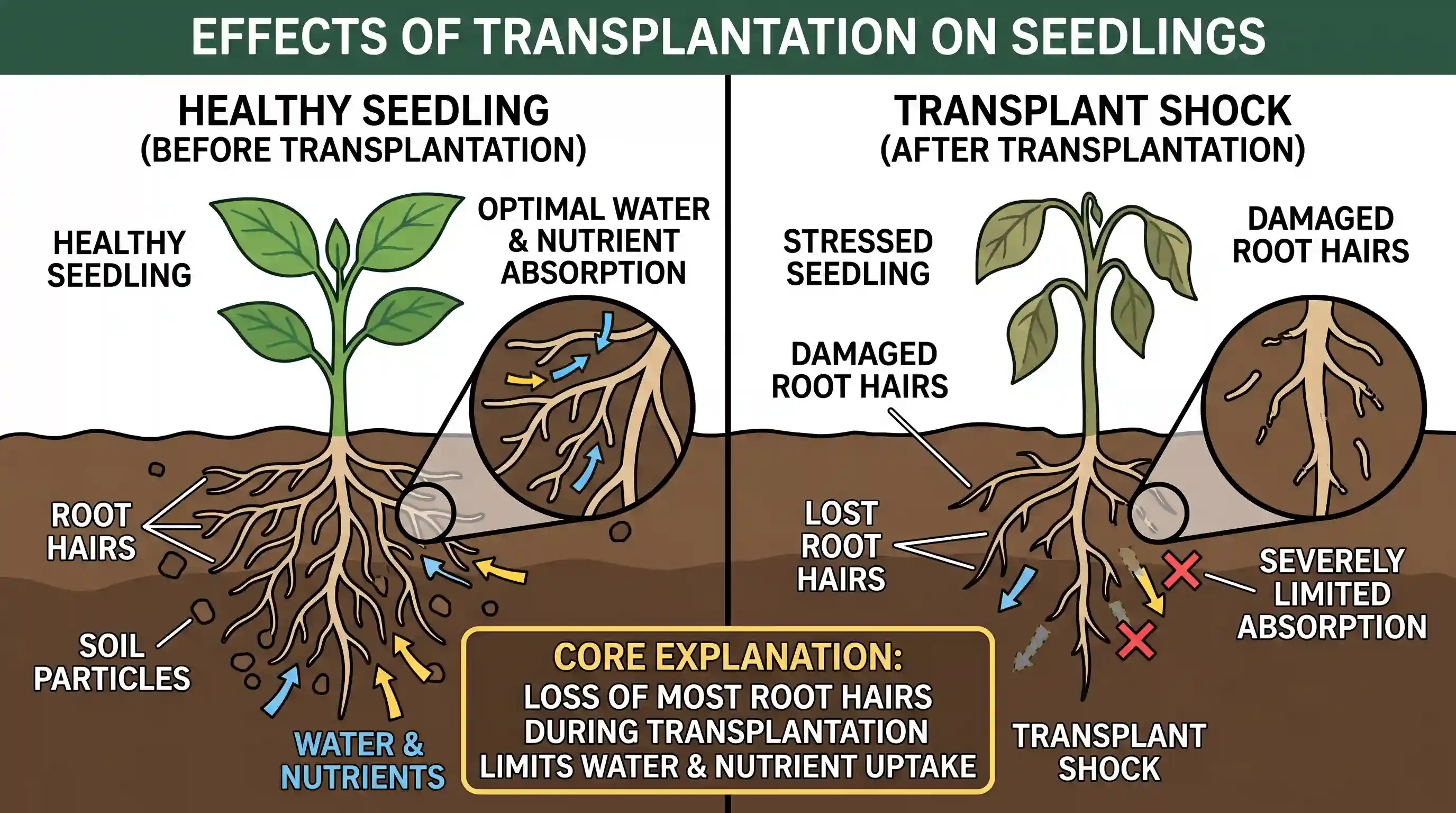
- CMost of the root hairs are lost during transplantationCorrect
- DLeaves get damaged during transplantation
Explanation
Correct Answer: C) Most of the root hairs are lost during transplantation
Explanation: Transplantation is a stressful process for seedlings. The most significant issue is the loss of root hairs. Root hairs are extremely delicate, single-celled extensions of root epidermal cells. They are primarily responsible for absorbing water and nutrients from the soil. When a seedling is transplanted, a large proportion of these root hairs are inevitably damaged or lost during the uprooting and replanting process. This drastically reduces the seedling's ability to absorb water and nutrients, leading to transplant shock and often, failure to establish.
Why other options are incorrect:
A) The new soil does not contain favourable minerals: While soil quality is important, it's less immediately critical than the ability to absorb nutrients. Seedlings can survive temporarily in less-than-ideal soil if they have a functional root system.
B) Most of the root hairs grip the new soil too hard: Root hairs don't 'grip' the soil; they penetrate between soil particles. Excessive gripping isn't a problem; the lack of root hairs is.
D) Leaves get damaged during transplantation: Leaf damage can contribute to stress, but the loss of root hairs is a far more critical factor. Plants can often recover from leaf damage, but severely compromised root function is much harder to overcome.
Related questions
More UPSC Prelims practice from the same subject and topic.
- Prelims 2013GS1geography
Which of the following can be found as pollutants in the drinking water in some parts of India? 1. Arsenic 2. Sorbitol 3. Fluoride 4. Formaldehyde 5. Uranium Select the correct answer using the codes …
- Prelims 2013GS1geography
In the grasslands, trees do not replace the grasses as a part of an ecological succession because of
- Prelims 2013GS1geography
Which one of the following is the correct sequence of ecosystems in the order of decreasing productivity?
- Prelims 2013GS1geography
Contour bunding is a method of soil conservation used in
- Prelims 2013GS1geography
Due to improper/indiscriminate disposal of old and used computers or their parts, which of the following are released into the environment as e-waste? 1. Beryllium 2. Cadmium 3. Chromium 4. Heptachlor…
- Prelims 2013GS1geography
Acid rain is caused by the pollution of environment by