Which of the following leaf modifications occurs/occur in desert areas to inhibit water loss?

- AHard and waxy leaves
- BTiny leaves or no leaves
- CThorns instead of leaves
- D1, 2 and 3Correct
Explanation
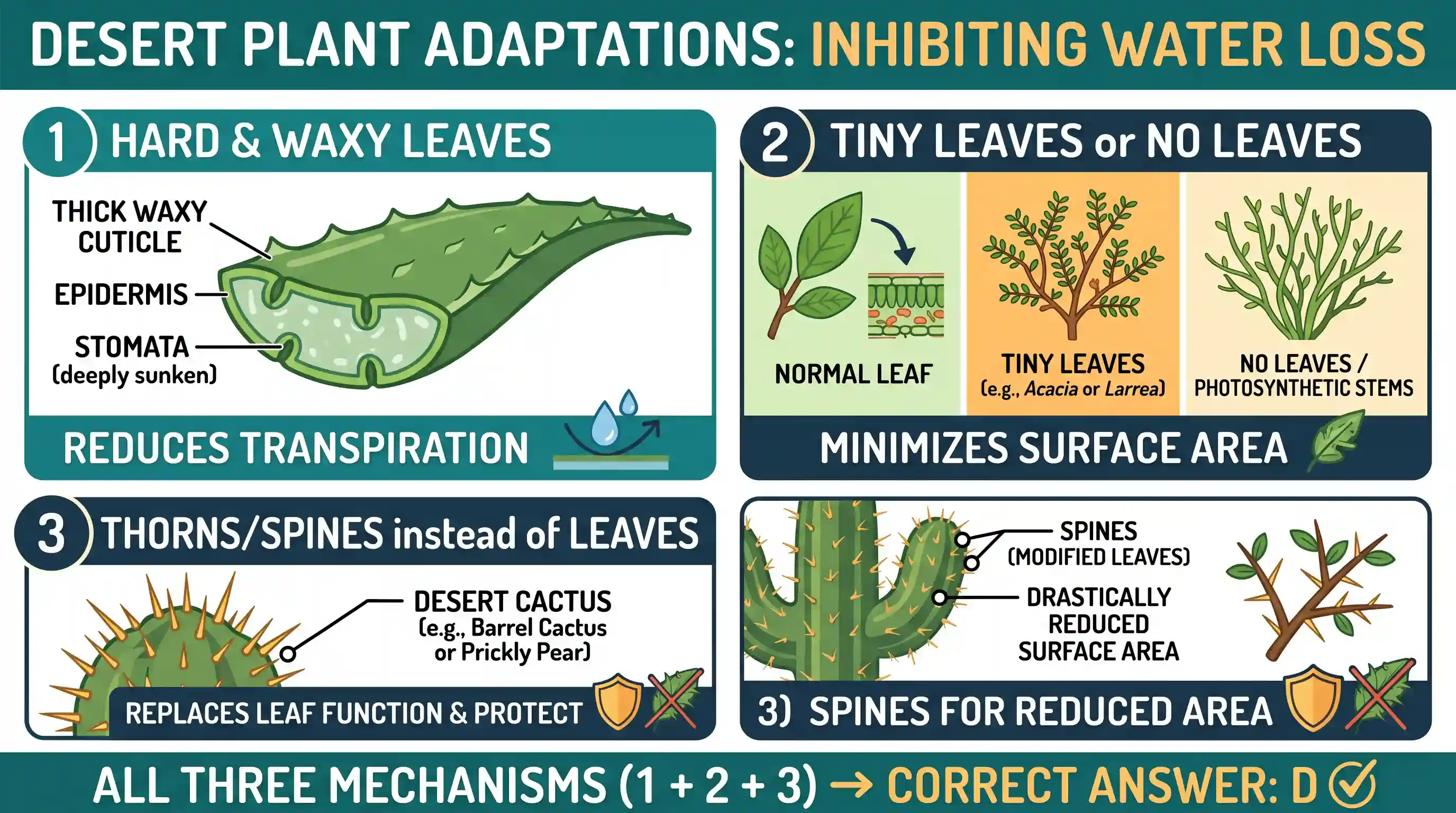
The correct answer is D) 1, 2 and 3. Desert plants exhibit several adaptations to minimize water loss due to the harsh, arid environment.
Hard and waxy leaves: A thick, waxy cuticle on the leaf surface reduces transpiration (water loss through stomata). The hardness provides physical protection. Tiny leaves or no leaves: Reducing leaf surface area directly minimizes the area available for transpiration. Some desert plants have leaves that are extremely small or absent altogether, with photosynthesis occurring in the stem. Thorns instead of leaves: Thorns are modified stems or branches. Replacing leaves with thorns drastically reduces surface area and thus water loss. They also offer protection from herbivores. Let's examine why the other options are incorrect:
A) Hard and waxy leaves: While correct, it's not the complete answer. B) Tiny leaves or no leaves: Also correct, but incomplete. C) Thorns instead of leaves: Correct, but not the full picture of desert plant adaptations. Therefore, all three modifications (hard and waxy leaves, tiny leaves/no leaves, and thorns instead of leaves) are commonly found in desert plants to inhibit water loss, making option D the most accurate.
Related questions
More UPSC Prelims practice from the same subject and topic.
- Prelims 2013GS1geography
Which of the following can be found as pollutants in the drinking water in some parts of India? 1. Arsenic 2. Sorbitol 3. Fluoride 4. Formaldehyde 5. Uranium Select the correct answer using the codes …
- Prelims 2013GS1geography
In the grasslands, trees do not replace the grasses as a part of an ecological succession because of
- Prelims 2013GS1geography
Which one of the following is the correct sequence of ecosystems in the order of decreasing productivity?
- Prelims 2013GS1geography
Contour bunding is a method of soil conservation used in
- Prelims 2013GS1geography
Due to improper/indiscriminate disposal of old and used computers or their parts, which of the following are released into the environment as e-waste? 1. Beryllium 2. Cadmium 3. Chromium 4. Heptachlor…
- Prelims 2013GS1geography
Acid rain is caused by the pollution of environment by