The number of deaths among the army personnel is 8 in 1000, but among the civilian population it is 20 per 1000. Which one of the following inferences can be drawn from this statement?

- AIt is better to join the army
- BThe relationship is fortuitous
- CQuality of Life Index is very high within the armed forces
- DThe groups cannot be compared due to their heterogeneity.Correct
Explanation
Explanation:
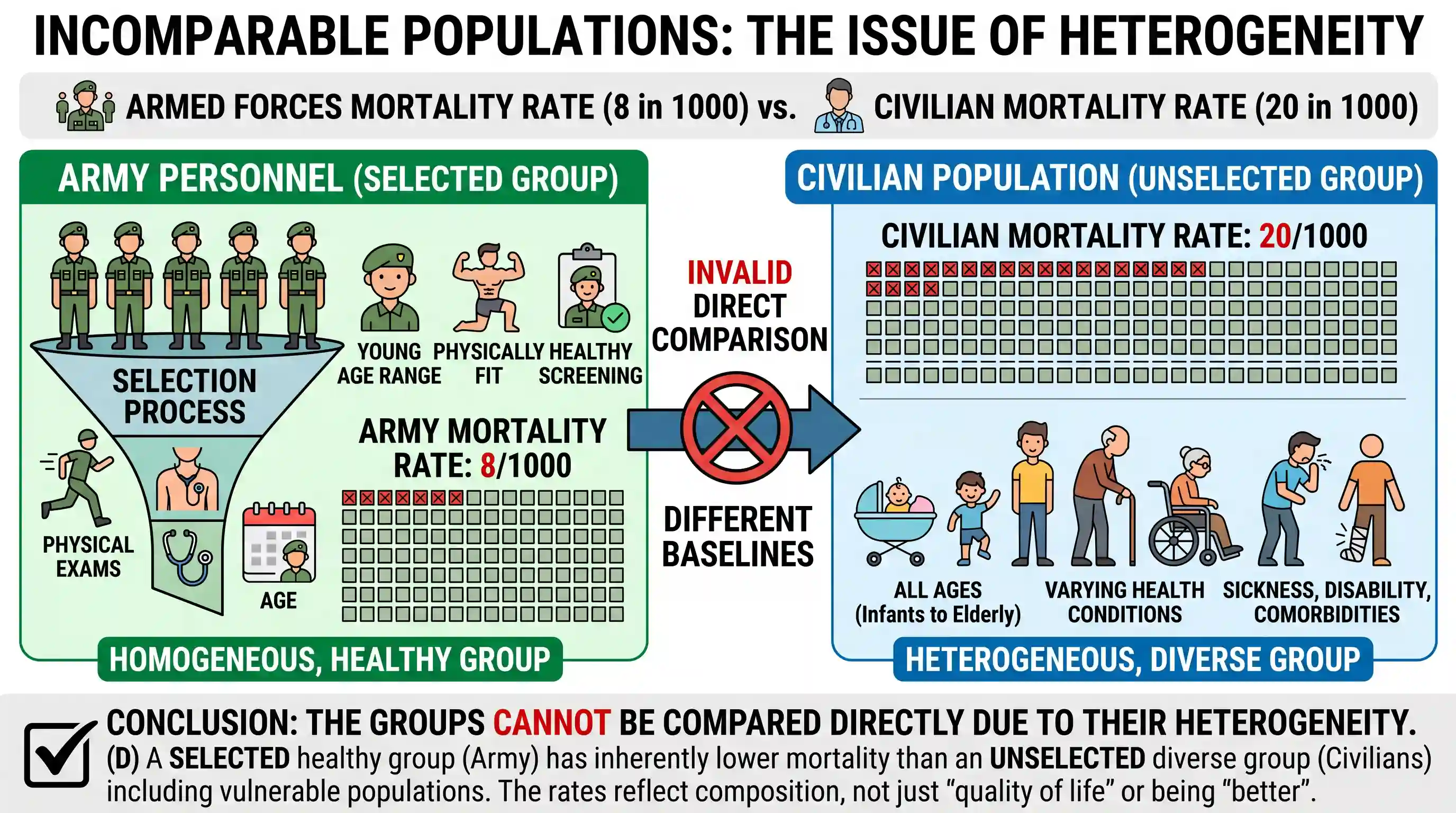
The correct answer is D) The groups cannot be compared due to their heterogeneity.
-
Why D is correct: Army personnel are a highly selected group. They are generally young, fit, and healthy individuals who have passed rigorous physical and medical examinations. They also typically have access to good healthcare. The civilian population, on the other hand, is a heterogeneous group, comprising people of all ages (infants, elderly), varying health conditions (sick, disabled), and diverse lifestyles. Comparing a death rate from a pre-selected, generally healthy, younger population (army) with that of an unselected, diverse population (civilians) is misleading because the inherent differences in the composition of the groups (their heterogeneity) make a direct comparison invalid.
-
Why A is incorrect: "It is better to join the army" is a subjective judgment and an oversimplification. A lower death rate alone does not define "better" without considering the context, risks, and overall life experience. More importantly, it ignores the fundamental differences in the demographic profiles of the two groups.
-
Why B is incorrect: "The relationship is fortuitous" means accidental or by chance. The observed difference in death rates is unlikely to be purely by chance. It is systematically influenced by factors like age distribution, health screening, access to medical care, and occupational risks inherent to each group.
-
Why C is incorrect: "Quality of Life Index is very high within the armed forces" cannot be directly inferred from a death rate alone. While the armed forces might offer certain benefits and healthcare, a lower death rate primarily reflects the younger, healthier demographic of the army, rather than being a comprehensive measure of Quality of Life, which encompasses many other factors. The heterogeneity of the groups remains the primary reason for the difference in death rates.
Related questions
More UPSC Prelims practice from the same subject and topic.
- Prelims 2014CSATReading Comprehension
Passage - 1 The Himalayan ecosystem is highly vulnerable to damage, both due to geological reasons and on account of the stress caused by increased pressure of population, exploitation of natural reso…
- Prelims 2014CSATReading Comprehension
Passage-1 The Himalayan ecosystem is highly vulnerable to damage, both due to geological reasons and on account of the stress caused by increased pressure of population, exploitation of natural resour…
- Prelims 2014CSATReading Comprehension
Passage-1 The Himalayan ecosystem is highly vulnerable to damage, both due to geological reasons and on account of the stress caused by increased pressure of population, exploitation of natural resour…
- Prelims 2014CSATReading Comprehension
Passage-1 The Himalayan ecosystem is highly vulnerable to damage, both due to geological reasons and on account of the stress caused by increased pressure of population, exploitation of natural resour…
- Prelims 2014CSATReading Comprehension
Passage-2 It is often forgotten that globalization, is not only about policies on international economic relationships and transactions, but has equally to do with domestic policies of a nation. Polic…
- Prelims 2014CSATReading Comprehension
Passage-2 It is often forgotten that globalization, is not only about policies on international economic relationships and transactions, but has equally to do with domestic policies of a nation. Polic…