Given the statement: "Buses are the cause of more accidents than cars, and trucks causes fewer accidents than buses", which of the following conclusions can we draw?

- AThere are more buses on the road than trucks
- BCar drivers are more careful than bus drivers
- CTruck drivers are more skilled than either car or bus drivers
- DNone of the aboveCorrect
Explanation
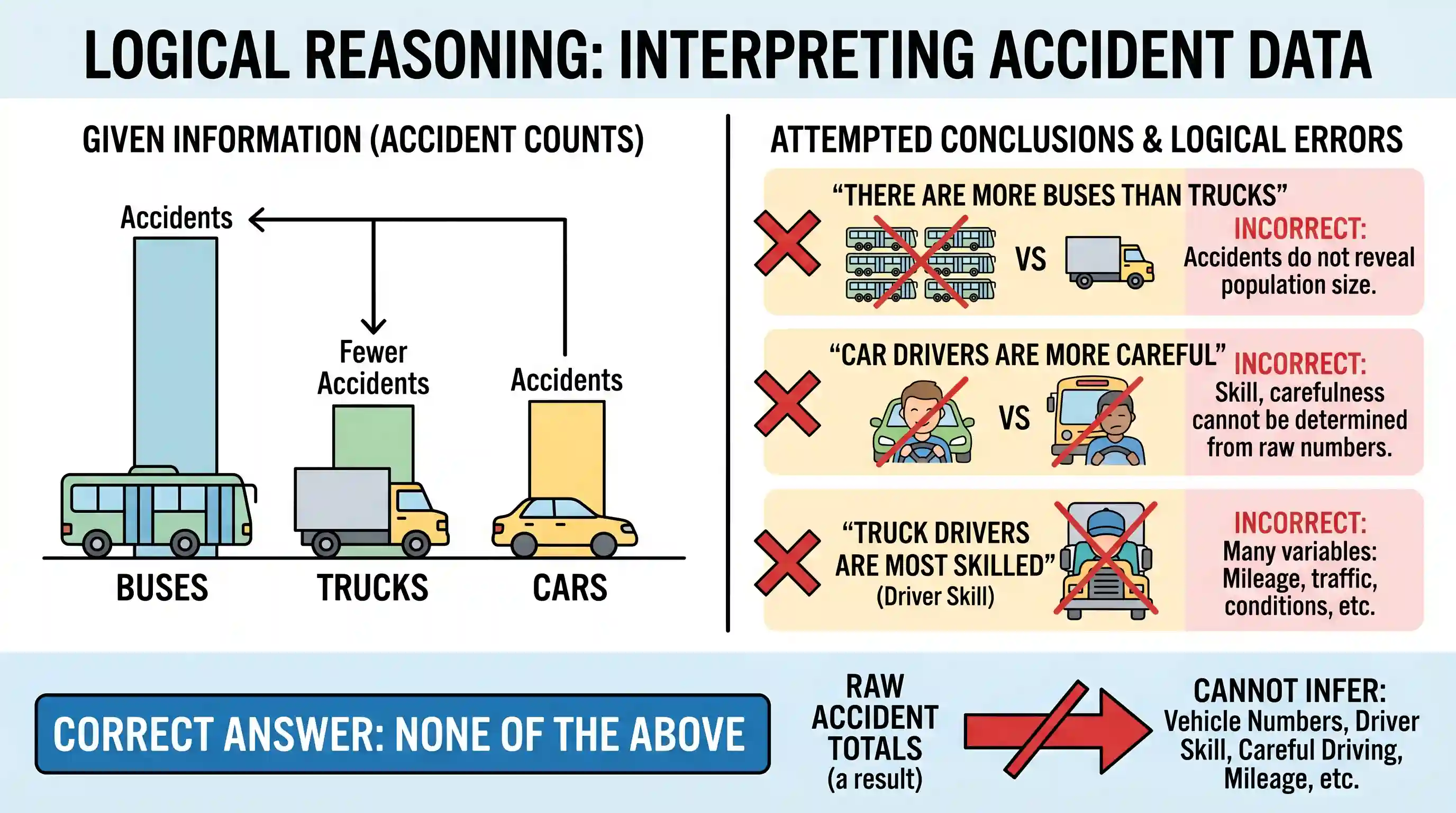
The given statement provides information only about the relative number of accidents caused by different vehicle types. It does not provide data on the number of vehicles of each type on the road, the miles driven by each type, or any other factors that could influence accident rates or driver behavior.
Let's analyze each option:
A) There are more buses on the road than trucks The statement says "trucks cause fewer accidents than buses." This does not tell us anything about the number of trucks or buses on the road. Trucks could cause fewer accidents because there are fewer of them, or because they are driven more safely, or for many other reasons. We cannot conclude anything about the population of vehicles from accident counts alone.
B) Car drivers are more careful than bus drivers The statement says "buses are the cause of more accidents than cars." This is a comparison of total accident numbers. It does not account for the number of buses versus cars on the road, the total miles driven by each, the types of routes they take, or the inherent safety features of the vehicles. For example, there might be far more buses driving many more miles in congested areas. Therefore, we cannot conclude anything about driver carefulness.
C) Truck drivers are more skilled than either car or bus drivers The statement tells us "trucks cause fewer accidents than buses." It also implicitly states "buses cause more accidents than cars." While we know trucks cause fewer accidents than buses, we don't know the relationship between trucks and cars in terms of accident numbers. More importantly, even if we knew the accident order, attributing differences in accident numbers solely to "skill" is not possible without considering all other factors like vehicle population, mileage, and operating conditions.
D) None of the above Since none of the conclusions A, B, or C can be logically drawn from the limited information provided in the statement, D is the correct answer. The statement only gives raw comparisons of accident counts, which are insufficient to infer anything about vehicle populations, driver carefulness, or driver skill.
Related questions
More UPSC Prelims practice from the same subject and topic.
- Prelims 2014CSATLogical Reasoning
Four persons, Alok, Bhupesh, Chander and Dinesh have a total of Rs. 100 among themselves. Alok and Bhupesh between them have as much money as Chander and Dinesh between them, but Alok has more money t…
- Prelims 2014CSATLogical Reasoning
There are seven persons up on a ladder, A, B, C, D, E, F and G (not in that order). A is further up than E but is lower than C. B is in the middle. G is between A and B. E is between B and F. If F is …
- Prelims 2014CSATLogical Reasoning
Consider that: 1. A is taller than B. 2. C is taller than A. 3. D is taller than C. 4. E is the tallest of all. If they are made to sit in the above order of their height, who will occupy the mid posi…
- Prelims 2014CSATLogical Reasoning
Consider the following statements: There are six villages A, B, C, D, E and F. F is 1 km to the west of D. B is 1 km to the east of E. A is 2 km to the north of E. C is 1 km to the east of A. D is 1 k…
- Prelims 2014CSATLogical Reasoning
Four children are sitting in a row. A is occupying the seat next to B but not next to C. If C is not sitting next to D, who is/are occupying seat/seats adjacent to D?
- Prelims 2014CSATLogical Reasoning
Assume that 1. the hour and minute hands of a clock move without jerking. 2. the clock shows a time between 8 o'clock and 9 o'clock. 3. the two hands of the clock are one above the other. After how ma…