Consider the following pairs: 1. Garba : Gujarat 2. Mohiniattam : Odisha 3. Yakshagana : Karnataka Which of the pairs given above is/are correctly matched?

- A1 only
- B2 and 3 only
- C1 and 3 onlyCorrect
- D1, 2 and 3
Explanation
Let's analyze each pair of dance forms and their associated states:
-
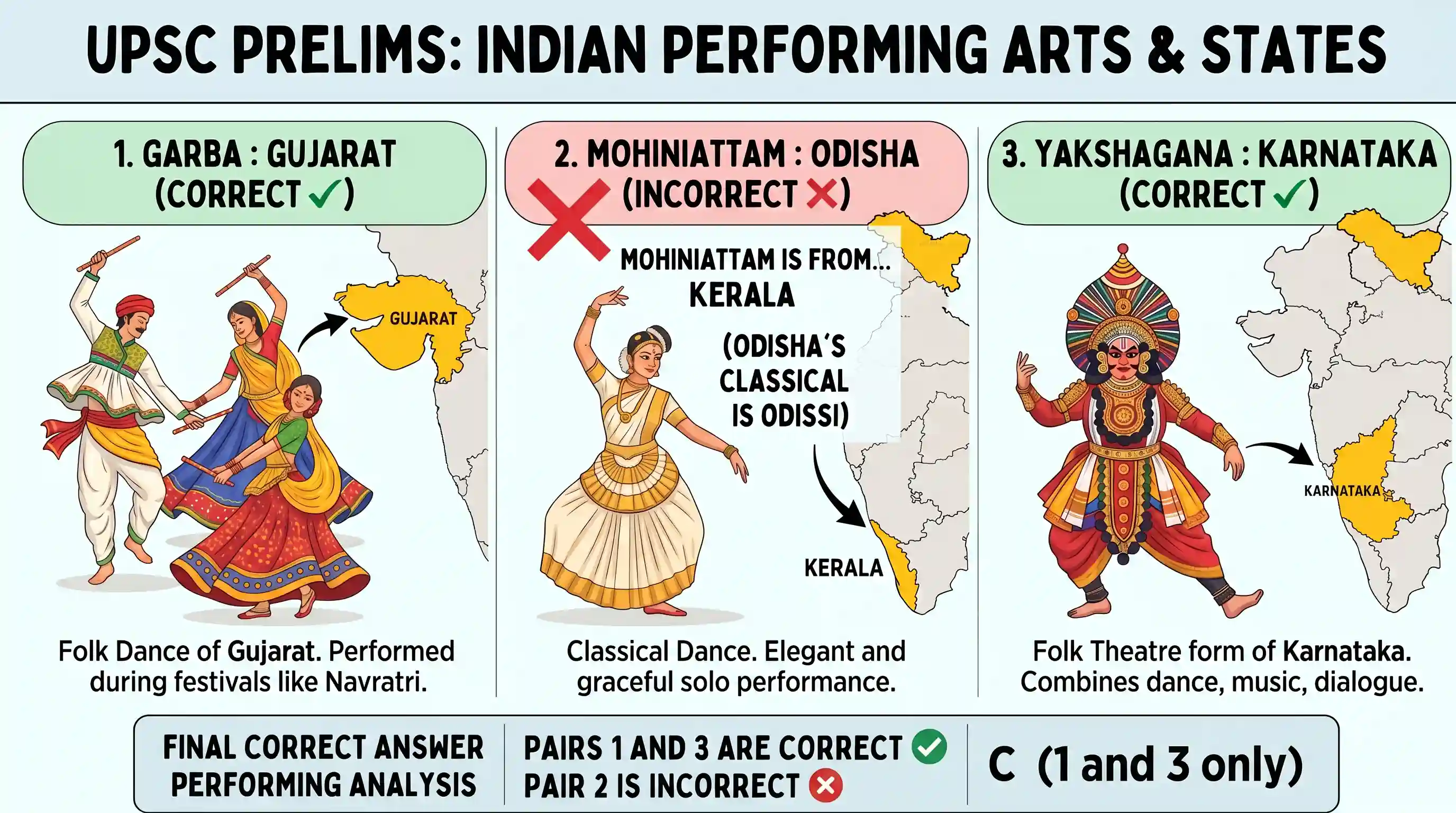
Garba : Gujarat This statement is correctly matched. Garba is a popular folk dance of Gujarat, performed during festivals like Navratri. It is characterized by circular movements and clapping hands.
-
Mohiniattam : Odisha This statement is incorrectly matched. Mohiniattam is one of the eight classical dance forms of India, originating from Kerala. It is a graceful solo dance performed by women, characterized by subtle movements and delicate expressions. Odissi is the classical dance form from Odisha.
-
Yakshagana : Karnataka This statement is correctly matched. Yakshagana is a traditional folk theatre form from Karnataka, combining dance, music, dialogue, costume, make-up, and stage techniques. It is primarily performed in the coastal districts of Karnataka.
Therefore, pairs 1 and 3 are correctly matched.
Related questions
More UPSC Prelims practice from the same subject and topic.
- Prelims 2014GS1art-and-culture
With reference to the famous Sattriya dance, consider the following statements: 1. Sattriya is a combination of music, dance and drama. 2. It is a centuries-old living tradition of Vaishnavites of Ass…
- Prelims 2014GS1art-and-culture
With reference to India's culture and tradition, what is 'Kalaripayattu'?
- Prelims 2014GS1art-and-culture
A community of people called Manganiyars is well-known for their
- Prelims 2014GS1art-and-culture
Consider the following languages: 1. Gujarati 2. Kannada 3. Telugu Which of the above has/have been declared as 'Classical Language/Languages' by the Government?
- Prelims 2014GS1art-and-culture
With reference to the cultural history of India, the term 'Panchayatan' refers to
- Prelims 2014GS1art-and-culture
Which one of the following pairs does not form part of the six systems of Indian Philosophy?