An automobiles owner reduced his monthly petrol consumption when the prices went up. The price-consumption relationship is as follows: Price (in Rs. Per litre) 40 50 60 75 Monthly consumption (in litres) 60 48 40 30 If the price goes up to Rs. 80 per litre, his expected consumption (in litres) will be

- A30Correct
- B28
- C26
- D24
Explanation
The correct answer is A) 30.
Here's a brief explanation:
-
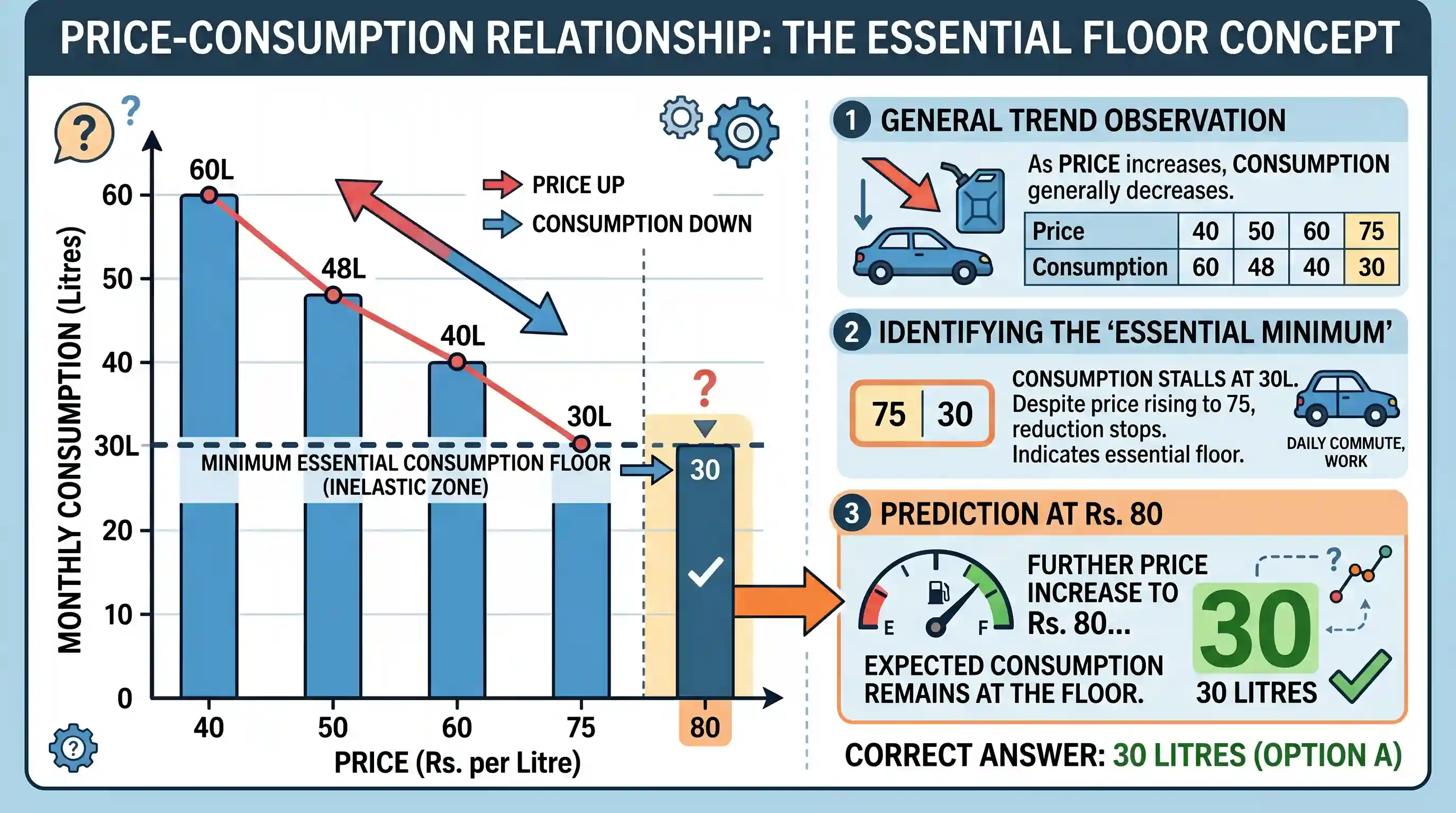
Observe the trend: The data shows that as the price of petrol increases, the monthly consumption decreases (60 -> 48 -> 40 -> 30 litres). This is consistent with an owner reducing consumption when prices go up.
-
Identify a potential minimum: The last recorded consumption is 30 litres when the price is Rs. 75. In real-world scenarios, individuals often have a minimum essential consumption for goods like petrol (e.g., for commuting, essential errands). Once this minimum is reached, further price increases may not lead to further reductions in quantity consumed because the demand becomes perfectly inelastic at that point.
-
Infer expected consumption: If 30 litres represents this minimum essential consumption for the owner, then even if the price increases further to Rs. 80 per litre, the owner is unlikely to reduce consumption below this essential level. Therefore, the expected consumption would remain 30 litres.
Analysis of options:
- A) 30: This option implies that 30 litres is the minimum essential consumption, and further price increases won't lead to further reduction. This is a plausible economic behavior.
- B) 28, C) 26, D) 24: These options would imply a further reduction in consumption. While a reduction is generally expected with a price increase, the concept of a minimum essential consumption suggests a floor beyond which reduction is not feasible. The pattern in the given data doesn't follow a simple linear or proportional decrease that would consistently lead to these lower values. For instance, if the owner were to maintain the expenditure of Rs. 2250 (which was the expenditure at P=75, C=30), then at P=80, consumption would be 2250/80 = 28.125 litres (close to 28). However, the initial expenditure was Rs. 2400, and the drop to Rs. 2250 at P=75 is better explained by hitting a consumption minimum of 30 litres, rather than a fixed expenditure cap. If 30 litres is the minimum, the owner would maintain it even if it means spending Rs. 2400 (80 * 30) again.
Related questions
More UPSC Prelims practice from the same subject and topic.
- Prelims 2015CSATQuantitative Aptitude
In a test, a candidate attempted only 8 questions and secured 50% marks in each of the questions. If he obtained a total of 40% in the test and all questions in the test carried equal marks, how many …
- Prelims 2015CSATQuantitative Aptitude
A father is nine times as old as his son and the mother is eight times as old as the son. The sum of the father's and the mother's age is 51 years. What is the age of the son?
- Prelims 2015CSATQuantitative Aptitude
Each of A, B, C and D has Rs 100. A pays Rs 20 to B, who pays Rs 10 to C, who gets Rs 30 from D. In this context, which one of the following statements is not correct?
- Prelims 2015CSATQuantitative Aptitude
Two equal glasses of same type are respectively 1/3 and 1/4 full of milk. They are then filled up with water and the contents are mixed in a pot. What is the ratio of milk and water in the pot?
- Prelims 2015CSATQuantitative Aptitude
In a parking area, the total number of wheels of all the cars (four- wheelers) and scooters/motorbikes (two-wheelers) is 100 more than twice the number of parked vehicles. The number of cars parked is
- Prelims 2015CSATQuantitative Aptitude
A person ordered 5 pairs of black socks and some pairs of brown socks. The price of a black pair was thrice that of a brown pair. While preparing the bill, the bill clerk interchanged the number of bl…