Consider the following statements followed by two conclusions: Statements: Some men are great. Some men are wise. Conclusion I: Men are either great or wise. Conclusion II: Some men are neither great nor wise Which one of the following is correct?

- AOnly Conclusion I is valid
- BOnly Conclusion II is valid
- CBoth conclusions are valid
- DNeither of the conclusions is validCorrect
Explanation
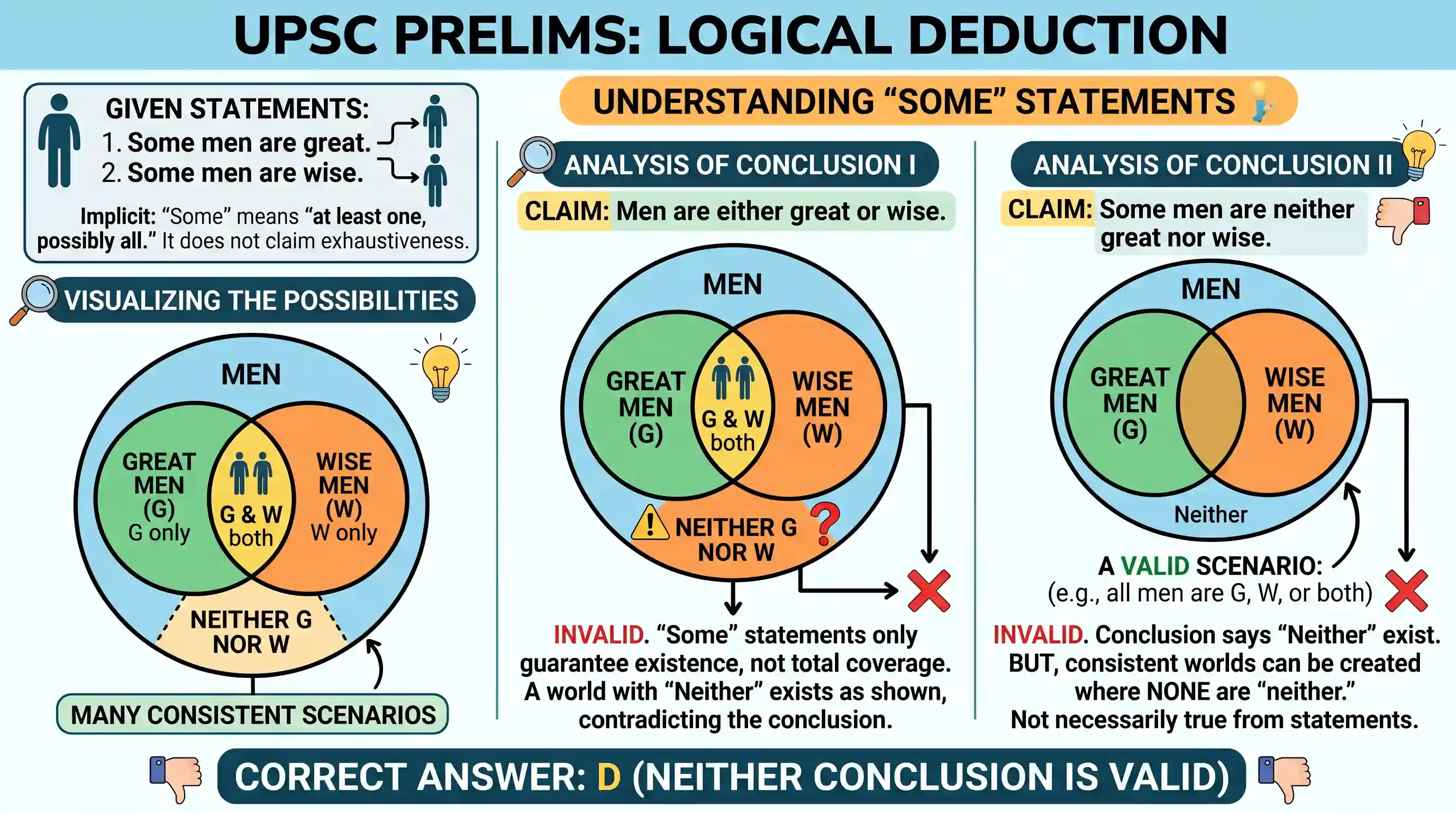
The correct answer is D because neither conclusion can be logically derived from the given statements.
Analysis of Statements:
- Some men are great. (This means there is at least one man who is great, and potentially some men who are not great).
- Some men are wise. (This means there is at least one man who is wise, and potentially some men who are not wise). These statements use "some," which in logic means "at least one, and possibly all."
Analysis of Conclusion I: Men are either great or wise. This conclusion makes a strong, almost universal claim that every man must possess at least one of these two qualities. The statements only confirm the existence of men with each quality, but they do not rule out the possibility of men who are neither great nor wise. For example, some men could be great, some could be wise, some could be both, and some could be neither. The statements do not provide enough information to support the claim that all men fall into one of these two categories. Therefore, Conclusion I is invalid.
Analysis of Conclusion II: Some men are neither great nor wise. This conclusion states that there exist men who possess neither of these qualities. The given statements only tell us about men who are great and men who are wise. They do not provide any information about men who are not great or not wise. It is entirely possible, based on the statements, that all men are great (which would satisfy "some men are great") and all men are wise (which would satisfy "some men are wise"). In such a scenario (where all men are both great and wise), there would be no men who are neither great nor wise. Since the statements do not necessitate the existence of men who are neither great nor wise, Conclusion II is invalid.
Since neither conclusion can be definitively proven from the statements, D is the correct answer.
Related questions
More UPSC Prelims practice from the same subject and topic.
- Prelims 2015CSATLogical Reasoning
Consider the following statements : 1) A man had a wife, two sons and daughters in his family 2) The daughters were invited to a feast and the male members of the family went out to take part in a pic…
- Prelims 2015CSATLogical Reasoning
Geeta: Naresh has become a better boxer since he started meditation. Radha: Impossible, A boxer's most important asset is his aggressiveness. Radha's statement reflect her belief that
- Prelims 2015CSATLogical Reasoning
All good athletes want to win and all athletes who want to win eat a well-balanced diet; therefore all athletes who do not eat a well- balanced diet are bad athletes. The best conclusion from this sta…
- Prelims 2015CSATLogical Reasoning
If A runs less fast than B, and B runs as fast but not faster than C; then, as compared to A, C runs
- Prelims 2015CSATLogical Reasoning
Examine the following statements: 1) Lady's finger is tastier than cabbage. 2) Cauliflower is tastier than lady's finger. 3) Cabbage is not tastier than peas. The conclusion that can be drawn from the…
- Prelims 2015CSATLogical Reasoning
Consider the following statements: 1) Some claim to have seen UFOs (Unidentified Flying Objects). 2) Life on other heavenly bodies is considered to be a possibility. 3) Voyage to space is now an estab…