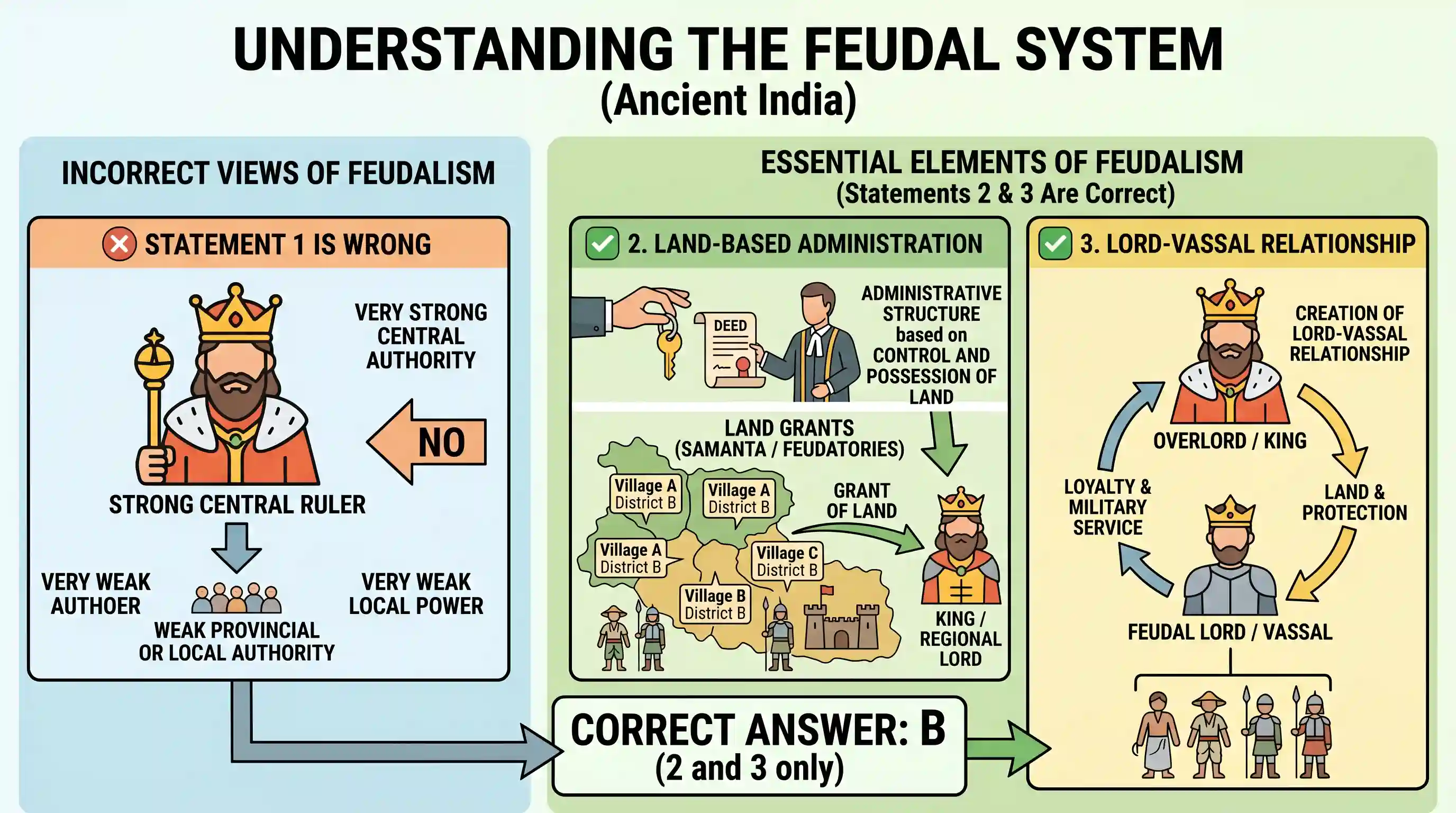
With reference to Indian history, which of the following is/are the essential element/elements of the feudal system? 1. A very strong centralized political authority and a very weak provincial or local political authority 2. Emergence of administrative structure based on control and possession of land 3. Creation of lord-vassal relationship between the feudal lord and his overlord Select the correct answer using the code given below.

- A1 and 2 only
- B2 and 3 onlyCorrect
- C3 only
- D1, 2 and 3
Explanation
The feudal system, both in India and globally, is characterized by specific socio-economic and political arrangements:
Statement 1: A very strong centralized political authority and a very weak provincial or local political authority. This is incorrect. Feudalism is typically characterized by a decentralized political authority, where the power of the central ruler is weak, and significant power rests with powerful local lords (feudatories or samantas) who control their territories. Statement 2: Emergence of administrative structure based on control and possession of land. This is correct. Land was the primary source of wealth and power in a feudal system. Kings granted land to their vassals (feudal lords) in exchange for military service and loyalty. These lords, in turn, controlled the land and administered justice within their domains. Statement 3: Creation of lord-vassal relationship between the feudal lord and his overlord. This is correct. A hierarchical structure, where a lesser lord (vassal) owed loyalty and service (often military) to a greater lord (overlord or king) in exchange for land or protection, is a defining characteristic of feudalism. This relationship was based on mutual obligations. Therefore, statements 2 and 3 correctly describe essential elements of the feudal system in Indian history.
Related questions
More UPSC Prelims practice from the same subject and topic.
- Prelims 2015GS1history
Which of the following kingdoms were associated with the life of the Buddha? 1. Avanti 2. Gandhara 3. Kosala 4. Magadha Select the correct answer using the code given below.
- Prelims 2015GS1history
Who of the following founded a new city on the south bank of a tributary to river Krishna and undertook to rule his new kingdom as the agent of a deity to whom all the land south of the river Krishna …
- Prelims 2015GS1history
With reference to Rowlatt Satyagraha, which of the following statements is/are correct? 1. The Rowlatt Act was based on the recommendations of the 'Sedition Committee'. 2. In Rowlatt Satyagraha, Gandh…
- Prelims 2015GS1history
With reference to Congress Socialist Party, consider the following statements: 1. It advocated the boycott of British goods and evasion of taxes. 2. It wanted to establish the dictatorship of proletar…
- Prelims 2015GS1history
The Government of India Act of 1919 clearly defined
- Prelims 2015GS1history
Consider the following pairs: Medieval Indian State Present Region 1. Champaka : Central India 2. Durgara : Jammu 3. Kuluta : Malabar Which of the above pairs is/are correctly matched?