Biomass as fuel for power, heat, and transport has the highest mitigation potential of all renewable sources. It comes from agriculture and forest residues as well as from energy crops. The biggest challenge in using biomass residues is a long- term reliable supply delivered to the power plant at reasonable costs; the key problems are logistical constraints and the costs of fuel collection. Energy crops, if not managed properly, compete with food production and may have undesirable impacts on food prices. Biomass production is also sensitive to the physical impacts of a changing climate. Projections of the future role of biomass are probably overestimated, given the limits to the sustainable biomass supply, unless breakthrough technologies substantially increase productivity. Climate- energy models project that biomass use could increase nearly four- fold to around 150 – 200 exajoules, almost a quarter of world primary energy in 2050. However the maximum sustainable technical potential of biomass resources (both residues and energy crops) without disruption of food and forest resources ranges from 80 – 170 exajoules a year by 2050, and only part of this is realistically and economically feasible. In addition, some climate models rely on biomass- based carbon capture and storage, an unproven technology, to achieve negative emissions and to buy some time during the first half of the century. Some liquid biofuels such as corn- based ethanol, mainly for transport, may aggravate rather than ameliorate carbon emissions on a life- cycle basis. Second generation biofuels, based on ligno- cellulosic feedstocks – such as straw, bagasse, grass and wood – hold the promise of sustainable production that is high- yielding and emit low levels of greenhouse gases, but these are still in the R & D stage. 21. Which of the following can lead to food security problem? 1. Using agricultural and forest residues as feedstock for power generation 2. Using biomass for carbon capture and storage 3. Promoting the cultivation of energy crops Select the correct answer using the code given below:

- A1 and 2 only
- B3 onlyCorrect
- C2 and 3 only
- D1, 2 and 3
Explanation
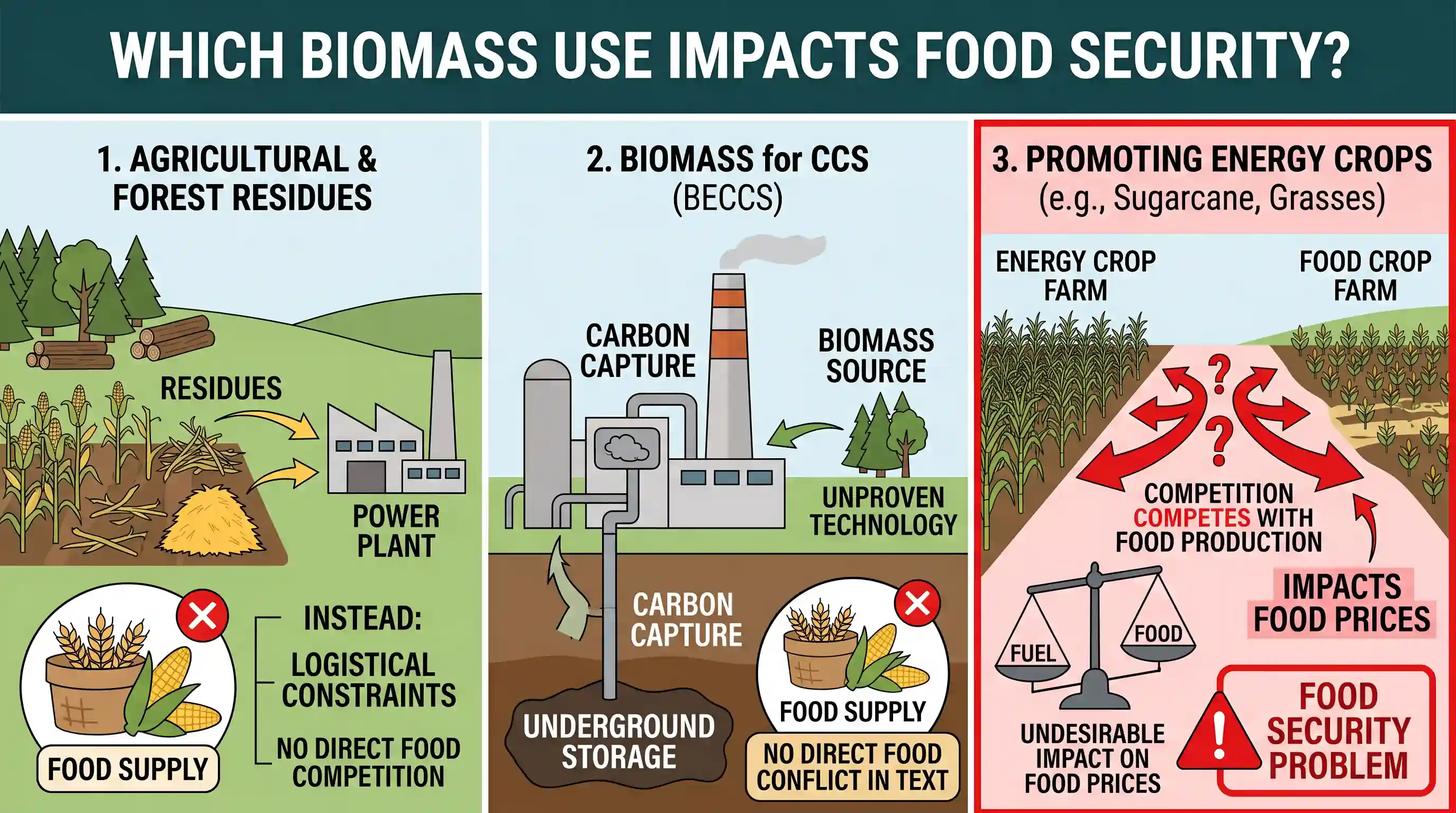
The passage explicitly states, "Energy crops, if not managed properly, compete with food production and may have undesirable impacts on food prices." This directly links the promotion and cultivation of energy crops to potential food security problems.
- Using agricultural and forest residues as feedstock for power generation: The text mentions challenges with residues are logistical constraints and collection costs, not direct competition with food production.
- Using biomass for carbon capture and storage: The passage notes this is an "unproven technology" but does not link its use directly to food security problems. The issue is its technological readiness, not its impact on food supply.
- Promoting the cultivation of energy crops: This is directly stated as potentially competing with food production and impacting food prices, thus leading to food security problems.
Therefore, only statement 3 can lead to a food security problem according to the passage.
Related questions
More UPSC Prelims practice from the same subject and topic.
- Prelims 2016CSATReading Comprehension
Accountability, or the lack of it, in governance generally, and civil services, in particular, is a major factor underlying the deficiencies in governance and public administration. Designing an effec…
- Prelims 2016CSATReading Comprehension
Accountability, or the lack of it, in governance generally, and civil services, in particular, is a major factor underlying the deficiencies in governance and public administration. Designing an effec…
- Prelims 2016CSATReading Comprehension
Accountability, or the lack of it, in governance generally, and civil services, in particular, is a major factor underlying the deficiencies in governance and public administration. Designing an effec…
- Prelims 2016CSATReading Comprehension
Accountability, or the lack of it, in governance generally, and civil services, in particular, is a major factor underlying the deficiencies in governance and public administration. Designing an effec…
- Prelims 2016CSATReading Comprehension
In general, religious traditions stress our duty to god, or to some universal ethical principle. Our duties to one another derive from these. The religious concept of rights is primarily derived from …
- Prelims 2016CSATReading Comprehension
In general, religious traditions stress our duty to god, or to some universal ethical principle. Our duties to one another derive from these. The religious concept of rights is primarily derived from …