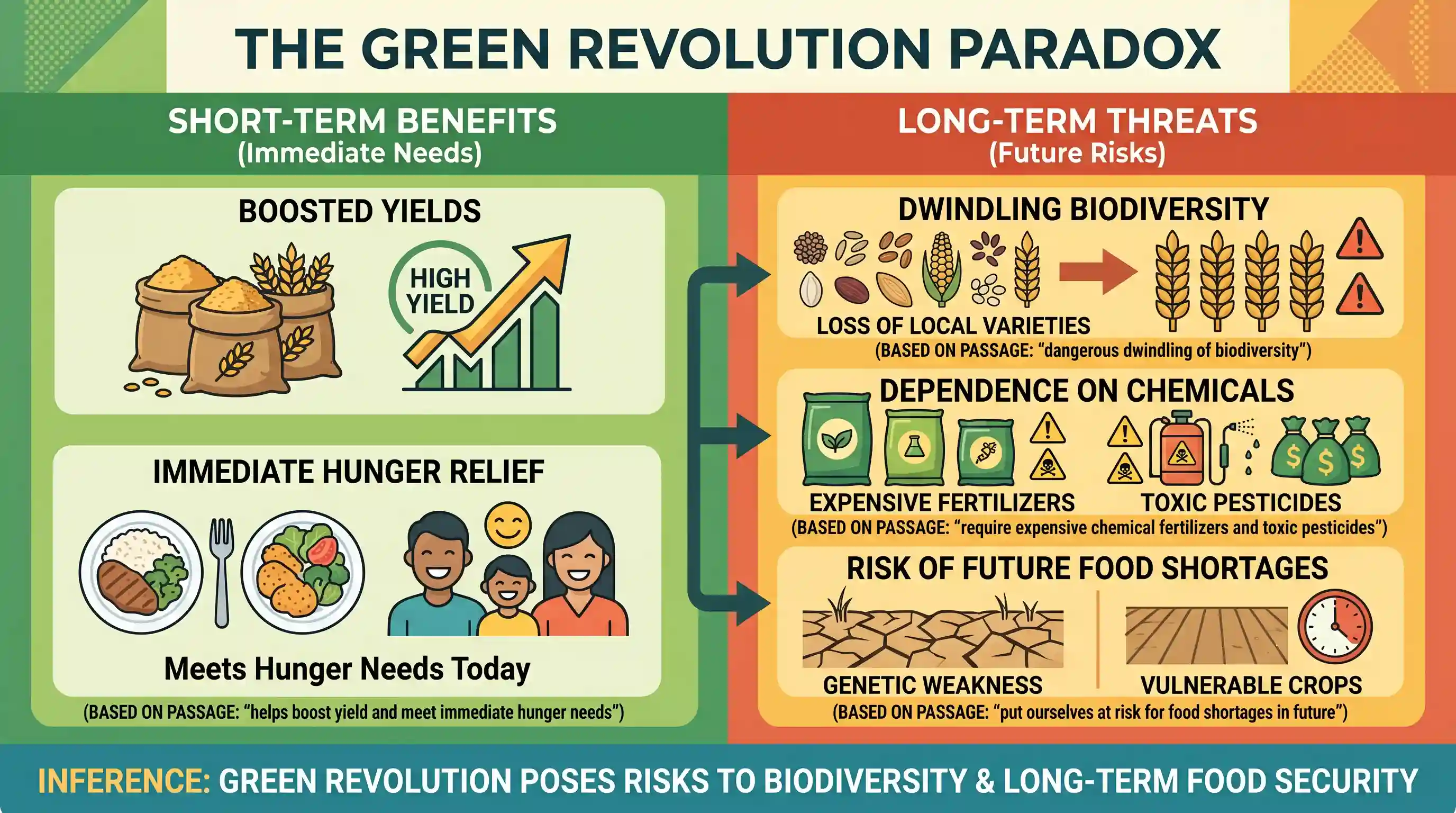
We are witnessing a dangerous dwindling of biodiversity in our food supply. The green revolution is a mixed blessing. Over time farmers have come to rely heavily on broadly adapted, high yield crops to the exclusion of varieties adapted to the local conditions. Monocropping vast fields with the same genetically uniform seeds helps boost yield and meet immediate hunger needs. Yet high-yield varieties are also genetically weaker crops that require expensive chemical fertilizers and toxic pesticides. In our focus on increasing the amount of food we produce today, we have accidentally put ourselves at risk for food shortages in future. Which among the following is the most logical and critical inference that can be made from the above passage?

- AIn our agricultural practices, we have become heavily dependent on expensive chemical fertilizers and toxic pesticides only due to green revolution
- BMonocropping vast fields with high-yield varieties is possible due to green revolution
- CMonocropping with high-yield varieties is the only way to ensure food security to millions
- DGreen revolution can pose a threat to biodiversity in food supply and food security in the long runCorrect
Explanation
The passage discusses the Green Revolution as a "mixed blessing," highlighting its immediate benefits (boosting yield, meeting hunger needs) but also its negative consequences: a dangerous dwindling of biodiversity due to reliance on high-yield, genetically uniform crops, and the long-term risk of food shortages despite current production increases.
Let's analyze each option:
A) In our agricultural practices, we have become heavily dependent on expensive chemical fertilizers and toxic pesticides only due to green revolution. This statement uses the word "only." While the passage states that high-yield varieties (associated with the Green Revolution) "require expensive chemical fertilizers and toxic pesticides," it doesn't claim this is the sole reason for all dependence on these chemicals in agriculture. The "only" makes it too strong and potentially inaccurate.
B) Monocropping vast fields with high-yield varieties is possible due to green revolution. The passage describes monocropping with high-yield varieties as a practice that helps boost yield and is linked to farmers relying on these crops over time. While the Green Revolution certainly promoted and expanded this practice, the passage doesn't state that it was only possible due to the Green Revolution. Monocropping existed before, though perhaps not with the same scale of genetically uniform, high-yield varieties. This is a plausible consequence, but not necessarily the most critical inference about the overall message.
C) Monocropping with high-yield varieties is the only way to ensure food security to millions. The passage explicitly states that while monocropping meets immediate hunger needs, "In our focus on increasing the amount of food we produce today, we have accidentally put ourselves at risk for food shortages in future." This directly contradicts the idea that it's the "only way" to ensure food security, especially in the long run.
D) Green revolution can pose a threat to biodiversity in food supply and food security in the long run. This option perfectly summarizes the critical message of the passage. The passage mentions "dangerous dwindling of biodiversity in our food supply" due to farmers relying on high-yield crops "to the exclusion of varieties adapted to the local conditions." It also concludes that focusing on increasing food today has "accidentally put ourselves at risk for food shortages in future." Both these points directly support the inference that the Green Revolution (with its associated practices) poses a threat to biodiversity and long-term food security.
Therefore, D is the most logical and critical inference.
Related questions
More UPSC Prelims practice from the same subject and topic.
- Prelims 2016CSATReading Comprehension
Accountability, or the lack of it, in governance generally, and civil services, in particular, is a major factor underlying the deficiencies in governance and public administration. Designing an effec…
- Prelims 2016CSATReading Comprehension
Accountability, or the lack of it, in governance generally, and civil services, in particular, is a major factor underlying the deficiencies in governance and public administration. Designing an effec…
- Prelims 2016CSATReading Comprehension
Accountability, or the lack of it, in governance generally, and civil services, in particular, is a major factor underlying the deficiencies in governance and public administration. Designing an effec…
- Prelims 2016CSATReading Comprehension
Accountability, or the lack of it, in governance generally, and civil services, in particular, is a major factor underlying the deficiencies in governance and public administration. Designing an effec…
- Prelims 2016CSATReading Comprehension
In general, religious traditions stress our duty to god, or to some universal ethical principle. Our duties to one another derive from these. The religious concept of rights is primarily derived from …
- Prelims 2016CSATReading Comprehension
In general, religious traditions stress our duty to god, or to some universal ethical principle. Our duties to one another derive from these. The religious concept of rights is primarily derived from …